

If you like my work, follow me everywhere because apparently one website is never enough:
Instagram: @bundleof.styx
Twitter: @bundleofstyx_
Tumblr: @bundleofstx
Bluesky: bundleofstyx.org
I also lowered my Substack prices to make paid subscriptions more accessible. <3 If you read my work regularly and have the money, becoming a paid subscriber directly supports me continuing to research and write this stuff.
And if subscriptions aren’t your thing, you can donate to my Ko-fi. Every donation helps keep a Black trans feminist writer writing instead of having to figure out how to pay rent in citations.
Ko-fi: ko-fi.com/bundleofstyx
Read, share, follow, subscribe, donate. I love you gorgeous gorgeous divas. <3
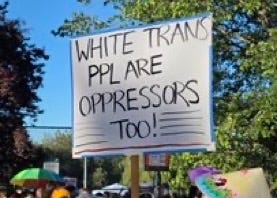
During the controversy over the sign saying WHITE TRANS PEOPLE ARE OPPRESSORS TOO, a white trans woman came into my comments insisting that she wanted to have a good-faith conversation with me about it. Against the better judgment that four years of running this account should have beaten into my skull by now, I believed her. I DM’d her. We talked. I eventually got on a call with her because I thought maybe an actual conversation would be more productive than two people performing politics at each other in an Instagram comment section.
I tried to explain a fairly basic Black feminist argument: being oppressed through one social relation does not remove your position within another. A white trans woman can experience transmisogyny while still possessing whiteness. She can be treated brutally as a trans woman and still reproduce racism against Black women, including Black trans women. She does not have to consciously choose white supremacy for whiteness to structure how she moves through the world, any more than a cis woman has to wake up and consciously choose transmisogyny before reproducing it against us. This should have been familiar territory for anybody who spends enough time around transfeminist politics.
Instead, the conversation eventually deteriorated into accusations that I was engaging in “reverse racism” and “racial essentialism” by describing white people as participants in racial domination. Great Vaush video, diva. Apparently structural analysis remains perfectly coherent until the structure reaches your front door.
What interested me afterward was how quickly the language changed. She had entered my comments asking for good faith. Once the analysis implicated her, the conversation became about whether I was being unfair to white trans women as individuals. Whiteness disappeared into personality. Structural power became an accusation about somebody’s moral character. Suddenly I was expected to reassure her that she was one of the good ones before we could continue discussing a system whose entire function does not depend on whether any particular white person feels personally racist.
That exchange clarified something I had been circling for a while. White trans women are often perfectly capable of understanding structural oppression when transmisogyny is the structure being discussed. We understand immediately that a cis woman can reproduce transmisogyny while considering herself progressive. We understand that individual kindness doesn’t erase social position. We understand why asking a trans woman to prove that a particular cis person consciously intended to oppress her misses how power actually works. Yet when a Black woman applies the same method to whiteness, some white trans women suddenly retreat into the exact liberal individualism they would ridicule coming from a cis feminist.
And this contradiction reaches beyond political language. The conversation that white trans spaces become extremely uncomfortable discussing because it interferes with the fantasy that white trans women spontaneously created a distinctive culture together: a remarkable amount of what gets called “trans girl culture” was borrowed, absorbed, commercialized, or straight up stolen from somebody else. Sometimes it came from Black women generally, sometimes from Black trans women specifically, sometimes from Black queer culture, ballroom, Black gay men, working-class women, sex workers, or other racialized communities whose language and aesthetics traveled farther than their names ever did.
This conversation that white trans spaces become extremely uncomfortable discussing because it interferes with the fantasy that white trans women spontaneously created a distinctive culture together: a remarkable amount of what gets called “trans girl culture” was borrowed, absorbed, commercialized, or straight up stolen from somebody else. Sometimes it came from Black women generally, sometimes from Black trans women specifically, sometimes from Black queer culture, ballroom, Black gay men, working-class women, sex workers, or other racialized communities whose language and aesthetics traveled farther than their names ever did. Then the origin disappears.
A white trans woman encounters a phrase after it has already traveled through five layers of internet culture and experiences it as something trans women simply say. Another encounters an aesthetic after Instagram and TikTok have stripped away the people who developed it and experiences it as something trans women simply wear. Someone else learns a style of humor, femininity, sexual bravado, insult, gesture, or self-presentation through predominantly white trans spaces and reasonably assumes those spaces invented it because everybody around her makes the same assumption. Eventually the borrowing becomes sediment, nobody remembers there was ever anything underneath it, and somebody calls the resulting collection trans culture.
Whose trans culture? That question ruins the party rather quickly.
A great deal of what gets presented online as universal trans woman culture is actually the culture of a specific population of predominantly white, online, American trans women who possess enough cultural power to mistake their particular habits for the habits of trans women everywhere. They take things from Black culture and from queer cultures produced disproportionately by Black and Latina people, mix them with anime, gaming, internet subcultures, lesbian culture, pornography, and whatever meme survived Twitter that month, and eventually present the resulting collage as though estrogen itself downloaded the software. Then Black trans women enter these spaces and encounter pieces of our own culture being explained back to us as trans culture. It’s almost impressive.
You can watch language move from Black communities into queer communities and then into white trans communities until its Blackness has been scrubbed away through repetition. AAVE becomes “internet slang.” Black queer language becomes “queer slang.” Ballroom language becomes “trans slang.” A mannerism associated with Black women becomes something every girl supposedly starts doing after enough estrogen. By the end of the process, acknowledging where anything came from is treated like pedantry.
Nobody consciously decided to perform this laundering operation. Reducing appropriation to intentional theft gives us a useless political vocabulary because culture does not require a masked burglar climbing through somebody’s window and escaping with a handbag full of nouns. Cultural power determines whose creations can be detached from their creators and transformed into common property. White people possess an extraordinary ability to encounter Black cultural production at the exact moment it becomes socially profitable and somehow believe it appeared from the atmosphere. White trans women don’t lose that ability when they transition.
Whose Culture Are You Building?
I’m not arguing that cultures should remain racially segregated or that every joke needs a fucking bibliography attached to it. Culture moves because people move. People fall in love and become friends. Communities overlap and language mutates. Black and white trans women obviously influence each other, and attempting to place every cultural practice behind an ethnic border would produce an incoherent politics with some extremely unpleasant historical company.
The problem is power. Who gets remembered as the creator? Who becomes the face? Who gets paid? Who gets mocked for doing something before it becomes fashionable? Who is considered trashy when she speaks a certain way and charming when somebody else adopts the same speech? Who gets described as aggressive for possessing the attitude that becomes “cunty” when performed by somebody white? Those questions turn cultural exchange into a political problem because culture moves through a society where people do not possess equal power to define what their own creations mean.
Black women have lived inside this contradiction for generations. Our femininity is repeatedly mined for material while Black women themselves are denied the protections associated with femininity. Features associated with us become fashionable on other women. Speech associated with us becomes funny when performed by people who will never experience the social consequences attached to speaking that way while Black. Our styles become trends after passing through somebody racially acceptable enough to introduce them to a larger audience. Trans culture didn’t somehow develop outside this history. Online trans culture accelerates it.
The internet destroys provenance with astonishing efficiency. A joke can travel from a Black trans woman’s account into a Discord server, from the Discord server onto Twitter, from Twitter onto TikTok, and from TikTok into the vocabulary of thousands of white trans women who have absolutely no reason to know where it began. Three years later somebody writes a post about the unique linguistic creativity of transfeminine culture. The Black woman who started it has 2,800 followers. The white girl explaining it has 80,000. Nobody technically stole anything, so everybody can pretend nothing happened.
The Black Trans Woman as Cultural Infrastructure
This is why I keep returning to infrastructure. Black trans women are expected to produce without necessarily being recognized as producers, and our usefulness increases as our authorship disappears. Once something becomes sufficiently detached from us, it can be reincorporated into a generalized trans identity. The political language becomes transfeminism. The cultural language becomes trans slang. The aesthetic becomes trans femininity. The sexual politics become T4T culture. The humor becomes trans girl humor. Blackness becomes raw material, whiteness becomes universality, and white trans women experience themselves as members of a culture they believe they collectively produced.
White trans women obviously have a culture of their own. Every social population develops shared practices, references, rituals, aesthetics, and forms of recognition. The problem comes from pretending those practices emerged inside a sealed laboratory called Transgender Culture instead of through contact with a racialized society.
The irony becomes unbearable when the same Black trans women whose cultural production helped build these spaces are treated as outsiders within them. Our language is welcome until we name where it came from. Our aesthetics circulate freely while our criticism becomes a problem. Our theories are useful until we use them to make demands. That should sound familiar because it’s one of the oldest racial arrangements in Amerikan culture: Black production without Black authority.
Transmisogyny Does Not Absolve Whiteness
White trans women sometimes struggle with this because there is a genuine contradiction involved in becoming culturally marginalized while remaining racially dominant. A white trans woman can lose access to enormous parts of respectable white society after transition. Her family may reject her. Her workplace may become hostile. Her body may become politically contested. She can become vulnerable to sexual violence, medical discrimination, housing discrimination, poverty, and public harassment. She can experience a form of womanhood organized around being treated as sexually suspect and socially disposable. None of those experiences are imaginary. None of them make her less white.
Transmisogyny does not absolve whiteness because oppression does not function as moral purification. Suffering cannot wash privilege away. A person can be brutalized by one social relation while benefiting from another because several systems of power operate through the same people at the same time. Black feminism has been explaining this for longer than most contemporary transfeminist vocabulary has existed, which is what makes the resistance from white trans women so frustrating. You already understand how it works.
You understand that a cis woman doesn’t have to consciously hate trans women to reproduce transmisogyny. You understand that somebody can benefit from cisness without requesting those benefits. You understand that institutions can reproduce transmisogyny through apparently neutral procedures and that good intentions don’t magically dissolve structural power. Then somebody says whiteness works through you too and suddenly structural analysis becomes terribly complicated. Apply your own politics to yourself.
If white trans women want to build a transfeminism capable of explaining the lives of all trans women, they have to abandon the comforting idea that entering one oppressed social category provides an exit from every dominant one. If they want something called trans culture, they need to become considerably more curious about who built its component parts. Black trans women cannot continue functioning as the mine where everybody extracts language, aesthetics, politics, femininity, humor, and theory before returning to predominantly white spaces to congratulate themselves on the richness of trans culture.
Sometimes the thing you love about your culture came from us. The theory you use to defend yourself may have come from us. The language you use to describe yourself may have passed through us. Sometimes the Black woman pointing this out is going to make you uncomfortable. That discomfort does not constitute transmisogyny. It means the infrastructure started talking.