
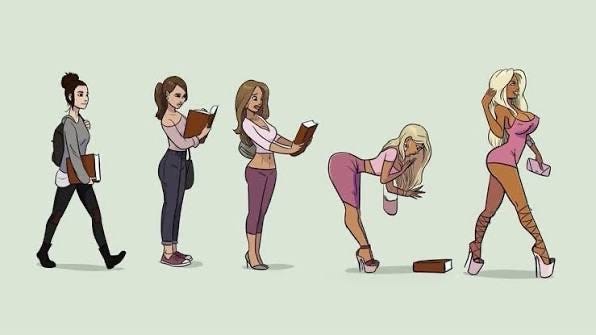
The Psychology of the Stacy
The Politics Of The Popular Girl
This one’s free, like everything here. Paid subscriptions are the reason I get to write instead of doing something else with the week, and they’re what covers groceries while I do it. If the work does something for you, that’s where you can let me hold the bag
You can find me at
Bluesky: bundleofstyx.org
Twitter: @bundleofstyx_
Tumblr: bundle of stx
One-time support, if a subscription isn’t your thing: https://ko-fi.com/bundleofstyyx
Psychology of the Becky did NUMBERS. I wasn’t expecting it to do so well. People sent it to their group chats. A few of you sent it to women you’d been arguing with for years, which is either a compliment or a war crime depending on how the argument went (and rather or not you blame me for it ). It got quoted back to me in places I don’t post. Somebody’s aunt read it. I still don’t fully understand the mechanics of what becomes popular. I’ve stopped pretending I do.
What I do understand is the question that came back, because almost all of you asked some version of it.
Well, what about the Stacy?
Sometimes it was a defense. She’s not the problem, the mean girls are, and here’s the story of what one did to me in 2009, and that is why Tara Knight should be put down. Sometimes it was a challenge, mostly from women who correctly noticed I’d spent thousands of words dismantling the girl with the tote bag and the correct opinions while leaving the girl who actually ran the hallway completely untouched, sitting there in the corner of the argument with her hair done, unexamined. Sometimes it was a woman writing to say she’d been the Stacy, that reading about the Becky had made her feel something she couldn’t name, and could I please explain why.
So. The Stacy.
American high school movies, an embarrassingly large share of American movies at this point, keep casting the same two girls against each other and asking you to care about which one wins. The genre has a favorite. She’s kind. She’s pretty in a way that reads as accidental. She ends up with the crown because the universe finally recognized what was always true about her. The movie calls this justice. The other girl knows what the crown costs. She built her entire being around getting it. She goes under a bus. She gets exposed at prom. Her diary gets read aloud.
Her friends abandon her.
Somebody humiliates her in the exact room she spent the film trying to rule. (Fuck you, Katy.)
The movie calls that justice too.
If you haven’t read the Becky article, read it first, because this is the second part of an argument that started there. Short version if you won’t: the Becky is the girl this culture hands the progressive microphone to. She’s correctly positioned and photogenic, and her politics is a redistribution that never asks where the goods came from. The crown moves from a cruel head to a kind one. The hierarchy survives. The audience exhales. Nothing structural has happened.
The Stacy is the other girl.
The one keeping the numbers.
The one who priced every face in the building before lunch and never bothered pretending she didn’t.
The genre has spent four decades making sure she never gets a political sentence to say out loud because, on some level, it already knows what would happen if she did. A girl who can read a room that accurately and has already refused every comforting lie about how that room works is probably someone you want destroyed before she figures out which direction to point.
The question here isn’t whether the Stacy is progressive.
She isn’t.
She runs the machine. She optimizes it. She disciplines other girls into compliance through nothing more than a well-timed glance, and she rarely uses her knowledge of the hierarchy to loosen it for anybody underneath her. That’s management with better shoes.
The question is what she becomes if somebody reaches her before the bus does.
That question matters because the Becky and the Stacy don’t begin from the same place. The Becky’s politics has a ceiling built into its foundation. She came up inside the system without ever having to price it, so redistribution is usually as far as her thinking goes. Move the crown. Improve representation. Put somebody kinder behind the microphone. Leave the factory running.
The Stacy already knows the factory.
She knows the shift schedule.
She knows which doors open.
She knows which ones only look unlocked.
She knows what everything costs because she has spent years paying and collecting.
She has simply never been given a reason to do anything with that knowledge except protect herself.
Reach her correctly, without demanding that she become sweeter or less feminine or less ambitious first, and something far more dangerous becomes possible.
The Becky asks the system to distribute better.
The Stacy already knows where the system keeps the books.
That difference has a consequence the genre works very hard not to say out loud.
The Becky is expected.
Every institution built to manage women’s politics has already planned for her. There’s a committee. There’s a fellowship. There’s a line in somebody’s budget. She has been the acceptable face of dissent since before either of us were born, and the machine absorbed her without breaking stride.
The Stacy, radicalized, is not in anybody’s plan.
Nobody built a committee for her.
A radicalized Becky writes a petition.
A radicalized Stacy knows which door the money comes through, whose name is on the deed, and what would come apart if you pulled the right thing out of the house.
One of those is a nuisance.
The other one is a threat to the household.
That difference is where I want to start.
Not in a movie.
In a hallway.
i.
Priya Anand let me copy her chemistry homework for two years.
She never charged for it out loud. The price came in a look that lasted half a second too long, long enough that I understood the loan and the interest both before she slid the folder across the table with a smile the yearbook staff loved and I never trusted.
She kept the folder in a canvas tote with a peace sign screen-printed on the side, the ink already cracking by October. Inside were color-coded notes, a running list of book club picks nobody else had read, and flyers for whatever the cause was that month. She organized the canned food drive freshman year and the coat drive sophomore year. By junior year, she’d graduated to things with actual stakes, the kind of causes that got you a paragraph in the local paper if you phrased the petition correctly.
She dated a boy from the debate team, Grant Delacroix-Meyer, who once used the sentence “I’m an ally” to describe himself at lunch and meant it sincerely enough to make the table uncomfortable. Priya let him finish.
Junior year, she wrote an op-ed for the school paper about the dress code.
It was good.
I want that established immediately because otherwise, the rest of this becomes too easy. The statistic she cited was real. The girls she described were real. Girls really were getting pulled from class for shoulders and thighs that boys walked past without a hall monitor blinking. Priya was right.
The article ran beneath her photograph.
Hair down.
Cardigan buttoned exactly one button lower than the handbook technically permitted.
Nobody said anything about it, which either meant nobody noticed or everybody noticed and understood that dress-coding the girl in an article about discriminatory dress codes would create a problem too photogenic to contain.
The hallway loved it.
Teachers complimented her.
Students shared it.
One administrator called it “thought-provoking,” which is the sort of phrase institutions use when somebody has criticized them in a way they believe they can survive.
And Priya deserved some of that praise.
What bothered me was how impossible it seemed for anybody to separate two facts.
Priya was right.
Priya looked like the kind of girl people expected to be right.
Everybody treated the second fact as proof of the first.
I didn’t have language for that yet. I just knew something about the applause felt strange, the way you recognize a smell before you know what’s rotting.
Three lockers down from mine stood Dani Voss.
Dani never wrote an op-ed.
She didn’t need to.
She could look at a girl’s shoes for one second on a Monday morning, and that girl would be wearing different shoes by Thursday.
I watched her do it to a freshman named Kayleigh.
Kayleigh had worn the same jean jacket four days running. Dani caught her eye near the water fountain, glanced down at the jacket, then back at her face.
Nothing else happened.
No insult.
No laugh.
No whisper to a friend.
By Friday, the jacket was gone.
Kayleigh had something new on, something closer to whatever the hallway had silently agreed counted as correct, something that had clearly cost somebody’s allowance.
Nobody would have called what happened bullying because nobody had said anything.
Dani had found a way to extract obedience that left no evidence a teacher could act on.
She knew what everything cost.
She knew what her own face cost too.
If you were close enough and asked correctly, she’d tell you which parts of it she’d built and which parts were still under construction. She once told another girl while doing her brows that the first six months of growing them out had been ugly on purpose because you had to grow out the damage before you could shape anything worth shaping.
She said it with the flat professionalism of a contractor explaining a renovation.
I was standing at the sink beside her, washing my hands slower than washing hands requires.
She wasn’t talking to me.
She was talking to me.
With Dani, that counted as an invitation if you were paying attention.
I was always paying attention.
I liked Priya.
I learned something from Dani.
Neither is her real name, and neither is one girl you could dig out of a yearbook. Priya is built from several girls I knew, compressed into one. Dani is too. They’re close enough to memory that I occasionally forget where the composite begins.
That seems appropriate.
The whole point is that the hallway was producing them in batches.
ii.
There was one Thursday when they stood at the same mirror.
It was before a dance, something smaller than prom, and Priya was fighting with eyeliner.
She had the right pencil.
She’d watched the tutorial.
She had apparently learned nothing.
Dani watched for maybe thirty seconds.
“Give me that.”
“I can do it.”
“Clearly.”
Priya laughed and handed it over.
Dani tilted her chin.
“Close your eye.”
One line.
Then the other.
Maybe twenty seconds total.
Priya looked in the mirror.
“Oh.”
Dani handed the pencil back.
“How did you do that?”
“Practice.”
That word has stayed with me longer than anything else either of them said that afternoon.
Practice.
The entire mythology of feminine effortlessness collapsed into eight letters.
Dani hadn’t woken up knowing.
She learned.
She failed.
She corrected.
She repeated.
Eventually, repetition hardened into fluency, and fluency became so smooth that everybody else mistook it for nature.
It’s one reason makeover movies are stranger than they first appear.
Take She’s All That.
Laney Boggs spends the first part of the film coded as invisible because Rachael Leigh Cook is wearing overalls and glasses, an extremely brave effort by Hollywood to imagine ugliness. Then comes the makeover. Hair. Clothes. Makeup. The labor is displayed directly in front of us.
Afterward, Laney walks down the staircase.
The room gasps.
Anna Paquin’s character announces herself as “the new, not improved, but different” Laney Boggs.
The line is supposed to be cute.
It is also the whole con.
Several people have spent an afternoon producing a result, and the movie immediately asks us to experience the result as revelation. Laney was always beautiful. They merely uncovered her.
Silvia Federici spends part of Caliban and the Witch tracing a much larger version of this trick: women’s labor being naturalized into something women simply are, especially reproductive and domestic work, precisely because labor understood as natural capacity becomes easier to leave uncounted.
The makeover montage does the miniature version.
It shows you the work and then destroys the invoice.
Nobody standing at the bottom of the staircase asks how long the hair took.
Nobody asks who did the brows.
The labor becomes essence between one shot and the next.
Arlie Hochschild gives the other half of this in The Managed Heart. She studied flight attendants trained to produce warmth on command, hour after hour, for strangers who would never know what the warmth cost, and she called it emotional labor. Managing your own feeling in order to produce a feeling in somebody else, then selling the result as personality.
A flight attendant’s smile looks like who she is.
It’s a shift.
Dani’s face was a shift too. Clocked in before first period, maintained through eight hours of hallway, clocked out somewhere after the last bell. Nobody in that building called it work because the entire value of the performance depended on it reading as free.
Dani didn’t have the privilege of forgetting the invoice.
She had receipts.
She knew which foundation oxidized.
She knew which haircut needed another three weeks.
She knew a face could be built because she’d watched herself build one.
The strange thing is that everybody else recognized the result while despising her for understanding its production.
High-maintenance.
Fake.
Vain.
Shallow.
Femininity was rewarded most when the woman performing it successfully concealed that she wanted the reward.
Priya stared at herself for another few seconds.
Then she remembered the petition.
She’d been gathering information for the dress-code piece and asked Dani, casually, whether she knew which teachers actually wrote girls up.
Dani knew.
Of course, she knew.
She named three teachers immediately.
She knew one enforced the rules harder against girls a grade below her own daughter.
She knew another could be softened with flattery about her classroom decorations.
She knew which administrator handled appeals and which appeals he’d actually overturned.
She knew which girls had already been written up and would sign a petition because they were angry.
She also knew which girls had gone quiet with shame and shouldn’t be asked to put their names on anything public.
She laid the whole thing out in under two minutes.
Priya listened.
She used almost all of it.
The piece that eventually ran beneath her photograph contained patterns she could never have discovered alone.
Dani’s name wasn’t in it.
I don’t think Priya consciously stole anything.
I don’t think the thought of crediting Dani even occurred to her.
That’s exactly what made the transaction so clean.
Knowledge from a girl like Dani rarely arrived coded as expertise.
It arrived as gossip.
Observation.
Girl stuff.
Something everyone already knew.
The same confusion the makeover montage depends on happened at the level of politics.
The knowledge was delivered.
The room later experienced it as discovered.
For one afternoon, the ledger changed hands.
Then everybody forgot who had been holding it.
iii.
Go back to Kayleigh’s jacket.
Dani looks.
Kayleigh changes it.
That sounds almost too small to theorize.
It isn’t.
Michel Foucault’s account of discipline is useful here because his central insight is that the most efficient authority eventually stops needing to stand over you.
The subject learns the rule.
The subject begins watching herself.
Bentham’s panopticon, the architectural model Foucault takes up in Discipline and Punish, works because the prisoner never knows when the guard is watching. Eventually, the possibility of observation becomes enough. The prisoner behaves as though watched even when the tower is empty.
Dani had built a panopticon three lockers from mine without ever reading Foucault.
She didn’t need to inspect Kayleigh again.
Kayleigh learned the gaze.
Thursday morning, standing alone in front of her own closet, Dani didn’t have to be physically present.
The look had already been installed.
This is how a hierarchy becomes cheap to maintain.
Constant enforcement costs energy.
Internalized enforcement runs for free.
Girls learn which clothes are embarrassing.
Which bodies need hiding.
Which sexual behavior makes somebody a slut.
Which amount of effort counts as desperate.
Which amount counts as letting yourself go.
Which girl can repeat an outfit.
Which girl cannot.
By the time everyone has learned the schedule, Stacy barely has to administer it.
The girls do it themselves.
It’s also where the easy feminist reading of Stacy fails.
Calling her a bitch identifies a personality and mistakes that personality for the structure.
Remove Dani tomorrow.
The hierarchy doesn’t disappear.
Somebody else learns the schedule.
Or, more efficiently, everybody continues enforcing it on themselves.
This doesn’t excuse Dani.
She understood the authority of her own glance and used it.
Kayleigh bought the jacket.
The money came from somewhere.
The shame came from somewhere too.
Understanding that Dani didn’t invent the market doesn’t make her innocent of collecting.
It tells us what her actual job was.
She was management.
iv.
Priya’s specialty wasn’t the op-ed.
It was the walkout.
Senior year, a boy two grades below us got suspended for something that should have gotten somebody else suspended. His name was Marcus. I’m not going to detail what happened to him because it isn’t mine to spend, and because what matters here is what happened around him afterward.
Within two days, there were flyers.
Then a hashtag.
Then a walkout.
Priya stood on the front steps with a bullhorn borrowed from the theater department, reading a statement to maybe three hundred students who had left fifth period to stand in a parking lot and feel something together.
I was there.
It felt good.
Crowds feel good when they’re angry about something true.
I remember the heat coming back through the soles of my shoes from the asphalt. I remember a girl crying beside me with the unselfconsciousness you only get in a crowd large enough to disappear inside. Somebody had a portable speaker. Once Priya finished, music started.
Her statement was good.
She’d spoken with Marcus’s older sister the night before.
She took careful notes.
She credited her by name.
She read the sister’s words with enough reverence that nobody watching could reasonably accuse her of treating Marcus’s family carelessly.
A local news van came.
The clip that aired that night showed Priya with the bullhorn.
Her hair was doing something cinematic in the wind.
Marcus wasn’t on the steps.
His sister wasn’t either.
Marcus transferred schools two weeks later.
Nobody organized a walkout for that.
I’m not accusing Priya of using him. I don’t think she experienced the afternoon as exploitation. I think she experienced it as courage.
The more uncomfortable argument is that the machinery deciding whose face represents a cause doesn’t require anybody’s malice.
It needs a face people already trust.
Priya had spent years building one.
A dress-code op-ed.
A canned food drive.
A photographed fundraiser.
A hundred competent little performances of correct concern.
By senior year, people saw her and already knew what kind of story she was there to tell.
I asked her about Marcus once, badly, at a bonfire the following summer.
Why hadn’t he spoken?
She said he hadn’t wanted to.
She said she’d asked.
She said some people process things privately, and you have to respect that.
Every word may have been true.
Every word also kept the bullhorn in her hands.
I didn’t push.
She glanced toward someone arriving, and the conversation closed without a slam. We talked about college instead.
I’ve remembered that non-conversation because it was probably the first time I understood that being right and being the person authorized to say the right thing publicly are different jobs.
The second job pays better.
Priya had been training for it long before either of us knew there were two.
v.
The Becky thrives in that second job.
That’s what I was trying to get at in the first essay.
Her politics is sincere often enough.
The sincerity isn’t the problem.
The problem is that sincerity arrives bundled with institutional fluency so tightly that eventually nobody, including Becky herself, can separate the message from the machinery selecting its messenger.
Priya’s parents ran a community health nonprofit from a strip mall office.
I went to her house twice for group projects.
The living room had photographs of her father shaking hands with local politicians, plaques on shelves, flyers stacked on the dining table for a health fair her mother was helping organize.
The work was real.
Appointments got made.
Forms got filled out.
People received services they otherwise couldn’t afford.
Priya wasn’t raised around fake politics.
She was raised around useful politics.
She also learned, from watching that usefulness operate, that causes need faces.
The face needs credibility.
The camera needs arranging.
A handshake needs photographing.
The person speaking needs to sound like somebody the room expects to hear.
None of this required cynicism.
Which is why it reproduced so easily.
By the time Priya stood on the steps with the bullhorn, sincerity and fluency had been growing together for so long that she probably couldn’t have told you where one ended.
Why would she?
Nobody had ever asked her to.
The Becky enters adulthood with institutions already prepared for her.
There is a foundation job.
There is a committee.
There is a fellowship.
There is an advisory board.
There is a DEI working group, or whatever renamed version survives the latest round of political cowardice.
She can criticize the institution in a language it already knows how to process.
It may even pay her to do it.
This is why redistribution becomes such an easy political ceiling.
She can ask who gets the microphone.
She’s much less prepared to ask why a microphone confers power in the first place.
Dani would ask that question accidentally.
She’d want to know who bought it.
vi.
Dani never ran for anything.
Student government was for girls who wanted titles. Dani had figured out that a title is what institutions hand you instead of power.
She didn’t sit through meetings.
She stood at a locker and ran an economy.
In Mean Girls, Regina George makes this economy literal.
The Burn Book is a ledger.
Names.
Photographs.
Judgments.
Records.
The film treats the book as proof of Regina’s cruelty, which it is. It rarely pauses on the other thing the book proves.
Running this operation requires work.
Somebody assembled those pages.
Somebody remembered the incidents.
Somebody knew which insult would stick.
Somebody distinguished useful information from boring information.
Cady spends the film horrified by Regina and eventually discovers she can operate the same machinery perfectly well.
Because the machinery was never Regina’s personality.
It was the position.
Whoever takes the crown inherits the accounting.
Dani’s accounting stayed in her head, which was smarter.
Until it didn’t.
Near the end of sophomore year, she wrote it down.
I don’t know why.
Maybe pride.
Maybe anger.
Maybe the same impulse that makes an accountant want the whole balance sheet visible at once.
Maybe seventeen-year-olds occasionally make catastrophically stupid decisions without first developing a theoretical justification for them.
Whatever the reason, she ranked the girls in our grade.
She wrote why.
The document left her hands.
By second period, it had been photographed.
By lunch, girls who barely spoke to each other were comparing positions.
I remember Brooke standing beside the vending machines, holding her phone away from her body like it might explode.
Then Dani entered the cafeteria.
The room changed.
It wasn’t silence.
It was three hundred separate calculations happening at once.
Everybody knew some version of what Dani had written before they read it.
That was why it hurt.
The list took private knowledge and made it common.
Faces were ranked.
Bodies were ranked.
Clothes were ranked.
Everybody had been participating in this privately for years.
Now one girl had made the mistake of becoming the author.
And authors can be punished.
vii.
René Girard calls this a scapegoat mechanism.
A community contains rivalries and tensions it cannot resolve directly. Eventually, those tensions converge on one available figure whose expulsion produces temporary peace.
The important part is that the community doesn’t experience the expulsion as arbitrary.
It feels like justice.
Stacy movies work exactly this way.
The hierarchy itself is diffuse.
Beauty has rules.
Status has prices.
Sex produces reputation.
Femininity requires labor.
Somebody is always losing.
Almost everybody participates.
Those conditions are difficult to punish because nobody authored them.
Then Stacy walks in.
She makes the structure visible.
She keeps records.
She says the price aloud.
She is cruel enough to make hatred feel righteous.
Suddenly, a diffuse social arrangement has a face.
Regina goes under the bus.
Courtney Shayne has her own confession played over the school PA at the exact moment she expects to be crowned.
Kathryn Merteuil’s diary destroys her publicly.
Heather Chandler dies.
Chris Hargensen goes through a windshield.
Then the audience experiences relief.
The hierarchy remains.
Somebody else becomes popular on Monday.
Somebody else makes the judgments.
Somebody else wins the crown.
The economy survives every one of these deaths because the death was never directed at the economy.
It was directed at the woman who made the economy legible enough to hate.
There’s a name for what the rest of that cafeteria was doing.
Freud called it disavowal.
Knowing something and refusing it at the same time, holding both live, because choosing between them would cost more than either.
Everybody knew the ranking existed.
Everybody clapped when the girl who wrote it down disappeared.
Dani never had access to that comfort. She was the one keeping the books, and books don’t disavow. They total.
It is easier to forgive a girl for being cruel than to forgive her for refusing the disavowal that lets everybody else sleep.
Dani transferred.
I remember the hallway afterward.
It felt looser.
People seemed lighter.
Nobody stopped ranking anybody.
Kayleigh didn’t put the old jacket back on.
The discipline survived its manager.
What disappeared was the possibility of pointing at a single person and admitting somebody had been keeping the books.
So everybody called Dani awful.
Which was true.
Then they stopped there.
Which was useful.
viii.
Andrea Dworkin gives me the language for the part that comes next.
In Right-Wing Women, she treats women who align themselves with patriarchal institutions as people making calculations under dangerous conditions. Her argument does not require believing those calculations are emancipatory. It requires taking seriously the conditions that made the bargain intelligible.
The woman looks around.
She sees danger.
She sees which arrangements offer protection.
She makes a deal.
The deal can reproduce the system, hurting her and still be rational from inside the options she has actually been offered.
Dani had already done something like that by fifteen.
She looked at the hallway.
She saw that beauty mattered.
She saw status mattered.
She saw femininity had rules.
She saw people who failed those rules got punished.
She did not respond by deciding the rules were socially constructed and therefore spiritually irrelevant.
Teenage girls, unlike political theorists, often have the disadvantage of encountering theory while still being forced to live through lunch.
Dani got good at the rules.
She accumulated enough authority that other girls preferred her approval to her hostility.
She made herself expensive enough that the market hurt less.
Then she began collecting.
You can condemn the collecting.
I do.
The more interesting question is why nobody ever offered her another use for the knowledge.
Imagine telling Dani that beauty standards aren’t real.
She would look at Kayleigh’s new jacket.
Imagine telling her popularity doesn’t matter.
She would look around a room that physically rearranged itself when she entered.
Imagine telling her people should simply stop caring what other people think.
She had seventeen years of evidence saying otherwise.
Mainstream feminism often approaches women like this with a moral correction before offering a material alternative.
You shouldn’t care about that.
You shouldn’t want him.
You shouldn’t want the crown.
You shouldn’t spend so much on your face.
You shouldn’t participate in hierarchy.
Dani’s answer, if she were being honest, is short.
Okay.
What are you offering instead?
That’s where the politics begins.
ix.
Nobody lets Stacy ask that question in the movies.
She rarely gets politics at all.
Regina George has no opinion about anything outside North Shore High School.
Kathryn Merteuil’s intelligence never becomes political.
Courtney Shayne runs her school with precision and apparently has never contemplated a world beyond it.
Their knowledge stops at the building’s edge because letting it travel farther would change the genre.
Give Regina George one serious political opinion, and suddenly Mean Girls has a problem.
A girl who can identify every coalition in a cafeteria, manipulate social incentives, distribute information, enforce discipline, detect insecurity, understand reputation, organize loyalty, and anticipate betrayal possesses an enormous amount of political skill.
The movie calls it being a bitch.
Put the same competencies in a campaign office, and somebody writes “strategist” on her LinkedIn page.
Cher Horowitz gets closer than most.
Her refugee argument in Clueless is played for laughs because she translates an unfamiliar political problem through the social vocabulary she actually knows: guests arriving unexpectedly at a dinner party.
The joke depends on the audience hearing the register as trivial.
Yet she is doing actual rhetorical work.
She takes something abstract and translates it through categories her audience understands.
She persuades.
Nobody calls this political intelligence because she does it in the accent of a girl who cares about Alaïa.
Legally Blonde goes further.
Elle Woods doesn’t become competent by surrendering the knowledge everyone used as proof of her stupidity.
Her knowledge of hair maintenance becomes evidence.
Her attention to clothing, beauty, social presentation, and feminine ritual travels into the courtroom intact.
The film lets her keep pink.
That should not feel revolutionary.
The fact that it does tells you how consistently the genre has demanded feminine women renounce some portion of femininity before intelligence can safely be recognized.
A radicalized Stacy should not need a makeover in reverse.
She gets to keep the nails.
x.
All of it gets clearer if you’ve ever had to learn femininity late.
I wasn’t visibly participating in that hallway’s economy yet.
To the school I was a boy, quiet enough that teachers called me thoughtful and other students used less generous words.
That invisibility gave me a vantage point.
Nobody was pricing my face because nobody believed my face belonged in the market.
I could stand at the bathroom sink longer than necessary.
I could watch Dani.
I could learn.
Years later, when I had to build my own face deliberately, the mythology of natural femininity was unavailable to me.
I remember the wrong foundation.
I remember the haircut that looked like a costume for months until one day it didn’t, with no single visible change explaining when the line had been crossed.
I remember learning that an eyebrow moved a face farther than it seemed reasonable for an eyebrow to move anything.
I remember failing.
Correcting.
Repeating.
Practice.
And when people began reading me the way I’d wanted to be read, it felt good.
That’s the annoying part.
Knowing recognition is socially constructed does not stop recognition from working.
Knowing beauty standards were built does not prevent somebody calling you beautiful from reaching some primitive little switchboard in the brain and turning the lights on.
Knowledge doesn’t dissolve desire.
I know money is constructed.
I still prefer having enough for groceries.
Dani understood this before I did.
That was one of the things I misread about her while I stood outside the economy feeling superior to someone who had already discovered the limits of opting out.
She knew the crown was built.
She still wanted it.
The contradiction wasn’t a failure of analysis.
It was life.
xi.
This is where Hegel becomes more useful than another speech about self-esteem.
Recognition cannot be reduced to an object because what people actually want is recognition from another person capable of withholding it.
The crown is the genre’s attempt to make recognition physical.
It turns an unbearable social need into something a girl can hold.
Here.
Tiara.
Problem solved.
Except the crown only matters because the room claps.
Stacy’s whole life has been organized around this unstable thing:
Being seen.
Being wanted.
Being envied.
Being chosen.
The same recognition that raises her can disappear almost instantly.
A boyfriend cheats.
Someone posts an ugly photograph.
A friend stops inviting her.
Another girl becomes prettier.
The social value everyone treats as her private possession turns out to have been collectively administered the entire time.
The crown never belonged entirely to her.
Neither did the face, really.
Everybody had an opinion on it.
It’s why Stacy often understands something about social construction before she ever encounters the phrase.
She watches value move.
She sees a girl become desirable because one boy desires her publicly.
She sees another become embarrassing because one socially authoritative girl laughs.
She watches fashion change.
She watches bodies move in and out of approval.
The entire thing is obviously relational when you stand close enough to the register.
The progressive girl may have the vocabulary.
Stacy has the transaction history.
xii.
Race changes the transaction.
There’s no universal Stacy waiting underneath different skin tones.
The archetype was built through white femininity.
That matters because the story depends on a specific fall.
The Stacy begins close enough to ideal femininity that her cruelty contaminates something the culture has already granted her:
Pretty girl.
Popular girl.
Desirable girl.
Potential innocent.
Then she behaves badly.
The audience gets to enjoy watching the ideal become corrupt.
Black girls have historically been denied the same neutral starting point.
A Black girl can be beautiful, popular, socially dominant, cruel, ambitious, feminine.
Obviously.
The cultural reading of those qualities changes before she speaks.
She can become “aggressive” faster.
Older faster.
Sexual faster.
Threatening faster.
The archetype gets rerouted.
Bring It On makes the racial structure unusually visible.
The Toros have been winning with routines stolen from the East Compton Clovers.
Isis already has the expertise.
The choreography is hers.
The trophies are elsewhere.
When Torrance discovers the theft, her father offers money that would allow the Clovers to attend nationals.
Isis refuses.
The Clovers get there another way.
They win.
This looks like narrative justice.
The film still belongs structurally to Torrance.
Gabrielle Union has discussed how additional Clovers footage was shot for marketing even though it wasn’t part of the film itself, so even outside the story the Black girls’ presence could be used to enlarge the apparent size of their role.
The extraction reproduces itself around the film that is supposedly criticizing extraction.
bell hooks describes whiteness consuming Black culture and style as spectacle while refusing the actual cost of Black life.
Bring It On manages it twice.
Once inside the plot, where the routines get taken.
Once outside it, where the faces get used to sell a story that gave them less than the trailer promised.
Hortense Spillers helps explain why the crown cannot simply travel onto a Black girl’s head and mean the same thing.
White womanhood was historically constructed as a protected status in relation to Black women whose bodies were denied those protections while their labor remained indispensable to the society producing the category.
The crown is a tiny, glittering version of that pedestal.
White girl to white girl, the movie can move it around without explaining the architecture.
Put a Black girl at the center and suddenly the architecture becomes harder to ignore.
Who built the pedestal?
Whose labor supports it?
Who was allowed to represent femininity before the contest even began?
The Combahee River Collective made the structural version of this point in 1977. Systems of oppression interlock, and a politics built to process one axis at a time will always leave somebody standing outside the room it claims to have built for everyone.
That’s the genre’s actual limit.
Its machinery was designed to process one thing: white girls testing the edges of a pedestal.
Give it a body carrying two weights and it doesn’t fail loudly.
It reroutes.
A different school.
A different subgenre.
A supporting role.
A social world that exists primarily as the environment through which a white protagonist discovers something about herself.
No shortage of Black actresses could fix this.
Stacy’s symbolic job was racialized before casting began.
xiii.
Follow the money out of the plot for a minute.
She’s All That cost around ten million dollars and returned more than a hundred.
Mean Girls did comparable numbers, then built an afterlife the original film couldn’t have imagined. Merchandise. A musical. A film of the musical. Two decades of quotable inventory.
The formula is cheap to produce.
The beats are proven.
Makeover, bet, reveal, crown, bus.
A studio has been converting a girl’s cruelty into shareholder value on a reliable schedule for forty years.
None of that money reaches a hallway.
It doesn’t reach the girl who actually got pulled out of class for her shoulders.
It doesn’t reach the real Danis who got transferred out of real schools for saying a true thing in the wrong format.
It moves upward, the way it always does, out of a story about girls extracting value from each other and into the hands of the people who extracted the story.
Federici’s argument was that capitalism needs certain labor to appear free so the value can be taken without anybody paying for it.
The genre runs the same operation one level up.
It takes real girls’ real social knowledge, the pricing, the ranking, the audit, and converts it into a formula that pays for four decades.
The girls who generated the knowledge get a bus, a transfer form, or an essay written about them years later by somebody who watched.
xiv.
The internet did something the high school movie never managed.
It fused Priya and Dani into the same platform.
Open any app organized around faces.
The makeover montage now runs continuously.
Get-ready-with-me videos make the labor visible.
Products named.
Steps demonstrated.
Brushes identified.
The invoice is finally on screen.
Then the finished photograph appears thirty minutes later, and the same audience treats the result as effortless.
Both versions make money.
Transparency makes money.
Mystery makes money.
The contradiction itself has been monetized.
Dani would have thrived here.
Her ability to price a face across a cafeteria at forty feet is now an occupation.
Women build audiences by performing the exact audit she once performed through silence.
Face analysis.
Color analysis.
Body typing.
Glow-up advice.
What looks expensive.
What makes you look cheap.
What ages you.
What makes you feminine.
What destroys facial harmony.
The ledger became content.
Priya thrives here too.
Correct politics beneath an attractive photograph has become its own communications genre.
The progressive caption and the optimized face no longer need separate hallways.
They can live in the same post.
I know because I live there too.
I know which photograph will carry a paragraph farther.
I know some arguments travel better when my face sits above them.
I know what time matters.
I know what gets clicked.
I know the unpleasant little relationship between being seen and being read.
I’m not standing outside the machine describing it.
Nobody writing on the internet is.
The interesting question is what you do once you recognize you’re inside.
xv.
I found Dani again years later.
Or she found me.
A mutual follower.
A changed last name.
A face I needed a few seconds to place because adulthood had softened some things and sharpened others.
I waited three days before messaging her.
She answered within an hour.
She remembered me.
We talked around high school for a while.
Then she brought up the note herself.
She said she didn’t regret writing it.
She regretted losing control of it.
Once something becomes an object, she said in effect, other people decide what the object does.
She learned that at seventeen.
She told me she still notices faces automatically.
She still does the math.
She’s made peace with the calculation itself even if making peace with what she did with it took longer.
I understood exactly what she meant.
I’ve done both women’s jobs since high school.
I’ve published the correct argument beneath my own photograph and watched people credit me for things women before me had been saying for years.
I’ve also priced another woman out because the joke was available.
There was a trans woman in my orbit once, early enough that the awkwardness of learning was still visible.
I made a joke about her in a group chat.
Nothing spectacularly vicious.
The kind of joke that receives a laughing emoji and disappears.
The satisfaction arrived before the guilt.
That’s the detail I remember.
The pleasure of knowing the rule well enough to enforce it against somebody else.
I didn’t apologize to her.
There’s no clean ending to that paragraph.
Knowing the hierarchy doesn’t lift you above it.
Sometimes it simply improves your aim.
That’s why Dani’s knowledge cannot be mistaken for politics.
An accurate ledger remains capable of cruelty.
The question is where the information moves.
xvi.
There’s a younger trans woman I mentor informally now.
No program.
No title.
Someone gets your number.
Then your phone rings.
Once she called late at night because somebody had posted a photograph of her from a party.
Bad angle.
Bad lighting.
The kind of picture capable of erasing a week’s worth of confidence before the screen finishes loading.
I could have told her beauty is constructed.
True.
I could have told her the photograph didn’t define her.
Also true.
Neither would have helped much.
So I did something else.
I told her exactly what the camera had done.
The lens was too close.
The angle was too low.
The light caught the underside of her jaw.
Technical problems.
Reproducible problems.
Correctable problems.
Nothing metaphysical had happened to her face.
She started taking notes.
That small exchange clarified the whole argument for me better than most of the theory did.
Dani had knowledge and used it to make Kayleigh replace the jacket.
I had learned the knowledge partly by stealing lessons from women like Dani who never knew they were teaching me.
Here was the possibility of another route.
Hand over the ledger.
The knowledge becomes common.
The girl at the bottom no longer has to experience the price as a mysterious statement about her inherent value.
Here are the numbers.
Here is how the photograph works.
Here is where the light goes.
Here is what the market is doing.
Now decide.
That’s fundamentally different from telling her she was beautiful the whole time.
The Becky gives reassurance.
The Stacy, reached correctly, can give technique.
xvii.
Give Dani another Thursday.
This one didn’t happen.
I want that clear.
Fiction cannot repair the first one.
It can show where another decision could have existed.
The dress-code petition succeeds.
This time somebody asks where Priya got the enforcement information.
She tells them.
Dani’s name appears.
Then someone asks Dani to speak.
She is terrible at it.
Public speaking isn’t her register.
She stands in front of maybe seventy students and says four sentences.
She tells them which teachers enforce the rules.
She tells them which administrator kills appeals by letting the clock run out.
She says girls with larger breasts get punished for shirts nobody notices on smaller girls.
She says the whole thing is obvious if you’ve been paying attention.
Then she sits down.
No inspirational music.
No personality transplant.
Monday, she is still mean.
She still thinks Kayleigh’s jacket is ugly.
She still knows who is sleeping with whom.
She still wants to be popular.
That’s important.
Political consciousness does not require psychological sainthood.
She keeps the expertise.
The difference is that something she previously used vertically begins moving sideways.
Other girls know.
The hierarchy becomes more expensive to administer once the people underneath it can see the bookkeeping.
That’s what makes knowledge politically useful.
Not possession.
Circulation.
xviii.
Now give her prom.
The genre keeps waiting for Stacy to prove growth by rejecting the crown.
I don’t want that ending.
Let her win.
She spent money on the dress.
She spent time on her hair.
She wanted the thing.
They call her name.
She walks up.
She smiles.
The crown goes on.
Nothing explodes.
The political revelation isn’t that the crown means nothing.
It clearly means something because an entire room has spent weeks deciding who receives it.
The revelation is that Stacy can finally see what it means without confusing meaning with nature.
She sees who voted.
Who didn’t.
Who could never have won.
Who spent the same amount preparing and got none of the recognition.
Who is standing by the wall.
Who already took off her heels.
Who gets photographed.
Who will clean the gym.
She knows exactly what her own dress cost.
She knows the crown cost almost nothing.
She knows the machinery producing the difference between those two prices costs a great deal more than either.
Then she enjoys herself.
That last part matters.
Feminist consciousness does not require a woman to stop experiencing pleasure from recognition.
Knowledge does not cancel desire.
The task is learning what desire is doing while you’re having it.
The crown stays on her head.
The ledger stays in her hand.
For once, the genre has to tolerate both objects in the same frame.
xix.
So is Stacy progressive?
No.
That answer still stands.
Regina isn’t a radical.
Courtney isn’t.
Kathryn isn’t.
Dani wasn’t.
The Stacy knows the rig and runs it during the same afternoon.
She optimizes the world she inhabits.
She accumulates safety by becoming unusually skilled at an unfair market and then makes it worse for girls with less bargaining power.
There’s nothing emancipatory about that.
The interesting part begins after the no.
Because no is different from never.
The Becky begins with politics and often lacks the audit.
The Stacy begins with the audit and lacks politics.
Those deficiencies are not symmetrical.
Priya can learn to credit Dani.
She can become a more careful organizer.
She can make sure Marcus’s sister gets the microphone.
She can improve the redistribution.
Those are worthwhile changes.
But her worldview was formed inside institutions that taught her to understand politics through access, representation, recognition, and correct procedure. Its outer edge appears exactly where the institution itself becomes the object of analysis.
Dani starts somewhere uglier and, potentially, farther out.
She already knows the institution lies about its own rules.
She already knows formal equality and actual enforcement differ.
She already knows status is produced.
She already knows people respond to incentives.
She already knows supposedly private choices cluster into public patterns.
She already knows everyone claiming not to care about hierarchy somehow behaves with extraordinary consistency around it.
She knows the machine because she learned to run it.
Reach her, and you start from disillusionment.
Nobody has to walk her out of innocence first, because she was never in it.
That can produce reaction.
It often does.
It can also produce something the Becky struggles to reach, because Dani does not need to be convinced that the individual explanation is insufficient.
She has already watched three hundred individuals reproduce the same pattern.
The question is whether she keeps using that knowledge to secure a better personal position or begins treating the knowledge as something everyone should possess.
That’s the hinge.
A ledger hoarded is management.
A ledger shared becomes organizing material.
xx.
This is why the genre destroys her so consistently.
It understands, perhaps accidentally, that the dangerous version of Stacy isn’t the cruel one.
Cruel Stacy is easy.
Cruelty personalizes the hierarchy.
Everybody gets to hate her.
Then the bus comes.
The difficult Stacy is the one who survives long enough to understand that the same skill set she used to discipline other girls can identify who actually sets the terms.
She knows who follows whom.
She knows which sanctions work.
She knows where reputation moves.
She knows which authority is formal and which authority is real.
She knows which people control access.
She knows which rules exist only because everyone has agreed to behave as though they exist.
An organizer’s education, hiding inside a mean girl’s biography.
Television occasionally lets one live long enough to prove it. Blair Waldorf gets six seasons, which turns out to be enough time for a show to discover that a girl who keeps records that precisely is very good at running things.
Film has never had that much patience.
So it interrupts.
Bus.
Diary.
Confession tape.
Public humiliation.
The girl who knew too much becomes the explanation for the system she knew too much about.
Then the credits roll.
xxi.
There’s still a third girl.
The one neither archetype quite contains.
She’s upstairs in the bathroom nobody uses, trying to make the eyeliner work.
Maybe she’s learning by watching.
Maybe she has a video paused.
Maybe she has no one.
Nobody is coming to crown her.
Nobody is coming with a bus either.
Visibility has privileges.
Invisibility has its own thin protections.
I was some version of her for years.
Watching an economy I wasn’t yet permitted to participate in gave me too much time to learn its prices.
You notice things when nobody believes you’re bidding.
Eventually, she finishes.
She checks the mirror.
Adjusts something that probably didn’t need adjusting because the adjustment is still hers.
Then she picks up her bag.
Walks back into the hallway.
The hallway has already assigned her a price.
Maybe she knows that.
Maybe she doesn’t.
What I want for her is something neither Priya nor Dani could give her alone.
I want the politics that can tell her why the price exists.
I want the knowledge that can tell her how the price was calculated.
Then I want her to have both without first being required to hate herself, reject femininity, pretend recognition means nothing, or demonstrate sufficient moral purity to deserve the information.
Tell her the truth.
Then give her the numbers.
xxii.
Some of you already know which girl you were.
If you were Dani, or still are, I’m not interested in absolving you.
The audit was never the problem.
The problem is where you send the bill.
You can know exactly what a room is doing and still spend that knowledge downward because downward is cheap.
The girl beneath you has less capacity to retaliate.
Hierarchy teaches this quickly.
If your knowledge never reaches anyone who could use it except you, you’re not outside the system because you understand it.
You’re management.
If you were Priya, the question is different.
Whose name isn’t on the statement?
Whose knowledge arrived in your hands looking so ordinary that you forgot knowledge had an author?
Who lived the thing you’re currently explaining?
Your politics doesn’t become false because somebody else should have been holding the microphone.
The politics becomes more serious once you stop treating the microphone as neutral.
And if you were the girl upstairs, learning a language nobody volunteered to teach you, then I don’t have a speech about authenticity.
You already know authenticity won’t fix the eyeliner.
Technique will.
Information will.
Someone willing to teach you without using your ignorance to increase the value of her own expertise will.
That’s solidarity in a form small enough to fit inside a bathroom mirror.
It still counts.
xxiii.
The crown and the ledger were always the same story.
One records recognition.
The other records what recognition costs.
American high school movies keep separating them because the separation produces the moral structure the genre needs.
The nice girl deserves recognition because she never appears to have calculated its value.
The mean girl deserves destruction because she did.
The nice girl gets the crown.
The mean girl keeps the books.
Then the movie burns the books and calls the crown innocent.
I don’t believe either object is innocent.
I also don’t think smashing either object automatically frees anybody.
The crown can be broken and the hierarchy survive.
The ledger can be exposed and the market keep running.
The political question begins after the symbolism has exhausted itself.
Who knows how this works?
Who gets access to that knowledge?
Who remains underneath it?
Who sets the rates?
What happens if the people being priced learn to read the price list?
That’s where Stacy finally becomes interesting.
Not when we discover she was secretly kind.
Not when she takes off the makeup.
Not when she stops caring about popularity.
Not when a boyfriend teaches her humility.
Not when she hands the crown to Becky and applauds.
When she keeps every skill the genre taught us to fear in her and changes what those skills are for.
She still walks into the room and understands it before everybody else.
She still sees the coalition.
The insecurity.
The hierarchy.
The weak point.
The difference is that now the girl beside her gets to know too.
The Becky, radicalized, becomes a better administrator of a house she has never once looked at the foundation of.
The Stacy, radicalized, has the blueprint.
She knows which wall is load-bearing.
That’s the girl the genre has never written.
The girl who keeps the ledger and hands copies out.
She would still be difficult.
She would still be vain sometimes.
She would still want things feminism has spent a century arguing women should stop wanting.
She might even still want the crown.
Fine.
Put it on her.
Then let her tell everybody what it cost.
Works cited
Federici, Silvia. Caliban and the Witch (2004). Used for the argument that women’s labor is frequently naturalized into feminine essence, applied here to beauty work and the makeover sequence, and later to the genre’s own extraction of that knowledge into a studio formula.
Dworkin, Andrea. Right-Wing Women (1983). Used for the argument that women’s apparently reactionary bargains can be rational responses to dangerous material conditions, applied here to Stacy’s decision to master a hierarchy she did not create.
Foucault, Michel. Discipline and Punish (1975). Used for the movement from external enforcement to internalized self-surveillance, applied to the informal discipline of femininity and status.
Girard, René. Violence and the Sacred (1972). Used for the scapegoat mechanism, applied to the genre’s repeated destruction of the popular girl as a substitute for confronting the hierarchy she administers.
Hochschild, Arlie. The Managed Heart (1983). Used for emotional labor and the production of apparently natural personality through managed performance.
Freud, Sigmund. Writings on fetishism and Disavowal.
Spillers, Hortense. “Mama’s Baby, Papa’s Maybe: An American Grammar Book,” Diacritics (1987). Used for the racial construction of womanhood and the instability of treating the Stacy archetype as racially universal.
Hooks, Bell. Black Looks: Race and Representation (1992). Used in relation to racialized spectatorship, extraction, and the consumption of Black cultural production.
Combahee River Collective. “A Black Feminist Statement” (1977). Used for the interlocking character of systems of oppression and the limits of treating gender hierarchy independently from race.
Hegel, G.W.F. Phenomenology of Spirit (1807). Used for recognition as a relation between subjects, applied here to the crown as an object standing in for social recognition.
She’s All That (1999), dir. Robert Iscove.
Mean Girls (2004), dir. Mark Waters, written by Tina Fey.
Bring It On (2000), dir. Peyton Reed.
Jawbreaker (1999), dir. Darren Stein.
Carrie (1976), dir. Brian De Palma.
Cruel Intentions (1999), dir. Roger Kumble.
Clueless (1995), dir. Amy Heckerling.
Legally Blonde (2001), dir. Robert Luketic.
Heathers (1988), dir. Michael Lehmann.
Gossip Girl (2007 to 2012), created by Josh Schwartz and Stephanie Savage.


I think the reason people love the character of Cordelia in Buffy so much is that she is totally a Stacy that gets politicized