
This one's free, like everything here. Paid subscriptions and donations are the reason I write instead of trying to cite theory for meals.
Bluesky: bundleofstyx.org / Twitter: @bundleofstyx_ / Tumblr: @bundleofstx / Instagram: @bundleof.styx
Theorygram was the corner of Instagram where critical theory became social media content. People posted highlighted pages, reading lists, quotations, short explainers, photographs of books, and carousels that translated Marxism, and feminism , accelerationism and whatever French man had ruined somebody’s week into something that could fit on a phone screen.(often Deleuze.) It was messy, often shallow, sometimes genuinely useful, and for a lot of young people it was the first place theory stopped looking like something sealed inside a university.
By the time Theorygram was becoming a recognizable scene, I had only recently graduated into it from Politigram, and the timing was almost stupidly literal. I moved from middle school into high school at the same time as this (you can tell I had a lot of friends.)
Looking back, the funniest part is that Instagram carousels and Substack arrived in the same year. Instagram introduced the ten-image carousel in 2017 A few months later, Substack launched its first paid publication (https://on.substack.com/p/five-years-of-substack-with-bill). One format taught online politics to become swipeable, while the other taught political commentary to become a recurring charge. Nobody knew both ends of the pipeline were being installed at once.
We didn't wake up in 2020 and accidentally download Canva because the habits were older. Tumblr had taught us to break an argument into whatever could survive a reblog, while Twitter made public association feel like evidence. After the 2016 election, online political scenes began living in a permanent emergency. By the time the pandemic locked millions of people inside with their phones, Instagram already had the classroom furniture arranged.
She had good contour and a highlighted copy of Simulacra and Simulation as morning light crossed the open book. A coffee had gone cold beside it, and the page was cracked to something underlined in orange. Her photographs repeated the setup until reading itself looked like a preset, and the carousels came twice a week. Slide one introduced a term, while slide two supplied its definition. The rest applied it to whatever the audience already hated, and her face came at the end looking accountable.
She called herself a communist; she had fifteen thousand followers and had never attended a meeting.
She wasn't one person; she was a format that survived the aesthetic carrying it. Theorygram was the online culture built around turning critical theory into Instagram content. It expanded access to difficult ideas while training people to meet theory as a sequence of consumable definitions. The books mattered because they supplied concepts for the feed. The histories and political organizations that gave those concepts their force became optional context.
The Theorygrammers were still actual people, a fact this retrospective must remember to avoid flattening them into another carousel.
In February 2020, a marketing consultant named Jess launched So You Want to Talk About (https://www.instagram.com/soyouwanttotalkabout/). She told Vox that she wanted to reach millennial women who avoided politics because they didn't know where to begin. The account had around ten thousand followers in early June and reached a million by August. Its creamy pinks and bubbly fonts borrowed the visual language of girlboss brands on purpose. The politics got past the brunch photos because they looked like something already native to the feed.
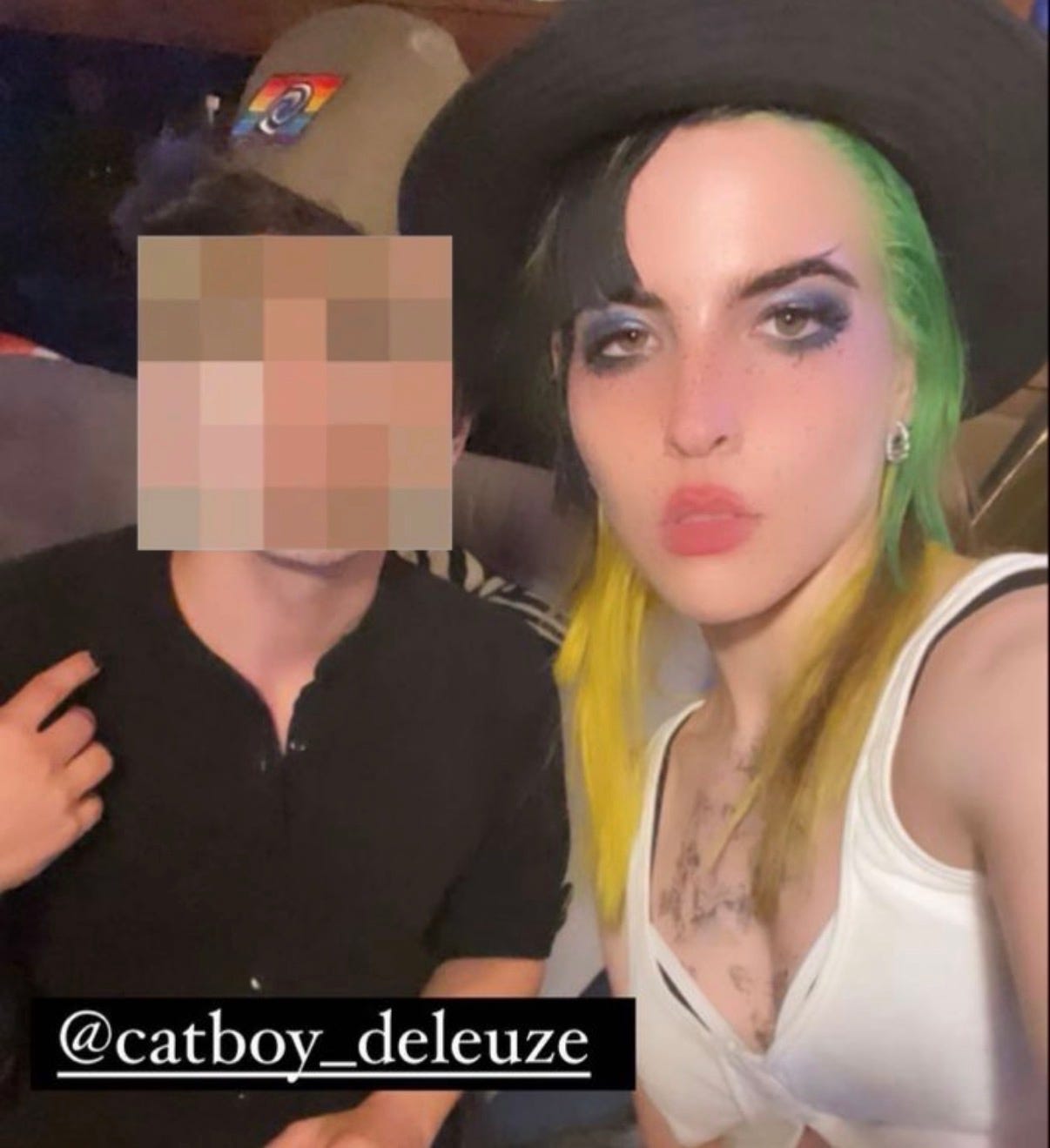
@catboy_deleuze along with Auto_Anon both came from and got popular on theorygram (but as auto anon is here I will allow her to speak for herself.) came from Theorygram's meme wing. The account moved Deleuze and Marx through an online persona whose name had already compressed theory into a joke you could recognize before you understood it. In a 2021 account of their political development, Catboy Deleuze described social media as an instrument of atomization that could also be used to communize knowledge (side note: I knew her and yes she was this annoying.) That contradiction belongs in this history because Theorygram kept trying to use the feed against the isolation the feed produced.
No White Saviors (hi white auntie) (https://www.instagram.com/nowhitesaviors/) was another creature entirely, and Olivia Alaso and Kelsey Nielsen started the campaign in Uganda in 2018. It used Instagram to make white saviorism legible to an enormous audience amid accusations that white privilege had structured its own internal life. It looks like a perfect parable of the era, but I don't trust the neatness because real people don't exist to complete my metaphor. (this was my dramagaden)
Years later, I'm friends with one of the women behind No White Saviors; history is rude like that. The friendship hasn't erased what happened or granted anyone immunity from criticism; it has made me less interested in freezing a person at the ugliest screenshot of her life. The women inside these accounts kept changing after the audience moved on, while the format learned how to carry on without them.
That is why the easy version of this essay would be dishonest. Theorygram met a political education crisis that can't be explained by shallow women enjoying pretty graphics. Universities kept theory behind tuition, and the organized left had become too weak to teach at the scale people needed. A teenager in a town without a left organization could discover that her private misery had a history. Plenty of us learned something real from a woman who had opened the book that morning.
The access mattered because people outside universities met ideas they might never have found through an institution, and that gain deserves preserving before I go back to being mean about everything else.
The format still ran on something simple: a concept came out of a book most people hadn't read. Its history got pared down until the definition fit on a slide, then a severe font supplied enough authority to let compression pass for education. The highlighted page proved the book existed and that its owner had caught seriousness by touching it.
Ten squares placed a hard limit on explanation. Every slide also had to keep a thumb from moving to the next post. History occupied space without producing immediate recognition, so it was usually the first thing cut. A concept arrived detached from the struggle that had made it necessary. What remained was a clean definition that could be recognized quickly and repeated somewhere else.
The result was readers who could clock the vocabulary a full beat before they could follow the sentence. Somebody learned a definition of neoliberalism at eleven at night. By nine the next morning, she was typing “read Harvey” under a stranger's post, having read neither Harvey nor the source named on the slide. The word arrived carrying social value before it carried analytical use. Political belonging got demonstrated through vocabulary, and an unfashionable term exposed anyone who had failed to keep pace.
In The Society of the Spectacle, the spectacle is a social relationship among people mediated by images. Under it, being degrades into having and having slides into appearing. He was writing about capitalist social life as a whole. The photograph of the highlighted page makes that relationship embarrassingly literal. Political authority circulates through a picture of reading until the appearance takes over the social function of the practice.
Cultural knowledge marks social position while presenting itself to the person holding it as taste, which is how class manages to feel like personality. His study moved through the classed practices of French life until even the furniture was snitching. Port the model onto a carousel and nothing breaks, except public metrics accelerate the conversion and publish the rate. Cultural capital now arrives with a visible follower count.
Theory became something people wore as the scene developed a dress code whose terms changed by the season. Profiles kept a public record of association, which meant following the wrong person could turn into a charge. People audited their own connections as if preparing for a deposition because political identity had become inseparable from visible proximity.
Theorygram had existed for years before the summer of 2020 turned it into an industry.
After the police murder of George Floyd and the uprising that followed, millions of people encountered political education through their phones. The pandemic had pushed social life online, where people were isolated and desperate to prove they were responding correctly to what they saw. Instagram stopped feeling like a place where politics could be ignored as posting became part of the event.
The black square was criticized almost immediately for being empty, so the infographic became the respectable alternative because it offered visible participation with information attached. Sharing a carousel about police abolition showed that you had learned something, or at minimum that you recognized what learning was supposed to look like. The feed became a classroom with an attendance sheet built into it.
Many of those posts moved useful information by directing people toward bail funds and explaining demands that television news refused to present honestly. Eve Ewing even used a Canva graphic to warn people that viral racial justice explainers were oversimplifying scholarship and stripping credit from the people who produced it. The criticism had to wear the format before the format would circulate the criticism, and you have to respect the trap for being that complete.
The reach was real, although the confusion began when reach started standing in for political relationship.
A share can introduce an idea to thousands of people without creating any obligation between them. Two strangers who save the same carousel haven't agreed to protect each other or carry out a decision together. They have consumed the same content, and the platform places their reactions beside each other until consumption begins to feel like belonging.
That feeling produced an inspection regime in which participants spent more time proving their beliefs than developing any capacity to act on them. Friendship with a condemned person threatened your credibility because standing near someone had become evidence. Suspicion kept expanding until you could be punished for a connection several people removed from the original offense. At that point we were deep into Kevin Bacon, and nobody involved had organized so much as a bake sale.
The purity spiral had better fonts, and it was gross while it was happening, years before somebody could turn that admission into a safe retrospective essay.
Instagram rarely paid creators for carousel labor, and that shaped who could sustain the schedule. Producing polished posts twice a week was a part-time job you did for free. The women best positioned to keep it up often had help with rent or an office job spacious enough to hide design work between emails. Poor women still made the work, although precarity made every hour of it more expensive.
The inspection regime also distributed punishment according to material position. A creator with family money could disappear after losing followers and return months later with a comeback essay in a slightly different aesthetic. A Black transsexual woman flagged for the wrong follow could lose housing or the ride that got her to the clinic. She could lose the few people who would vouch for her at the door, although the accusation stayed the same while the bill changed.
Then beige infographics became embarrassing because corporations had learned to reproduce the aesthetic perfectly, which exposed how little the design itself had ever guaranteed. The carousels began looking like artifacts from a period everyone claimed to have survived with better judgment than they showed at the time. The culture announced its death and migrated into newsletters before anyone checked the body.
The creators had grown older and needed rent money, while their arguments had also outgrown ten squares. Substack had been waiting since 2017 with more room and an easy subscription button. The old accounts started publishing longer paragraphs, and a lot of their owners opened newsletters, which was the same move as a scene kid discovering blazers.
The migration solved a real problem because writers could earn money directly from readers who valued the work. A mailing list offered more stability than an Instagram following rented from an algorithm. Marginalized writers could build an income without waiting for a university or magazine editor to decide our politics had become respectable enough to fund.
The old habits came with us as the carousel became an essay. The definitional box became a footnote from a French theorist placed near the center of the argument, like hiding a vegetable in a smoothie. The callout acquired a subtitle containing the word toward, which you use when you don't know where you're going but would like credit for facing that direction. The photographed page expanded into a bibliography that worked as body armor. Surround a weak argument with enough citations and asking what it accomplishes starts to feel impolite.
Here is the racket: a writer publishes a position, and the position finds readers who already wanted an account of the world from there. Their subscriptions become part of the material environment in which her later analysis develops. Recognition retains subscribers, and retention covers rent. The platform rewards a consistent political experience because consistency is easier to sell every month.
A movie arrives and readers already know which newsletter will declare it reactionary before the trailer is out. A scandal appears, and familiar interpretive frames compete to absorb it. Each one works like a horoscope written afterward, which means it never has to be wrong. The object changes while the purchased political experience stays recognizable.
Deception isn't required, which is the genuinely annoying part. A writer can believe every sentence while learning through open rates and cancellations which conclusions her audience rewards. Sincerity leaves the pressure completely intact, so she experiences the familiar conclusion as thought because the platform has trained thought and income to travel together.
Actual thinking sometimes means abandoning an argument that once defined you. Conditions can reveal that a trusted theory explains far less than you believed. A newsletter market punishes that revision because the recognizable political line forms part of the product. Consistency becomes customer service when disagreement threatens income. Changing your mind starts to resemble a breach of contract with people who subscribed for certainty.
She keeps finding liberalism everywhere because that is the discovery her audience pays to watch. The political method and the business model become difficult to pull apart.
The individual writer is only one piece of it. The bigger problem is the political class that formed around newsletters, which is the part newsletter people are going to like least. These publications behave like competing camps, where recommendations make alliances visible while public citations transfer authority between writers. Feuds circulate through shared links because each response introduces another audience to the dispute. The platform converts political emergency into engagement, and the denunciation still includes a link because we remain professional.
Readers attach political identity to the writers they pay, so criticism of the writer reads as an accusation against every subscriber. A disagreement about an argument acquires the emotional atmosphere of a custody battle.
A newsletter starts behaving like an institution once enough people treat it as one. It has thousands of readers and a shared vocabulary that develops into its own dialect. Unless those readers build obligations outside the publication, the apparent institution remains a mailing list with delusions of statehood. Somebody in the replies is definitely calling it the community.
This is how we got here: visibility grew faster than obligation at every stage. Theory became shareable on Tumblr, then legible as identity on Instagram. The uprising of 2020 made posting feel urgent; Substack gave the political camps that followed a payment processor. We mistook the expanding audience for an expanding capacity to act.
An audience doesn't become an organization through scale. Reading the same essay creates no durable relationship between readers. A subscriber count measures reach, while organizational capacity depends on shared obligations and a mechanism for acting together. The number can't tell you whether those people would protect one another when doing so cost them something. It only tells you how many people wanted the next essay.
What we built was a political layer fluent in radical analysis and powerless outside discourse. Its members recognized approved arguments and repeated them across the feed. Since no infrastructure was built, the analysis performed political identity while the conditions it described went untouched. Theorygram built the layer, and Substack gave it longer paragraphs. Its organizational capacity still resembles a group chat that can't choose a restaurant.
I am writing this on Substack, and I still make carousels and ask people to share them. My readers fund my work, and they can often predict where my essays will go. My audience has sometimes behaved like a camp because I helped create an atmosphere in which it could; I know this history from the inside.
I am also friends with a woman whose work became part of the history I am criticizing, which doesn't weaken the analysis because it forces the analysis to survive contact with a person. Ruthless criticism becomes cheap theater when everyone inside it is a cardboard villain and the author is the only human being allowed a complicated life.
I'm going to say the money thing now so the cheap ones can stop preparing their responses.
Writers should be paid because poverty has never purified anyone's analysis. It makes a writer tired and leaves her vulnerable to any institution offering money in exchange for a softer argument. Marginalized writers are constantly told our work is necessary by people who discover a principled objection to the subscription button the second they're asked to fucking push it.
The white leftist demanding free labor from a Black transsexual woman hasn't escaped capitalism. She has found a way to be cheap that sounds like Marx, and I'm done pretending that is theory.
Paying writers solves the problem of uncompensated labor while subscription dependence hands an audience material leverage over the political line. Refusing payment preserves the exploitation without removing an ounce of that pressure, and both facts have to stay in the room.
The critique reaches me directly, and announcing immunity because I believe my own analysis is correct would turn self-confidence into an exemption from materialism, which is the least cute version of the bit. Ruthless criticism has to land on the person swinging it.
Any method that decides an event's meaning before investigating it can't be rescued by confidence. Calling the method materialist doesn't cleanse the transaction.
The same goes for every white leftist about to screenshot this as an attack on her newsletter's rivals while her readers assume their chosen writer escaped the diagnosis. You're inside the critique, sweetheart, and pointing at everybody else is how we can tell.
Escaping Theorygram's logic requires theory to carry responsibilities beyond producing content. Ideas need to enter collective work where reality can answer back. A political line should guide decisions whose consequences extend past the author's subscriber count. That means leaving an argument unfinished until the people involved understand what they are discussing. A scandal can survive until morning while you read the entire book without photographing it beside an iced coffee. Carousels can educate people while newsletters support a writer's labor. An audience can supply resources for collective work, which still has to be organized somewhere beyond the publication.
Pay writers enough to work, then demand criticism rigorous enough to make the work answerable beyond the feed. We'll know we've escaped when theory stops functioning as a costume for online identity and starts answering to the women who have to live inside the conditions it claims to describe.
Works cited
Bourdieu, Pierre. Distinction: A Social Critique of the Judgement of Taste (https://www.hup.harvard.edu/books/9780674212770). Translated by Richard Nice, Harvard University Press, 1984. Originally published 1979.
Catboy Deleuze. My Political Journey: Catboy Deleuze.(https://donotresearch.net/posts/my-political-journey-catboy-deleuze) Do Not Research, 15 September 2021.
Debord, Guy. The Society of the Spectacle (https://www.zonebooks.org/books/3-the-society-of-the-spectacle). Translated by Donald Nicholson-Smith, Zone Books, 1994. Originally published 1967.
Kimeu, Caroline. No White Saviors: How a Campaign Against Stereotype of Helpless Africa Rose and Fell (be very skeptical of this source.) (https://www.theguardian.com/global-development/2022/aug/01/no-white-saviors-how-a-campaign-against-stereotype-of-helpless-africa-rose-and-fell) The Guardian, 1 August 2022.
McKenzie, Hamish. Five Years of Substack, with Bill Bishop.(https://on.substack.com/p/five-years-of-substack-with-bill) On Substack, 16 October 2022.
Nguyen, Terry. How Social Justice Slideshows Took Over Instagram (https://www.vox.com/the-goods/21359098/social-justice-slideshows-instagram-activism) Vox, 12 August 2020.


