


“Sexual liberation without the abolishment of patriarchy is sexual liberation for men”
On Queer Sex, Ambient Consent, and the Refusal of the Erotic
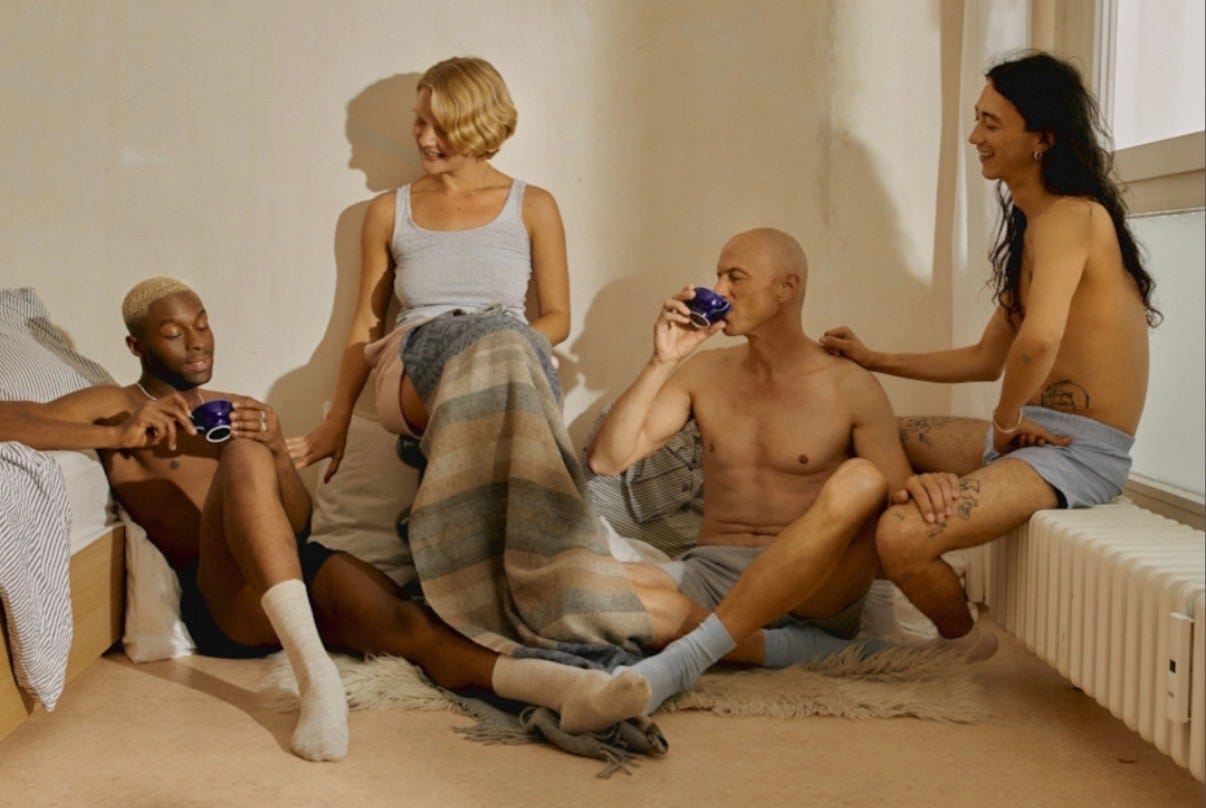
A girl I know threw a party a few months ago. Forty people in her apartment, most of them trans women, most of them the kind of trans woman who has a Substack, a podcast, or a body of work. Sometime around midnight, two people began making out in the kitchen. A third wandered over and joined them. By one in the morning, there was a pile of queer people on a mattress in the living room doing what everyone at the party had tacitly agreed, in advance, without anyone having to announce it, was the thing you did at a party of this kind. Nobody was drunk. Nobody was high. The pile was not romantic. The pile was not erotic in any register I could identify as erotic. It looked, from where I sat on the kitchen counter, like a group project.
The girl who hosted wandered over eventually. She had not been in the pile. She said, without looking at me, “I don’t know what’s wrong with me lately. I’m just not into any of it.” I asked her what she meant. She said, “I don’t know. It used to feel like something.”
I have been carrying that sentence for months. It used to feel like something. What it is now, what replaced the something it used to be, what the replacement is composed of, what it costs, and who pays, is what I want to name.
When did sex stop being political?
It did not stop. Sex under male supremacy has a specific ideological function, and that function has not shifted. What has shifted is the cultural vocabulary available for acknowledging it. The vocabulary has been systematically hollowed of the concepts that would permit us to recognize what sex is doing. The hollowing is the subject of this essay. The vocabulary we have been handed in its place is called casual intimacy. It is neither casual nor intimate. Its labor is the concealment its name performs.
0. Before the Morality Police Arrive
I know what some of you are already composing in your head. A woman who posts about sex on the internet, who describes herself in interviews as a kinky freak, who has a fiancée she fucks with enthusiasm and talks about fucking with enthusiasm, cannot credibly write a critique of the desexualization of sex. A woman who likes Andrea Dworkin cannot coherently hold that position alongside her own raunchy, visible, unapologetic sexual life. The essay is incoherent before it has even begun.
Let me be honest about the Dworkin part first, because the defensive version of this prologue would be beneath us both.
Frankly, yes, Dworkin would probably not approve of some of the sex I have. I know this. I am not laundering her into a figure who would have given me a thumbs-up at the kink party. My desire is, without question, informed by patriarchy. Parts of what turns me on are shaped by an ideology I did not choose and could not escape, because there was no outside of it when I was forming into a person. That is true. It is also true of yours. Every woman reading this was socialized by a culture that eroticizes female subordination from the moment she became legible as a future woman. There is no uncontaminated desire to retrieve. The fantasy of a pre-political eros that would be ours if we could only strip the ideology off is one of the ideology’s more effective products. It keeps us looking for the pure thing underneath instead of working with the actual thing we have. I work with what I have. I try to be mindful of where my desire came from. I try to notice when the thing I want is a thing the world trained me to want at a cost I do not always want to pay. I fail at this regularly. So does everyone. The mindfulness is not an accomplishment. It is a practice, and the practice does not require me to stop fucking the way I fuck. It requires me to know what I am doing while I do it.
Stoltenberg, in our interview leaves the door open for a reexamination of how we view his wife’s analysis The substance is that Dworkin’s framework leaves room for meaningful consent and erotic seriousness when the encounter is not structured by a man’s domination of a woman, which means T4T, and queer sex between women more broadly, occupies analytical terrain the framework can actually accommodate.] The critique of pornography that has been attached, often lazily, to her name was never a blanket critique of the erotic. It was a critique of a specific apparatus in which the domination of women by men was industrialized for profit. What two trans women do in a room is not that apparatus. What my fiancée and I do is not that apparatus. The framework was built to name a specific structure of violation. It is not reducible to “all sex is bad.” It never was. The people who reduced it had their reasons, and the reasons were mostly about discrediting the analysis by making it sound hysterical.
The demand that a woman’s intellectual attachments be perfectly congruent with her sexual practice is, additionally, a demand made of no man in the history of this civilization. Male writers adore Nabokov and do not have to justify their reading list against their sex lives. Male writers publish essays on Sade and then go home to their wives. Male writers can be in love with every thinker whose politics makes them uncomfortable, and nobody audits the contradiction. Women are asked to audit it. Trans women are asked to audit it while publicly undressed. Black trans women are asked to audit it while publicly undressed and apologizing. I am declining the audit.
The personal is political. My sex life and my politics are not separate domains requiring reconciliation. They are one domain. I fuck because of what I believe. I believe because of what I have survived. I have survived inside a body where the politics gets transacted. There is no hobby version of my intellectual life that exists apart from what I do in bed. There is no recreational-sex version of me that exists apart from what I think when I read. The woman who reads Andrea Dworkin and the woman my fiancée has held down and made beg are the same woman. The coherence of that woman is not a debt she owes you. The coherence is already there. Your failure to see it is your problem.
The reader who thinks an essay on the desexualization of sex must be an anti-sex essay has misread the title. Critique of a specific cultural configuration is not opposition to the category. A woman who critiques the way food is produced is not opposed to eating. A Marxist who critiques commodity fetishism is not opposed to objects. Critique names a specific material or cultural arrangement and describes what it is doing. Description does not imply opposition to the category itself. I am not opposed to casualness, lightness, pleasure, kink, play, or the full appetitive register of what women can do with each other in rooms behind closed doors. I am opposed to a specific cultural form that has colonized sex in queer spaces and produced the effects I will describe.
My raunchiness is not in tension with the critique. My raunchiness is where the critique is written from. I fuck. I think about fucking. I have had kinds of sex that would register on the cultural radar as serious and kinds that would register as filthy and kinds that blurred the distinction so thoroughly the distinction ceased to be useful. My sexual life is the credential that licenses the argument, not the embarrassment that undermines it. The writers who should be disqualified from a discussion of sex are the ones who cannot speak about their own desires in public without flinching, the ones so thoroughly disciplined by the cultures they defend that they can no longer tell you what they want done to them in a darkened room. Ask them. Watch what happens. The desexualization I am naming has eaten their interiority and left them fluent only in the critical vocabulary of the scene. That is what the scene produces. The fluency and the hollowness are the same thing.
The woman writing this essay is the woman my fiancée has held down and made beg. The woman writing this essay has, on multiple occasions, done things in bed that would make the casual-intimacy set clutch their pearls if the casual-intimacy set had pearls. The woman writing this essay likes it rough, likes it slow, likes it several other ways that do not belong in this paragraph. None of this contradicts the argument. All of it is the argument. The culture I am critiquing has made it difficult to be a woman who takes her desire seriously in public because the cultural default is that sex should be handled with the bored nonchalance of a person ordering takeout. I am not bored. I am not nonchalant. I am a serious person having serious sex and writing serious essays. The whole apparatus is coherent. The reader who cannot see that coherence has been trained by the culture I am critiquing not to recognize coherence when it is in front of her.
Now let’s go.
I. The Sex Is Everywhere and Nowhere
Call it evacuation. Desexualization, taken literally, would mean the removal of sex, and sex has not been removed. It saturates the scene. It flickers across every surface of queer cultural production. The removal is interior. The weight has been extracted from the category while the category continues to be invoked as though the weight remained. Sex circulates as a signifier unmoored from the freight it once carried, and the discrepancy between the signifier and its missing cargo is the condition this essay is attempting to name.
Observe how this functions in queer sociality. Sex is a constant topic. The conversation is not erotic in its texture. It is not political. It is a mode of communal administration. Who is fucking whom gets catalogued with the taxonomic fervor of nineteenth-century amateur naturalists assembling butterfly collections. The information is social currency. The referential content, that the information is about sex, a bodily-political phenomenon with consequences, seems nearly irrelevant to its circulation. A girl I was sleeping with a couple of years ago once told me, unblinking, that she had slept with someone she had no desire for because “it would have been weird not to.” The weird-not-to had taken up residency where desire used to live. Sex had migrated into the register of social obligation, a gesture one made at parties to demonstrate one was a participant rather than a spectator of the participation.
The evacuation has a specific grammar. Sex becomes lightweight because the participants have tacitly concurred that the weight is embarrassing. The weight is provincial. The weight belongs to straight people, conservatives, the unfashionable, the cousins still living in the suburb queer culture has evolved out of. To approach sex with weight, in the idiom of the contemporary scene, is to expose oneself as underdeveloped, not yet arrived at the sophisticated relation to one’s own body that queer culture purports to deliver as its developmental endpoint. Maturity is the capacity to have sex that does not matter. The people for whom sex still matters are pitied at the party. They are attached. They are hung up. They still think who they fuck is a question with stakes.
The scene enforces this developmental logic through a repertoire of recognizable moves, each so habituated by the time you encounter it that you stop noticing the enforcement and start believing in the sophistication. The most visible is the preemptive defusing, which operates before any sexual interaction commences. Before the touch, the participants verbally establish that the coming interaction does not signify. This is distinct from adult conversations about desire, consent, barrier methods, and limits, which are indispensable and which this culture, to its credit, often conducts competently. The preemptive defusing is an operation on affect, not logistics. I just want to be clear this doesn’t have to be a whole thing, someone says, and the formula proliferates through the scene in variants: no pressure, totally fine if we never do this again, I’m not looking for anything, let’s just see how it feels. These utterances arrive before the touch. The touch, when it arrives, has already been cushioned, quoted, and bracketed as provisional. The sex occurs inside the bracket. The bracket is the purpose the sex served. The sex confirms the bracket.
The bracket is held in place by a presumption of polyamory so thorough that it has ceased to feel like an assumption and become the weather. In most queer milieus, a person is assumed polyamorous until demonstrated otherwise, and the presumption extends into the sexual act itself. The expectation is that you will be at ease with the knowledge that the person you are about to fuck was fucking someone else three hours prior and will be fucking someone else by dinner. Ease is not solicited. Ease is presupposed. To request exclusivity, or even to articulate a preference for it, is to brand oneself as possessive, and possessive is the unforgivable attribute in this culture. Possessive exceeds incompetence. Possessive exceeds cruelty. Possessive is the sin without absolution. The polyamorous default is not arrived at through deliberation among equals. It is the atmosphere in which deliberation would have occurred, and it has already decided the question. The minority who consciously negotiated into nonmonogamy from a monogamous baseline are outnumbered in this scene by the majority who were presumed poly before they had considered what they wanted, and whose relational architecture was designed for them by the cultural air they breathe.
Alongside the presumption runs a continuous cultivation of low expectation, audible in the tonal register in which sex is discussed afterward. It was fine. It was pretty good. A six. A seven. A four, but we had a nice conversation after. The scoring is affectionate, ironic, and continuous. No participant is permitted to grade her sex life a ten, because a ten would announce feelings, and feelings about sex are the provincialism the scene has organized itself to exceed. The scoring register, ironic, detached, implying the speaker knows sex is faintly ridiculous, is the evacuation rendered audible. The speaker is notifying her interlocutor, in advance, that she will not be caught caring.
The most consequential of these moves is also the most concealed. The culture of casual intimacy produces an affective flattening of sexual violation. Acts that would be legible as assault in other cultural contexts become, in this one, “a bad hookup,” “a weird experience,” “a situation where the energy was off.” The vocabulary of violation has been supplanted by the vocabulary of vibe. A friend of mine was raped at a house party by a transmasculine person who was, at the time, dating her closest friend. She told me about it a week later. She used the phrase kind of a mess. She had been sober. She had said no. The perpetrator had not stopped. She was describing her rape in the phraseology of a regrettable meal. I said, carefully, that sounds like assault, and she said, with equal care, I don’t want to call it that because things are complicated. Things are complicated meant the perpetrator was beloved in the scene and she could not absorb the social expenditure of naming what had happened to her. The culture of casual intimacy had generated a vocabulary in which rape could not be called rape, because the designation of rape requires the sex to have possessed gravity, and the sex had not been permitted to possess gravity. Therefore the act performed upon her did not possess gravity. Therefore she was not entitled to register it as the thing it was.
I have considered this at length. I consider it every time someone explains to me that casualness is a form of sexual liberation.
The casualness is not liberation. The casualness is a disciplinary apparatus that instructs women, particularly women whose bodies are already marked, already politicized, already at elevated structural risk, that the violation we experience is not the kind of thing that admits of being named. Naming it would require us to hold sex as consequential, and the refusal to hold sex as consequential is the condition of membership. The refusal is what marks us as sophisticated. The refusal is the cover charge. Once we have paid it, we learn not to name what occurs to us. Because we do not name what occurs to us, the occurrence recurs. It continues to recur under the protection of our own trained silence.
There is a longer theoretical tradition that can hold what I am describing, and it comes from Black feminist thought rather than the traditions the casual-intimacy scene usually cites. The tradition distinguishes between the body, which is a symbolic construct produced by and protected within the grammar of gendered civil society, and the flesh, which is the pre-symbolic bodily material exposed to violations the body’s grammar cannot register. Under chattel slavery, Black women were ungendered, rendered flesh rather than body, and thereby made available to forms of violation that the gender grammar governing white women could not conceptualize. That analytical operation, identifying a mode of embodiment in which violation cannot be named because the categorical infrastructure for naming it does not extend to this flesh, describes, in a different and derivative form, what is occurring in contemporary queer space to trans women, to women of color, to anyone whose body is ungrammatical within the sexual taxonomies the scene makes available.
We are, in this sense, the ungendered flesh of the queer scene. Our bodies are the bodies to which the rules do not quite apply. When a cis white queer woman sleeps with me and treats the act as casual, an implicit operation is underway. The casualness is presented as protective, as a mutual lightening, as a gift we are exchanging. When she subsequently commits, within the envelope of that casualness, an act that in a different cultural context would be legible as violation, the violation resists naming because the casualness has been pre-established, and the casualness is the interpretive frame governing the encounter’s retrospective description. I am the ungendered flesh of her evening. My body is accessible to her in a register in which hers is not accessible to me, because she retains the cultural credentials to retroactively redescribe whatever passed between us as a casual thing and therefore unaccountable to the standards that would apply to serious sex. We did not meet as equals, and the meeting’s vocabulary was hers.
The evacuation is selective. Sex is evacuated of weight for the bodies that benefit from weightlessness. The weight falls onto the bodies that cannot shed it. The cultural form of casual intimacy is the redistributive mechanism by which this imbalance is produced and then represented as equality.
The evacuation is recent. Women my age, women in their twenties, have no cultural memory of anything else, and the absence of an alternative in living memory has helped convince us that the evacuation is the natural condition of sexual sophistication rather than the specific invention of a specific decade. It is an invention. It was built. The scaffolding that built it is identifiable, and the builders, in most cases, are still living. That the evacuation feels eternal is itself part of its power. The evacuation cannot be understood without its prehistory. The weight did not accumulate on sex by accident.
II. Doll this is on purpose.
Nobody in the culture of casual intimacy wants to discuss the fact that sex became heavy for material reasons. Sex became heavy because sex was the site where the species reproduced itself, and the reproduction of the species was the site where the primary labor of producing and maintaining populations of workers, soldiers, citizens, and slaves was performed. Jurisdiction over that labor was the foundation of the economic systems under which humans have organized themselves for the last several millennia. Sex was political because reproduction was political. Reproduction was political because population was the economic substrate.
This is not an idiosyncratic reading. The scholarship on primitive accumulation has long established that the European witch hunts of the sixteenth and seventeenth centuries were not a medieval residue. They were a distinctively modern apparatus deployed to shatter women’s customary control over reproductive decision-making: contraception, abortion, midwifery, sexual knowledge transmitted among women. They subordinated reproductive labor to the emergent capitalist economy. The witch hunt was the mechanism by which women’s bodies were enclosed into the conjugal household and reconfigured as private productive machinery for the reproduction of the labor force. This analysis provides the explanatory infrastructure for what sex’s historical heaviness consisted of. Sex under patriarchal-capitalist modernity was not primarily about pleasure, and it was not primarily about intimacy. It was about the production of the next generation of labor. Women’s bodies were the machinery of that production. The regulation of women’s bodies, legal, economic, religious, and sexual, was the regulation of the labor supply. This is why patriarchy took the form it took. This is why the government of sex became the central technology of female subordination. Sex was the channel through which women’s reproductive labor was captured and expropriated toward the accumulation of male wealth.
The implications for the contemporary queer project are stark and unflattering.
The queer culture under description proceeds on the axiom that sex can be rendered casual because the reproductive function has been decoupled from it through contraception, abortion access, nonprocreative queer sexual practice, and the broader demographic-technological condition in which substantial populations can have sex without producing children. The decoupling is real. The decoupling is historically unprecedented. I honor it, and I depend on it. The decoupling has produced the material conditions for queer life as a livable form, for abortion as a right, for nonreproductive pleasure as a thing available for cultivation. None of this is being contested.
The error is the assumption that decoupling the mechanical reproductive function from sex terminates the ideological cargo sex accumulated during the millennia when sex was reproductive. The mechanical function and the ideology that attached to it are two distinct historical sediments. The first has been substantially attenuated. The second has not been dismantled. Patriarchal ideology has outlived the original reproductive anchor of its power and found other anchors. This is the general condition of ideologies. Ideologies persist past their material occasion. Ideology operates precisely by persisting past its occasion.
The ideology of sex under patriarchy is that women’s bodies exist for men’s use, that the primary historical function of that use was reproductive, that the secondary function is the satisfaction of male sexual desire, and that women’s own pleasure, agency, and refusal are subordinate to both. The ideology has been borne by every cultural form patriarchy has produced: religious doctrine regarding women’s divinely ordained role, legal structures that rendered women the property first of fathers and then of husbands, medical discourse constructed around male physiology and treating female physiology as the deviant case, literature that recited, across centuries, the same plot in which women were objects of pursuit and vessels of inheritance, and pornography that industrialized the ideology at the scale of commercial reproduction.
The queer project of making sex casual has not dismantled this ideology. The queer project has not seriously attempted to dismantle this ideology. The queer project has declared the ideology inoperative within queer space because queer sex is nonreproductive, under the operative assumption that sex without reproduction is sex without reproductive-ideological freight. This is the wager the scene has placed. The wager is that nonreproduction exempts the nonreproductive actor from the ideological history that reproduction originally anchored. If you are not making babies, you are not doing patriarchy.
It is losing because the ideology was never strictly about reproduction in the narrow biological sense. It was about the jurisdiction of women’s bodies as the material base of male supremacy. The reproductive function was the original anchor of that jurisdiction, but jurisdiction long since exceeded the anchor and extended to every sexual interaction involving a female-coded body, regardless of reproductive context. A man fucking a cis woman on birth control operates inside the ideology of the usable female body. A man fucking a lesbian in a nonpenetrative register can operate inside that ideology as a matter of the structuring of desire, even when penetrative practice is absent, because ideology organizes the framing of the act as much as the act itself. Ideology adheres. It does not require the original material practice that produced it to continue enforcing its effects. This is what ideology is.
Queer culture has concluded, collectively, that removing reproduction from sex is sufficient to remove male supremacy from sex. It is not sufficient. The removal of reproduction from sex has been one of modernity’s genuine achievements, and I am profoundly grateful for every form of contraception, abortion access, and queer nonreproductive practice that has made my life and the lives of the women I love possible. That achievement is not the terminus of the struggle. It is one victory in a longer war, and the enemy has not conceded the field because we have taken the hill.
The specific operation the ideology performs, which the culture of casual intimacy has failed to address, is this: the female-coded body is a pre-available body. The female-coded body is a body that other parties possess access to, by cultural default, unless the female-coded body has specifically and audibly retracted that access. The burden of constructing nonavailability falls on the person with the female-coded body. The default is availability.
This default is why rape culture exists. This default is why the legal standard in most jurisdictions, until extraordinarily recently, required that a woman physically and conspicuously resist in order for sex to register as rape. The controlling assumption was that her body was available and that she was obligated to overcome the default in order to establish that it was not. This default is why women are trained, from childhood, in the extensive repertoire of soft refusals, redirections, escapes, and verbal de-escalations that constitute the daily labor of occupying a body presumptively available to men. Queer casual-intimacy culture has absorbed this default, the default availability of the female-coded body, and extended it across queer space, where it has become the default availability of all bodies in the scene to all other bodies in the scene. The presumptive polyamory, the preemptive defusing of sexual weight, the affective flattening of violation: these are the cultural mechanisms through which the scene produces the generalized availability of every body in it to every other body in it. The availability is the atmosphere. You breathe it before you speak.
The frame that best names what is happening here is the one Black feminist thought has developed for thinking about how systems of violation persist after the formal structures that produced them have been abolished. The technologies of dehumanization developed under Atlantic chattel slavery did not terminate at emancipation. They were reformed, redistributed, and refunctioned through the legal, economic, and cultural apparatuses of the modern state and modern social life, and contemporary Black life remains structurally conditioned by slavery’s unfinished work. The analytical move, that a system of violation persists after the formal structures that produced it have been abolished because the ideological infrastructure outlives the material institution, is the move I am making about sex. The reproductive-patriarchal ideology persists after reproduction has been technologically uncoupled from most sexual practice. The uncoupling was supposed to terminate the ideology. The ideology did not terminate. It continued without its original material anchor and found other ones to fasten to.
The new anchors are visible to anyone willing to look at them. The commodification of sexed bodies as circulating image. The monetization of women’s bodies through the commercial pornography industry. The specific forms of sexualized exploitation and violence that persist in queer space under the cover of the casual. The enduring presumption that certain bodies, trans bodies, Black bodies, disabled bodies, fat bodies, poor bodies, are more available than others, carry less evidentiary weight in their own refusals, and bear the burden of continuous explicit opt-out rather than the protection of an opt-in default. The ideology has a working career. It is not in retirement. It is at the office every morning.
The culture of casual intimacy has built itself on the premise that sex has been liberated from its historical ideological cargo. The premise is false. The cargo remains, better concealed, because the culture has agreed to stop examining it. The women for whom sex was never light to begin with, the women whose bodies have been the specific sites at which the ideology has been most violently enforced, which in this country means Black women first and then the full descending order of racialized and precaritized women downstream of that violence, know the cargo is still loaded. We have been carrying it. We have not been extended the option of making sex casual because the culture that extends that option to others has never extended it to us. Our sex was and remains serious, because our sex was and remains inside the ideological structure that made sex serious in the first place.
The scholarship on trans-of-color embodiment closes this frame. The modern category of transness possesses a specific racial genealogy. The ungendering of Black bodies under chattel slavery produced the conceptual conditions for the contemporary understanding of gender as malleable, and the trans categories available to us are not racially neutral. They emerged from specific racial histories of how bodies were rendered available to violence and to conceptual manipulation. Trans bodies do not occupy racially neutral terrain. The trans body is already racialized. The Black trans body is particularly legible within an ideological history that has rendered Black bodies specifically available to sexual violation for four hundred years. My body, when I walk into a queer space, does not enter that space from the same starting position as the cis white body entering beside me. The casualness being extended to both of us is being extended under structural conditions of inequality that the casualness is not equipped to recognize. The white queer woman who sleeps with me retains access to the retroactive redefinition of our encounter in ways I do not. Her body is not in the same ideological position as mine. Our casualness is not equivalent. We are not the same kind of body occupying the same kind of space.
The culture of casual intimacy treats all its participants as analytically fungible. The fungibility is the lie. The bodies in the scene are not interchangeable. A culture that treats them as interchangeable is producing a condition in which the noninterchangeability cannot be spoken, because speaking it would reintroduce weight, and weight is the category the culture has agreed to refuse.
This is the mechanism by which a cultural form designed around the comfort of white cis queer women has become the universal form all other bodies are expected to adopt. This is the mechanism by which trans women of color, Black women across genders, and working-class women of every configuration have found themselves inside a sexual culture that was not made for them and that cannot be adjusted to acknowledge that it was not made for them without the entire structure collapsing.
The structure should collapse. This essay is a modest contribution to the collapse.
III. Call the Thing the Thing
The theoretical has to land in the body or it has not earned its existence. The register shifts now, blunter than what has preceded, because the body does not speak in citations.
What I want to name, and what this essay has been building toward since the party in the opening scene, is a specific pattern of nonconsensual sexual contact that has happened to me and to other trans women I know in queer spaces, and that the culture of casual intimacy has made nearly impossible to name inside the vocabulary the scene provides. A few of us, privately, among ourselves, have started calling it lowkey rape. I am going to use the phrase once in this essay and then describe the thing it names, because the phrase is accurate and it is how a specific group of women have come to identify the phenomenon. The phrase is not the point. The phenomenon is the point. What it is, how it happens, why it cannot be named in public, and what the naming costs when we try, is what this section is about.
Here is what I mean. I have been fingered at parties without being asked. I have been penetrated during encounters I had agreed to as making out only, after I had said no to penetration, because the person I was with decided the no was soft and could be worked past. I have been held in positions I had said I did not want to be held in by people who treated my saying so as a negotiating position rather than a limit. I have had people put their hands inside me while I was still deciding whether I wanted their hands on me. I have, in several cases, laughed while it was happening because the cultural register of the scene required the laugh, and laughing was less socially expensive than freezing, and freezing was less socially expensive than refusing out loud, and refusing out loud was the unthinkable thing. Refusing out loud would have required me to treat the encounter as the kind of encounter where refusal applies, and the cultural air of the encounter had already established that it was not that kind of encounter. The casualness was the whole frame. The casualness had preempted the possibility of refusal without needing to override it, because the refusal had been made unavailable by the framing before the event began.
Each of these events, in a nonqueer cultural context, would be legible as sexual assault. Unwanted penetration is rape. A no overridden by penetration is rape. A hand inside a person who has not agreed to the hand being inside her is sexual assault. None of this is controversial in abstract feminist analysis. It becomes controversial only when the people involved are queer, in a scene coded as casual, at a party coded as sex-positive, with participants who have culturally pre-agreed that sex is supposed to be light. The lightness is the apparatus that renders the violation illegible. The lightness is what I am indicting.
I want to say what the specific mechanism is, because the specific mechanism is how this keeps happening, and knowing the mechanism is the first requirement for refusing to participate in it.
The mechanism operates as a double bind and it operates in sequence. The culture first establishes, through ambient conditioning that predates any particular encounter, that sex is casual and weightless and not a big deal. Everyone knows the rules before they arrive at the party, in the DMs, at the kitchen table. An encounter then begins inside that culturally pre-established frame, with both parties operating under the assumption that the sex about to happen is casual sex. One party does something the other party did not agree to. The second party now faces a choice in which both options cost her. If she names what just happened as assault, she violates the pre-established frame. She becomes the unsophisticated one, the hung-up one, the provincial one who thinks sex is supposed to matter. Her social standing in the scene depends on her not doing this. If she does not name it, the thing that just happened to her becomes a thing that is not a thing, a weird evening, a vibe that was off. The violation is absorbed by the absence of a vocabulary adequate to it. The culture has built the trap in advance and closed the exits before anyone entered it.
The vocabulary is not actually absent. Every woman reading this knows the word for what I am describing. The word is rape. What is absent is the cultural permission to apply the word inside a queer casual-intimacy context, because the permission has been actively withdrawn by the culture itself, which has declared that sex in this context is preemptively consented to by the act of being present at the party, in the DMs, at the kitchen table, in the bed. The consent is ambient rather than specific. You consented by showing up. You consented by being hot. You consented by being someone who has hookups. The consent is structural, which means the refusal has to be structural too, and structural refusal is not available to an individual woman in an individual encounter unless she is willing to take the social hit of becoming the unsophisticated one.
This is why the phrase exists among the small circle of trans women who have started using it. The phrase is not a softening of the word rape. The phrase is an indictment of the culture that has produced a category of rape that cannot be named as rape. The lowkey does not modify the act. The lowkey modifies the cultural apparatus that has rendered the act unspeakable. Lowkey is what they have made the rape be. The rape itself is not low-key. The rape itself is a hand inside your body that you did not consent to having inside your body. The lowkey is the cultural varnish painted over it so that you cannot scream about it without being treated as the one out of line.
Since the platform grew, the pattern has accelerated. When I was an unknown person, the frequency of these encounters was terrible. Since I became a recognizable figure, the frequency has increased and the tenor has shifted. I am now approached, in queer spaces, by people who want access to the person who wrote the essays rather than to me, and the access they want is sexual, and the sexual access they take is often access I did not grant. The platform has functioned, for a certain kind of trans woman and a certain kind of queer, as a license. The logic is that I am a public person, that public persons must be sexually available, that my having written publicly about sex constitutes a preauthorization of sexual approach, that the casual-intimacy frame that governs the scene governs me with extra force because the frame now has my own public sexual writing as one of its ambient consents. I did not consent to being available to everyone who read my essays. My essays are not a blanket release form. The people who have treated them as one have done so because the cultural infrastructure of the scene has made that treatment feel ordinary.
I have had trans women I had never met approach me at parties within an hour of arriving and propose sex as though the proposal were a natural continuation of the evening. I have had trans women send me unsolicited nudes in the DMs of a public account I use for political writing. I have had people I barely knew describe, to my fiancée, in granular detail, what they wanted to do to me, as though my fiancée were an administrative function of my availability rather than the woman I am marrying. I have had people I agreed to make out with at parties escalate past what I had agreed to, past my no, into what I am calling by its correct name, which is sexual assault, and I have had to deal afterward with the scene’s social machinery protecting them and not me, because they were beloved in the scene and I was the one who was going to make it weird by saying what had happened.
I am not going to name them. The essay is about the culture that made what they did available to them, and naming them would convert the essay into a set of indictments of individuals. The essay is not about individuals. It is about the cultural conditions that produce the pattern. The individuals know who they are. They will read this. They are welcome to recognize themselves. They are not welcome to contact me about it. The women who know who they are may choose to do whatever they want with that information, and I am not going to adjudicate what the women who know should do. My job is the analysis. The analysis is what I am producing.
I want to address the cis readers reading this with an agenda, because this essay will reach them. The sexual violence committed in cis spaces against women, trans women, Black women, Black trans women, and every body downstream of male supremacy is enormous, structural, and ongoing. Cis men will harm you for being trans in ways queer people generally will not. I am not naming a problem unique to queer community. Sexual violence is the general condition of occupying a feminized body in this civilization. The comparison between rates of sexual violence in queer versus cis spaces is not a settled empirical question. CDC NISVS data and trans-specific studies show elevated victimization rates for LGBTQ+ people overall, and the comparative picture of perpetration inside queer relationships versus straight ones is less definitively established in the peer-reviewed literature. I am not going to pretend it is settled in order to produce a tidy sentence. What I can testify to, from inside a specific scene, is that the cultural form of casual intimacy dominating queer sociality generates a specific failure of recognition around sexual violation that is distinct in kind from the failures that operate in cis spaces, whatever the total volumes turn out to be. Queer casual intimacy renders violation illegible. Cis culture renders violation unspeakable through a different apparatus. Both systems manufacture silence. I am writing about one because I inhabit one, and because the silence in the scene I inhabit is being generated by a culture that calls itself liberatory. I would like the culture to stop calling itself liberatory until it stops generating the silence.
A note on my own sexual practice, since the essay has promised throughout that it is written from the position of a woman who takes her desire seriously. I am a kinky freak. My fiancée and I fuck with intention. Our sex has context, has before and after, has the capacity to include what would look from the outside like force and, inside the actual encounter, is something entirely different, because the force is scaffolded by a structure of trust, explicit negotiation, and aftercare that is the opposite of the casual-intimacy apparatus I have been describing. Kink done well is the most serious sex there is. Kink requires the participants to have specifically and elaborately consented, to have named in advance what is welcome and what is not, to have constructed a context in which escalation is by agreement and refusal is instantly honored. This is why kink communities, at their functional best, often have clearer tools for recognizing and interrupting the kind of violation I am naming than casual-intimacy queer spaces do. The kink community takes consent more seriously than the casual-intimacy scene does, because kink has had to. The aesthetics of kink make the stakes of consent visible in ways the aesthetics of casual intimacy obscure. The casual-intimacy scene looks low-stakes. It is not low-stakes. The low-stakes look is the apparatus through which the high-stakes violations pass.
This is the juncture at which the essay has to stop describing the culture and say the thing it has been implying. The culture has to end. It does not need reform. It does not need improvement. It does not need to become slightly more careful about consent while retaining its general texture. It has to end. The reason the culture has to end, and cannot be reformed into a better version of itself, is that the features producing the violation are the features the culture is made of. Casual intimacy is the apparatus through which the violation becomes unsayable. Without that apparatus, there would be no casual intimacy to speak of. The lightness, the preemptive defusing, the presumptive polyamory, the cultivated low expectation, the flattened vocabulary of vibe: these are the culture. Strip them away and you do not have purified casual intimacy. You have a different culture, which is what I am arguing for. A culture that takes sex seriously is not a softened version of this one. It is the opposite of this one. The two cultures cannot coexist in the same scene, because every feature that makes the first one feel like what it feels like is the feature that produces the harm the second one refuses.
The objection will come from the defenders of the scene, and it will come in a specific form. I am going to name the form in advance so that the reader who hears it being made can recognize what it is doing. The objection will be that I am sex-negative. That this whole essay, for all its gestures at kink and all its talk of my own raunchiness, is doing the work of the religious right by asking queer people to take sex seriously. That insisting on gravity is the puritan move dressed up in radical clothes. That the casual intimacy I am indicting is the liberation from that very puritanism and I am trying to drag us back. I want to take this apart slowly, because it is the move on which the defense of the entire apparatus depends, and because once the reader sees what the move is actually doing, she cannot unsee it.
Sex-negative is a term that should mean something specific. It should mean a position that treats sex as shameful, dirty, dangerous in itself, a regrettable biological function that decent people transcend. It should describe the Victorian reformer, the church lady who refuses to discuss what her husband does to her, the abstinence-pledge educator teaching teenagers that their desires are the devil’s work. The term was built to describe those positions, and when it described those positions, it was useful. The term has since been weaponized, by the culture I am critiquing, to describe anyone who suggests that sex might have weight. Anyone who suggests that sex might have consequences. Anyone who suggests that the specific sexual arrangements of the contemporary queer scene might be producing harm. The term has been stretched until it covers everything from actual church-lady moralism to the woman saying, please do not put your fingers inside me without asking, and the stretching is not an accident. The stretching is the apparatus by which the culture inoculates itself against critique. You cannot name the harm because naming the harm gets you the sex-negative charge, and the sex-negative charge is socially fatal in queer space, and therefore the harm cannot be named, and therefore the harm continues, and therefore the charge has done its work.
I am a woman who thinks sex is the single most important physical-emotional-political act two people can do together. I think it is serious. I think it is sacred in the nonreligious sense of that word, the sense in which certain acts create obligations and meanings that persist after the act is over. I think the people I have sex with and I are accountable to each other for what we do, in the moment and afterward. I think desire is a form of knowledge, and I think ignoring what my desire is telling me is a way of lying to myself about who I am. I think kink is play, and play is deeply serious business. I think my body belongs to me and my fiancée’s body belongs to her. We have chosen to share access to each other’s bodies under specific conditions that we have negotiated and continue to negotiate, and the specificity of those conditions is what makes the sharing meaningful rather than administrative. This is a sex-positive position. It is, in fact, a more sex-positive position than the one held by the culture that has stretched the word sex-positive until it means, I will not notice what is being done to me or to you, and I will punish you socially if you notice it instead.
The culture of casual intimacy is the sex-negative culture. I am going to say that again because it is the claim that does the work. The culture of casual intimacy is the sex-negative culture. The people who have organized their sexual lives around the principle that sex should not be a whole thing, should not carry weight, should not demand presence, should not obligate anyone to anyone, are the people who have decided that sex is not worth taking seriously. They have made peace with the triviality of sex because taking it seriously was too expensive for them, and they have built a culture that punishes anyone who refuses the peace they made. A woman who insists that sex should matter is not dragging the scene back to the 1950s. She is insisting that sex is worth more than the scene has decided it is worth. The dragging-back accusation is rhetorical cover for the actual move, which is protecting the right to continue having sex that means nothing with people who are not expected to mean anything to you.
The charge that I am doing the religious right’s work is the most cynical version of the defense and the one I want to name most directly. The religious right wants women owned by men, pregnancy compulsory, homosexuality criminalized, trans women erased, and sex that does not produce babies stigmatized out of existence. I want none of these things. My life, my body, my fiancée, my politics, my Black trans womanhood are everything the religious right has spent its institutional life attempting to annihilate. To suggest that my critique of queer casual intimacy is aligned with them is to suggest that any criticism of any queer practice is conservatism. That is the move. That is what the charge is for. It is a cordon sanitaire around the scene, designed to make internal critique impossible by associating every internal critic with the external enemy. The trick works because the external enemy is real. There are people who would kill me for being alive. The fear of helping them makes even committed queer theorists hesitate before naming what is happening inside the community. I am not hesitating. The external enemy exists. The internal problem also exists. They are not the same problem, and naming the internal problem does not hand ammunition to the external one, because the external enemy does not care about the subtleties of my argument. They want us dead regardless. We do not owe them our silence about our own community in exchange for a protection they are not going to extend anyway.
the sex-negative accusation is the one directed at trans women specifically. It is the suggestion that we, of all people, cannot afford to indict queer sexual culture, because we are already marked as suspect, already treated by the broader culture as the problem inside queer community, already vulnerable to expulsion if we become inconvenient. The argument is that we should hold our tongues about the violence happening to us inside this community because speaking up will be used against all of us. I have heard this argument from other trans women. I have heard it with sympathy and I have heard it with hostility. I have thought about it, and I have rejected it. The expulsion is coming whether or not I write this essay. The broader culture does not need my essay to find excuses to harm trans women. It has been generating excuses for a hundred years without our help. Our silence has never protected us. The specific silence about intracommunity violence has, if anything, made us more available to further violence, because the abusers know they can operate inside our community without consequence. Breaking the silence is how the violence stops. The people who have told me not to write this essay are, in many cases, the people who need the silence maintained in order to continue their own patterns, and I am not going to respect that need. I am going to name what is happening. The women who recognize themselves in what I am describing can do what they want with the recognition. I am not writing for the women who need me quiet.
The exit, when there is one, has been pointed to already in the feminist tradition, and the most direct articulation belongs to Black feminist thought on the erotic. The distinction that tradition drew is between the erotic, the full bodily-emotional-spiritual engagement with one’s own desire and with another person’s presence, a deep epistemic and spiritual resource systematically denied to women under patriarchy, and the pornographic, which is the suppression and commercial substitute for the erotic, the reduction of erotic power to the sensational and the purchasable.
The culture of casual intimacy I have been describing is not the erotic in that sense. It is the pornographic extended into social life. It is the exterior of sex, the gestures, the signifiers, the bodies in arrangement, without the interior, without the bodily-emotional-spiritual substance of the thing. The culture has taken the outside of sex, extracted the inside, and offered the outside as the complete article. The women who occupy this culture and experience a felt emptiness are correctly experiencing the absence of the inside. They are not defective. The cultural form they were handed was defective before it reached them.
This is what I want trans women in particular to absorb. The sense that something is missing is not your personal failure. You were handed a cultural form that was not built for you, does not nourish you, cannot accommodate the weight you actually bring to sex. You bring weight. Your body brings weight. The specific history of your body, as trans, as a woman, as whatever race you are, as whatever class you occupy, as whatever survival configuration you have assembled, brings weight. The culture is instructing you to leave that weight at the door of the party. The culture does not permit you to retrieve it on the way home. The weight is yours. You cannot leave it. The attempt to leave it is the thing making you ill. Worse, the attempt to leave it is the thing making you available to the violation the scene will not let you name.
The erotic is available. It is available in the sex you have with people willing to be inside it with you, who do not require the preemptive defusing, who can acknowledge during the act that the act is occurring and that something is at stake in its occurrence. It is available in the relationships that are serious enough to be political, economic, accountable to the material conditions of your life. It is available in kink, in play, in the games where both parties know what they are doing and know they are doing something real. The erotic is not the opposite of casualness. The erotic is the opposite of evacuation. You can be playful, laughing, goofy, light in tone, and remain erotic. You can be intense, heavy, grave in register, and remain erotic. What the erotic requires is presence. What casualness-as-evacuation forecloses is presence. These are different categories and they should not be confused.
I Want the Erotic Back
The culture of casual intimacy is performing a specific operation on queer life. It is not serving you. It is not serving me. It is producing a scene in which sex is ubiquitous and signifies nothing, in which violation is routine and cannot be named, in which the women whose bodies are already politicized are required to become lighter in order to become lovable, in which the women who cannot become lighter are processed as problems. The culture is maintained by the participants for whom its costs are lowest. The costs are absorbed by the rest of us.
You have a choice. The choice is not between the casual intimacy of the current scene and the carceral monogamy of the culture that preceded queer liberation. That opposition is false, and it has been deployed to protect the current scene from critique by pretending every critique is a covert wish to return to the 1950s. I do not want to return to the 1950s. I want to proceed somewhere we have not yet been. I want a queer culture that holds sex seriously enough to hold its participants seriously. I want a culture in which my body, upon entering a room, is not automatically positioned as available unless I loudly revoke availability. I want a culture in which the trans women I love do not spend the whole decade of their twenties working out what happened to them in the hands of people who would not have been permitted to touch them if the cultural infrastructure had not preauthorized the touching. I want the erotic back. I want weight back. I want sex to matter.
The question is what you are going to do. Not what the culture is going to do, because the culture does not act without the participants making it act. The culture is you and me and everyone else. The culture is generated by the social decisions its participants make at parties, in DMs, at kitchen tables, in bed. If you want the culture to change, you change the decisions you make. If you are someone who has been producing casualness because casualness is the cultural atmosphere, you can stop. You can decide, next time you are about to announce that this doesn’t have to be a whole thing, that it does have to be a whole thing. That every instance of sex is a whole thing. That you will not defuse your own sexual life in order to appear sophisticated. You can decide that seriousness is not provincial. You can decide to be present in your own body while someone is touching it, and to require that the person touching you be present in theirs.
You can also decide, if you are a trans woman inside this culture and feeling erased by it, that you are permitted to name what has occurred to you. You can call the thing the thing. You do not have to allow the culture to persuade you that your weight is embarrassing. Your weight is the condition of your reality. The women who cannot tolerate your weight were not going to be yours anyway. Release them. The ones who can hold it are worth the rest of your life.
I will keep writing. My sex will remain heavy, weird, kinky, political, and mine. Your move.
—Tara
Bundle of Styx is written free and unhedged. If this mattered to you, you can support the work at ko-fi.com/bundleofstyyx.
Citation Notes
Spillers, Hortense. “Mama’s Baby, Papa’s Maybe: An American Grammar Book.” Diacritics 17:2, Summer 1987, pp. 64–81. Relevant for the body/flesh distinction and the language of ungendering.
Federici, Silvia. Caliban and the Witch: Women, the Body and Primitive Accumulation. Autonomedia, 2004. Relevant for the argument that the witch hunts helped subordinate women’s reproductive labor to emerging capitalism.
Hartman, Saidiya. Scenes of Subjection: Terror, Slavery, and Self-Making in Nineteenth-Century America. Oxford University Press, 1997. Also Lose Your Mother: A Journey Along the Atlantic Slave Route. Farrar, Straus and Giroux, 2007. Relevant for the afterlife of slavery and the persistence of slavery’s ideological and social structures after formal abolition.
Snorton, C. Riley. Black on Both Sides: A Racial History of Trans Identity. University of Minnesota Press, 2017. Relevant for the racial genealogy of modern transness and the relationship between Black ungendering and gender’s conceptual mutability.
Lorde, Audre. “Uses of the Erotic: The Erotic as Power.” Delivered at the Fourth Berkshire Conference on the History of Women, Mount Holyoke College, August 25, 1978. First published as a pamphlet by Out & Out Books in 1978 and reprinted in Sister Outsider: Essays and Speeches, Crossing Press, 1984. Relevant for the erotic/pornographic distinction.
Empirical claim regarding sexual violence rates in LGBTQ+ versus general populations. Use CDC NISVS data and trans-specific peer-reviewed studies for the claim that LGBTQ+ people experience elevated victimization rates. For any more specific comparison between queer and straight relationship contexts, cite a direct empirical source and keep the current caveat unless the data supports a stronger claim.
Tara, i don't think you've written an essay yet that hasn't articulated something that's been bugging the fuck out of me for eons.
the compulsory polyamory of the casual sex scene wrapped in the label "Sex Positive" has been bugging my Wife and i for years, and your essay just tears it to shreds. Thank you.
looking forward to citing you!
Tara, I have to print you. I can’t be staring at my phone for 24 pages of text! New to the feed but loving your insights. 👋