


Update: i changed the title due to realizing how abrasive it is. I gave it 24 hours to let the backlash have its time.
*A note before I begin. This is not about ballroom. Ballroom is its own world, built by Black and Latina trans women and queens as survival and family and art, and it deserves its own essay written with its own care. That essay is coming. What follows concerns something different, and I will be clear later about where the line falls. Hold that thought until I reach it. I will also not be addressing trans women who love drag.
This is an entirely separate question which will have me showing off a new project early. Patience.*
This essay is free to read. Paid subscriptions and donations are genuinely how I cover groceries and keep this work going full time. If my writing has meant something to you, helped you think, made you feel less alone, pissed you off productively, or given you language for something you could not name yet, please consider becoming a paid subscriber or donating to my Ko-fi.
I do this because I believe the work matters. I also do it inside the same economy as everyone else, which means the rent exists, the groceries cost money, and theory does not magically turn into food unless people support the person writing it.
Donate here: https://ko-fi.com/bundleofstyyx
The Community Loves Drag More Than Trans Women
The first queer event I ever attended was a drag show, and someone brought me to it. Who that someone was is a story for another day, a story with its own bruises, and I am leaving it out of this one. What matters here is where I was standing in my own life. I was a year into estrogen, newly arrived in a city where nobody knew my history, still learning the coordinates of a self I had only just decided I was permitted to have. I sat in a dark bar that smelled of spilled well drinks and somebody’s vape, my body still adjusting to its own new chemistry, and I watched a man turn into a broad parody of the very thing I was in the earliest and most unsteady stages of becoming. The crowd around me adored him for it. I clapped along with them. The whole time, something settled in my chest and stayed there, a swallowed stone that was not quite hurt and not quite anger and not quite anything I could yet name, because I was twelve months into a language I was still assembling word by word. I was too new to have the vocabulary. I was also too grateful to be anywhere at all, in a place where no one could connect me to who I used to be, to go searching for it. So I smiled, and I clapped, and I told the person who had brought me that the evening was wonderful. The stone did not move. I carried it out to the parking lot and home and into the years that followed, and I never once said any of it aloud.
I am going to say all of it now. Because the whole fucking reason we celebrate this month is for autonomy or whatever I guess (this used to be a fucking riot what happened)
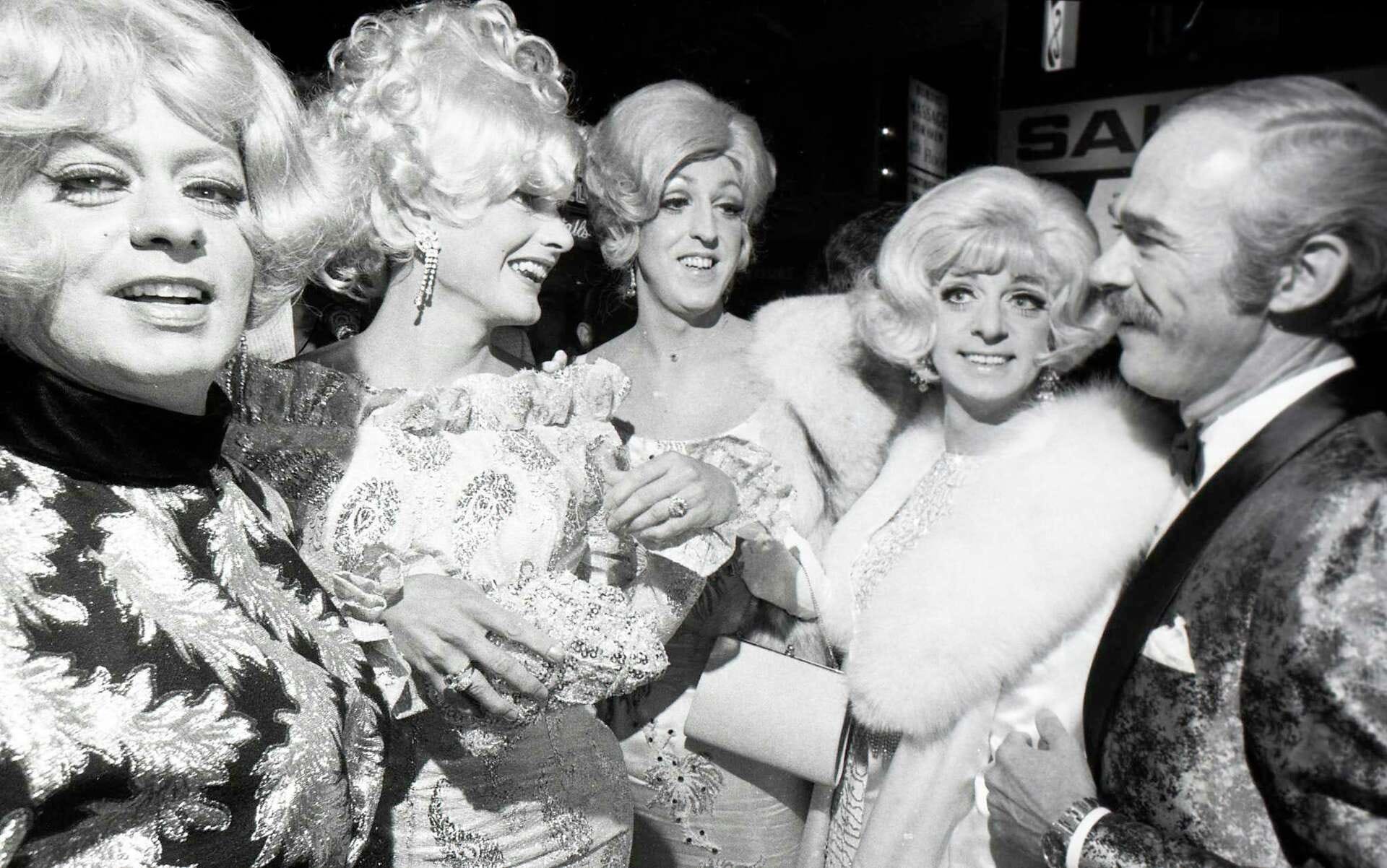
I want you to imagine her, because I was her and could not yet see it. She is standing at the back of the bar, not dancing, nursing a single drink for an hour because the second one costs nine dollars and she has done the arithmetic, the way she does the arithmetic on everything, because the counting is the whole shape of her life. On the small stage a man in a wig is collecting a standing ovation for an act about being her. His lashes are longer than any lashes a living woman grows. His breasts are foam. His voice has climbed into the register that performs womanhood the way a cover band performs a song you love, close enough to recognize and broad enough to laugh at. The crowd is delighted. They are having the best night they have had in a month. She claps too, because if she ever stopped clapping she would become the bitter one, the woman who cannot let other people enjoy themselves, the one who soured Pride for everybody.
i already know what your about to say “but Tara not all drag is like-“ shut up. This is not about RuPaul. It is not about the television franchise, or the fights over story hour, or the men in state legislatures trying to turn a wig into a felony charge. That fight is real and it belongs to a different essay, and the reflex that hears a single word of criticism aimed at drag and immediately files that criticism beside the fascists is itself one of the hinges I am here to examine. I am talking about the bar. I am talking about your bar, the specific one in your specific city, on an ordinary weeknight, where the harm carries names and everyone present knows the names and nobody intends to write any of it down, because we have all quietly agreed that this particular institution is sacred, and it is June, and we are supposed to be celebrating. I am writing it down.
A minstrel show was an act of mockery, and the men who performed it knew exactly what they were doing. That is the part the sentimental histories work hardest to bury, so let me lay it out slowly and completely. The man who blacked his face with burnt cork built a caricature engineered to make an entire people contemptible, and he built it on purpose, with craft, refining the shuffle and the mangled speech until the laughter arrived on cue. The figures he assembled, the lazy slave and the thieving fool, were instruments of ridicule, and everyone in the room understood them as ridicule, the performer who sold it and the audience that paid to laugh. The talk of tribute came afterward, once the laughing was done, when the performers reached for a flattering account of themselves and told anyone who asked that they were honoring something they loved. That account did real work. It let a country degrade the people it was in the business of owning and feel tender about itself while it did so, and it has fooled a remarkable number of historians since, but it never once fooled the people being mocked. The caricature pressed itself into the public mind as the truth of a people, made their subjection feel earned, and routed the proceeds of stolen songs into white hands, and it did every bit of this because that was the work it was designed to perform. It sat in perfect comfort beside the auction block and the rope. The audience laughed at Black people and knew they were laughing at Black people. The love was the alibi. The mockery was the act.
I want to dwell on the history for a moment, because the resemblance is closer than a passing comparison. American blackface, from the 1830s onward, was deliberate ridicule, and it announced itself as ridicule to the people who came to laugh. The performers studied the real thing in order to distort it, took its music and its speech and bent them into a caricature engineered to humiliate, and a great many of them said afterward that they were honoring what they borrowed, which was the lie the form told to keep itself respectable. The mockery was the product. The appreciation was the packaging. And the caricature pressed itself into the public mind as the truth about a people, made their subordination feel like the natural order of things, and shoveled the proceeds of Black cultural forms into white hands. Set that beside the drag show and the elements correspond one to one. He studies womanhood in order to exaggerate it past the point of a person and into a joke. The ridicule is deliberate, tuned into the foam and the climbing voice, every choice calibrated to land the laugh at womanhood’s expense, and the crowd laughs because it has been invited to laugh at precisely that. And the performance is at the same time fixing a caricature in the public mind as the truth about a category of people, making their subordination feel comfortable, and routing the money toward people who are not the ones living the expensive version.
Yes, the performer is sometimes a queer man carrying his own share of the world’s cruelty… It does not change how the thing works.” With minstrelsy now deliberate and the drag crowd still sincere we come at an impasse that against my better judgement I’ll say a therapyspeak line:
the intent doesn’t care for the impact.
What happens when she says it feels wrong
The way an objection gets silenced tells you exactly what is being protected, so I want to walk you carefully through a silencing.
I will tell you about a woman I will call Vera, because that is her name for the purposes of this telling. She is two years into hormones. She is afraid of losing her job in the particular, stomach-level way you are afraid of losing something you had to fight to obtain. She is broke in the grinding manner I will document in a moment with figures. One night she comes home from the Pride drag show and finds she cannot sleep, and at two in the morning she does the thing you are advised never to do, which is write down what she is feeling somewhere other people can read it. She says nothing cruel. She does not even sound certain. She writes that the evening felt strange to her and that she cannot fully explain why, that something simply sat wrong, in exactly the way it had once sat wrong in me, years earlier, when I had said nothing at all. Within an hour the replies arrive, and they follow a shape you have seen before. The first informs her that drag is trans resistance and that she should learn her history. The second informs her that she is repeating the precise rhetoric the right deploys to ban drag and that she ought to consider whose side she has placed herself on. The third is gentle, and the gentleness is what makes it effective, and it comes from another trans woman. It suggests that Vera may have some internalized feeling to work through, and that this is acceptable, that it is a journey, but that she might take care not to lay it on the community. By the end of the night Vera has deleted her post. I know this because I watched it happen, and I recognized the exact temperature of the thing draining out of her, because it was the same thing that had drained out of me in a dark bar over a nine-dollar drink, years before I found the nerve to name it.
She learned that saying the thing costs more than swallowing it. She learned that the people around her would rise to defend the performance faster and more fluently than they had ever once risen to defend her. So she goes silent. She does not change her mind, only her behavior. And her silence is then read as evidence that there was never any problem to begin with, which permits the following month’s drag show to proceed with the same warmth and the same unanimity as before, because the single woman who felt the wrongness has been taught to keep it to herself. This is how a community manufactures an agreement that does not actually exist. It does not persuade anyone. It wears them down one at a time, until the resulting silence resembles consent and the institution appears beloved by all.
There is a pattern at work here that is older than this particular argument, and it runs the same way every time it runs. You begin with a fact about how power and money and labor move through a space. You shrink that fact down until it fits inside one woman’s psychology. You relabel it as her private wound, her damage, her unfinished personal work. Then you call the silence that follows her consent. Betty Friedan caught this same trick in 1963, watching an entire generation of housewives told that their misery was a private failure to achieve proper femininity rather than evidence of anything real about the homes they were confined to. The diagnosis is always prepared before the woman has finished her sentence, and it always locates the trouble inside her. She is told to sit with her discomfort. She is told to examine why she cannot simply celebrate. The one response this whole maneuver exists to prevent is the response that would stop and grant that she is describing something genuinely there.
What the costume actually is
Let me say the plainest version of this.
A costume is something a person puts on and later takes off, and that is the whole of its definition, and it turns out to be the whole of my argument as well, so I want you to stay with how simple it is. On the stage, womanhood is a costume. The breasts are foam, and the performer can lift them out and set them on the counter at the end of the night. The face is paint, and it comes away with a wipe and a towel, the contour and the lashes and the lined mouth all dissolving back into a man’s bare face beneath the dressing-room bulbs. The lashes peel off. The wig lifts from its cap and returns to its stand. The voice drops back down to where it ordinarily lives the moment the set ends and no one is listening for it any longer. Everything that earned the standing ovation can be removed, and the performer does remove it, every last piece, and then he walks back out into the world as a man, and that man does not have to carry a single thread of it through the places where it becomes dangerous. He does not carry it through airport security. He does not carry it to the pharmacy counter, or the emergency-room desk, or his family’s Thanksgiving table, or a traffic stop at midnight on a road with no other cars and no witnesses.
The woman at the back of the bar is wearing the very thing he removed, except that hers is neither foam nor paint, and hers does not come off. Hers is her own face. Hers is her own body. Hers is the thing she will carry through airport security and the pharmacy and the emergency room and Thanksgiving and the traffic stop, every single day, for the remainder of her life, with no dressing room anywhere to return to. He received a costume. She received a life. The crowd gave him a standing ovation for an hour spent wearing what she cannot take off for a second. That is the entire difference between them, and once you have seen it you cannot unsee it. The same arrangement of signs is a delightful trick when he performs it and a genuine danger when she lives it, and the only thing that has changed between the two is whether the person wearing it is permitted to take it off.
When you run womanhood through this arrangement you have not invented anything new. You have taken a very old thing and aimed it at a fresh target. I will grant the complication before anyone offers it to me. Yes, the performer is sometimes a queer man carrying his own share of the world’s cruelty, and sometimes a gender-nonconforming person in his own daily life, and that does change how the thing feels from the inside. It does not change how the thing works. The existence of poor white performers in blackface complicated the class story of minstrelsy without laying a finger on its racial function, and the same holds here. A person standing lower on the ladder can still perform an act at the expense of the people standing one rung beneath him. That is among the oldest moves there is, and naming it is not a defense of it.
I want to dwell on the history for a moment, because the resemblance is closer than a passing comparison. American blackface, from the 1830s onward, did not present itself to its audiences as mockery. It presented itself as appreciation, as a kind of intimacy with something the audience found vital and gorgeous and funny. The performers studied the real thing and borrowed the real songs and dances and speech, and a great many of them sincerely believed they were honoring what they borrowed. The form produced genuine hits and genuine warmth in the people who watched it. And all of that warmth pressed a caricature into the public mind as the truth about a people, made their subordination feel natural and affectionate, and shoveled the proceeds of Black cultural forms into white hands. Set that beside the drag show and the elements correspond one to one. He studies womanhood and borrows its real signs. The crowd feels warmth, even reverence, toward the figure on the stage, and sincerely experiences that warmth as a celebration. And the performance is at the same time fixing a caricature in the public mind as the truth about a category of people, making their subordination feel comfortable, and routing the money toward people who are not the ones living the expensive version. The trans woman occupies the performed-upon position here, and I want to be exact about why, because her suffering does not equal slavery and I will not permit that to be the takeaway. She occupies the position the minstrel form requires someone to fill. She is the one who is performed rather than present, the one whose actual life supplies the raw material the costume is cut from, the one who watches a cartoon of her existence collect the affection and the money that her existence itself cannot earn. The claim I am making is about that position and that arrangement, never about an equivalence of suffering.
Fanon described this before drag existed
my nigga Fanon says what’s good and hands me the sharpest instrument for understanding this and I say thanks big F I’ll want to handle it with care, because the analogy between racial and gendered subjection can be abused and I have no intention of abusing it. I am not claiming that being trans is the same as being Black. I am claiming that Fanon described a process, the process by which a dominant people builds a self out of a subordinated person and then hands that self back to them, and that this process recurs wherever one group holds the power to decide what another group is.
In *Black Skin, White Masks* he writes that “the black soul is a white man’s artefact,” and I want you to sit with how brutal that sentence is, because he means it literally and not as a flourish. The colonized man does not get to author the version of himself that moves through the world. His rulers compose it for him, out of the traits that happen to serve them, the laziness and the danger and the appetite and the childishness, the entire convenient catalogue of things it is useful to believe about a person you are in the business of robbing. Then they hand that composition back to him as the truth of his own nature, and they expect him to wear it. He is, in Fanon’s phrase, “overdetermined from without.” He walks into a space and a version of him is already waiting there, fully assembled, a version he did not write and cannot climb out of, built by people who will never once have to live inside it. Fanon describes the sensation of this as being fixed, pinned in place, and he reaches for a chemical image to convey it. The glance of the other settles onto him, he writes, the way a dye fixes a solution, flooding the whole of it and staining it through and setting it so that it cannot move. He enters as a man with an interior life and emerges as an object among other objects, sealed, in his own words, into a crushing thingness. His impossible task from that point forward is to go on existing as a person beneath an image of himself that his oppressor manufactured and that the world insists on seeing in his place.
The drag version of woman is a man’s artefact in exactly that sense, and the dye performs exactly the same work. It is womanhood imagined from the outside, by people who will never have to live there, assembled out of the parts that read as funny or sexual or pathetic from across a crowded bar, and then handed back to that crowd as a kind of truth about what a woman is. I want you to consider which parts get chosen, because the selection reveals the whole thing. The exhaustion does not get chosen. The fear on the walk home does not get chosen. The endless private accounting of whether she can afford the second drink does not get chosen. What gets chosen is the breasts and the lashes and the helplessness and the hunger, the surfaces that photograph well, the features a man can assemble in an hour and a crowd can read in a second. And here is where it ought to wound, because for the trans woman standing in that crowd this is not some marginal product she can scroll past on her own time. It is one of the most visible and most celebrated and most heavily funded images of transfeminine womanhood that exists anywhere in the culture, and it is being produced and applauded inside her own community, by her own people, beneath a banner that announces it is for her. When the straight world wants to picture a man who became a woman, drag is the image it reaches for, because drag is the version that comes with a television show and a Pride slot and a brunch, the version that arrives pre-assembled and easy to hold. She has been overdetermined from without by a dye that her own family mixed. She walks into the queer bar and a version of her gender is already waiting there, performed by a man, for laughs, fixed in place and staining everything around it, and she is asked to look at it and find herself inside it and offer her thanks.
Fanon wrote, too, about mimicry, about the colonized man invited to become almost the colonizer, almost the same but never quite, and about how the invitation is a trap, because the nearer he draws the more violently the remaining distance is enforced against him. You are a doctor, he is told, you are a writer, you are different, you are one of us. And the instant he believes it, the difference is produced all over again to remind him that he is not. The trans woman lives the cruel inversion of this. She is not performing womanhood as mimicry. She simply is a woman, on the terms she was able to secure, which are violent and partial and which cost her everything she had. And she watches a man perform womanhood as mimicry, as a knowing costume, as the thing one puts on and peels off, and she watches the crowd reward his version above her real one. His artifice is legible and safe and funny. Her reality is the thing that makes people uncomfortable, because her reality cannot be switched off when the set ends, and a womanhood that cannot be switched off is a womanhood that makes a claim on the world, and claims are exhausting, and the crowd would rather have the version that knows it is a joke. Her reality is the problem. His artifice is the celebration. Everyone present has already decided which of the two they are able to love, and it is not her.
Fanon offers one more figure who belongs in this account, the évolué, the “evolved” colonial subject who has done everything that was asked of him, who learned the language and adopted the manners and swallowed the standards whole, and who discovers that the reward for flawless assimilation is a more refined form of rejection. The trans woman who tries to purchase the affection of her scene by becoming its ideal queer subject, by being fun and being light and learning the vocabulary and laughing on cue and never once dragging the weight of her actual life into the gathering, is offered that same bargain. Assimilate flawlessly, she is told, and we will keep you. And she discovers, as he discovered, that the bargain is a trap, that the acceptance is conditional and can be revoked, and that the moment she stops performing and begins needing, she is reminded that her belonging was always extended on loan. The drag show is the purest version of this test that exists. The women who can perform pass it and are folded into the celebration. The women who cannot are reminded, gently and warmly, that there is no chair for them unless they are willing to entertain. Fanon would have recognized it at once. The invitation is extended precisely so that it can be withdrawn, and the withdrawal is the entire lesson.
Dworkin and the woman made into a surface
If Fanon gives me the manufactured self, Andrea Dworkin gives me the manufactured woman, and the two of them together complete the account of what the performance actually does. Glad to see it’s not just me that has a thing for snow (I’m so fucking sorry)
Dworkin spent an entire career describing how, under male power, womanhood is built as display, as object, as a surface arranged for someone else’s eye and someone else’s use, and then how that built thing gets mistaken for the nature of woman herself. She was writing about pornography and about the sexual arrangements of male dominance, and yet the process she identified is general, and it is the same process the drag show reproduces and amplifies. Her argument was that woman, as the dominant culture dreams her, is not a person who happens to be looked at. She is a thing whose entire existence has been organized around being looked at. The breasts, the mouth, the helplessness, the availability, the vanity, the hunger that flatters whoever feeds it, none of these are descriptions of actual women. They are descriptions of an object that male power calls woman and then demands that women become. Dworkin aimed her whole ferocity at that substitution, at the object installed in the place where a person ought to be, and at the way women are then required to recognize themselves in the object and perform it, on pain of being judged failed and ugly and unwomanly.
Consider the stage in that light. The drag performance of femaleness is the Dworkin object given flesh and played for laughs. It is womanhood as pure display, exaggerated until the display is the entire content, the breasts that exist only to be looked at, the face that is a surface with nothing required behind it, the helplessness and vanity and hunger turned up until they constitute the whole act. He is not embodying a woman. He is embodying the object that male power calls woman, the assembled surface, the thing arranged for the eye, and he is doing it with a wink that announces the surface is all there is and all there was ever meant to be. The crowd laughs because the exaggeration exhibits the object as an object, which would qualify as subversive if the object being exhibited were not also the daily prison that a real category of people is forced into and killed for occupying.
Here is the cut Dworkin makes, the one the celebration cannot survive. When the manufactured object is performed by a man who removes it at the end of the night, the performance confirms the substitution rather than breaking it. It announces that this surface, this assembly of signs arranged for the eye, is what woman is, and it demonstrates how well the surface sits on someone who is not a woman, and it demonstrates how cleanly the surface comes off. The trans woman in the crowd is watching the very object that male power jammed into the place where her personhood should have been, and she is watching it performed and applauded and then peeled away, and the applause is telling her that her womanhood is that object, that removable surface, that assembly of signs a man can wear more convincingly than she can. Her actual personhood, the self beneath the surface, the self that does not reduce to display, is the one thing the performance cannot accommodate, because the performance rests on the premise that there is nothing beneath the surface, that woman is the display and the display is woman. Dworkin fought her entire life against the reduction of woman to her surface. The drag show stages that reduction as a celebration and dares the trans woman to object to it.
Dworkin understood the deepest part of it as well, the part about possession. She described how the object is not only displayed but owned, and how the whole arrangement annihilates a woman’s claim to a singular self, leaving her with nothing on which to found a dignity that is hers rather than granted to her. “Nothing must be left to the woman,” she wrote of possession, “on which she could base any claim to personal dignity.” The drag economy performs a version of this upon a trans woman’s relationship to her own gender. It takes the most intimate fact of her self, the womanhood she paid for in blood and money and risk, and it turns that fact into public property, into something everyone present owns and performs and enjoys, a costume in general circulation, so that her private and costly and real relationship to being a woman is overwritten by a collective ownership of womanhood as an act. She cannot even keep her gender as her own. It belongs to the stage now. It belongs to the crowd applauding the man who is wearing it. Her singular claim, the claim that this is mine and it is real and it cost me everything, is the precise thing the performance dissolves, because the performance has converted her gender into everyone’s costume and no one’s life.
Note: because I know a dork will try and tell me Dworkin wasn’t a trans ally (that’s never been the argument) I’m well aware she had problematic opinions (but not terf ones!) but someone being problematic is not evidence for discarding their analysis.
The figures, because she is not a literary device
I have been describing a woman at the back of a bar as though she were an image I invented, and she is not. She occupies a position in the economy, and the position has hard figures attached to it, and the figures are the reason this is cruel rather than merely tasteless.
When she walks out of that bar she walks back into an economy that has sorted her toward its thinnest and most precarious edge with a consistency that stops resembling accident the moment you examine it. The 2022 U.S. Transgender Survey, the largest survey of trans people ever conducted, gathered responses from 92,329 of us, and it found an unemployment rate of eighteen percent, very nearly five times the national rate at the time. It found that more than a third of respondents, thirty-four percent, were living in poverty. It found that thirty percent had been homeless at some point in their lives. And none of these numbers improved once the law extended its protection. Unemployment climbed from fifteen percent in the 2015 survey to eighteen percent in 2022, and poverty climbed from twenty-nine percent to thirty-four, even after the Supreme Court’s 2020 decision in Bostock made it illegal to fire someone for being trans. The law changed and the sorting did not, and I would ask you to read that twice.
The wage data grows worse when you separate trans women from the larger population and examine us on our own. The Human Rights Campaign’s analysis places trans women at roughly sixty cents for every dollar the typical worker earns, which is the largest wage gap of any group within the LGBTQ population, and I want you to think hard about what sixty cents actually means as a way of living, because it is not an abstraction. It is forty cents absent from every dollar that the people around her take for granted. It is the arithmetic that converts a movie into a luxury, a dentist into a someday, an unexpected car repair into a catastrophe that takes months to climb out from under. The Williams Institute at UCLA, working from CDC survey data gathered between 2014 and 2017, found a trans poverty rate of 29.4 percent against 15.7 percent for cisgender straight people, very nearly double, and the breakdown by race lands like a blow. It found 38.5 percent of Black trans adults and 48.4 percent of Latina trans adults living below the poverty line, which means that for a Black or Latina trans woman the odds are no longer a long shot but closer to even that she is poor, in the wealthiest country that has ever existed. And one study in the clinical literature found that trans women who transition after they have already entered the workforce watch their income fall by roughly a third, and what that figure describes is the act of becoming visibly herself functioning as an economic event in its own right, a line drawn straight through her earnings on the day she finally tells the truth about who she is. It is a subtraction, taken directly out of her capacity to eat.
She sits at the far edge of what Marx called the reserve army of labor. Capitalism maintains a population whose insecurity disciplines the wages of everyone else, a population that can be drawn into work when it is convenient and pushed back out when it is not, and whose precarity is a function the system requires rather than an accident the system regrets. Her access to steady work is thin and her employment ends easily, and the survey found that more than one in ten trans people who have ever held a job were fired or pushed out specifically on account of being trans. I want to walk this through a single life so that you see the workings and not only the aggregate. She transitions at twenty-six. She had a job, and within a year she does not, because the company restructured in a manner that happened to eliminate exactly one position, or because the customer complaints her manager kept mentioning without ever quite explaining became a documented performance issue, or because the thing the survey measured simply happened to her, quietly, with a severance package and a handshake arranged so that no one would have to say the word aloud. Now she is searching for housing while unemployed, which means she fails the credit check and the income verification, the very procedures that take the instability the labor market produced and reproduce it as instability in housing, and this is how nearly a third of us end up homeless at some point, which is the same catastrophe as the lost job rather than a separate one, arrived at one step further down the stairs. She loses the apartment, or she never secures the next one. Without a stable address she cannot easily hold the next job, because every application assumes an address, and she cannot easily keep her healthcare, because in this country her hormones are tied to her insurance and her insurance was tied to the job she has already lost, so that the continuity of her own body now depends on a clinic’s charity program and a pharmacy’s patience. Each of these institutions, questioned on its own, will swear that it merely followed a neutral rule. The employer followed its metrics. The landlord followed its credit standards. The insurer followed the terms of the plan. Not one of them hated her. Each applied a neutral rule, and the neutral rules stacked one atop another into a woman with no job and no stable home and no reliable access to the medication that keeps her body hers, and a swiftly narrowing list of ways to make her rent. By the time anyone in the discourse pronounces the word choice about how she earns her money, four institutions have spent two years closing every door that was not that one.
When the formal economy shuts against her, the survival economy opens. One in five of the survey’s respondents reported having worked in the underground economy, the sex and drug trades in particular, at some point in their lives. Across the international research, lifetime participation in sex work among trans women ranges from twenty-four percent to seventy-five percent, and trans women are roughly twice as likely as transmasculine people to enter it. This is an economic fact about a labor market that expelled them and a survival strategy that remained available after the others had been foreclosed, and it is not a moral fact about trans women. It carries its own body count. The Trans Murder Monitoring project found that sixty-two percent of the trans people murdered worldwide between 2008 and 2017 were sex workers.
That is what she carries out of the bar while a man in foam breasts performs her gender for tips. None of this is happening to an abstraction. It is happening above the head of a person whose womanhood is, in the plainest statistical terms, a predictor of poverty and homelessness and a violent early death. His costume is amusing because it comes off. Her identical womanhood is dangerous because it does not.
## The killing is local, and it knows her by name
I promised this essay would concern the local scene and not RuPaul, and I mean to honor that, because the temptation when writing about anti-trans violence is to point immediately at the state and the right and the legislature, all of which are real engines of harm and all of which conveniently let the gathering off the hook. The gathering is an engine of harm as well. The violence I am describing is not only the violence of the police officer and the lawmaker. It is also the violence of a scene that loves the costume and cannot house the woman.
Consider the data on fatal violence, which is local in the most literal sense imaginable, since these are people killed in cities, frequently by people who knew them. The Human Rights Campaign has recorded at least 372 trans and gender-expansive people murdered since 2013, through 2024, and trans women account for more than four in five of them, 82.8 percent. Black trans women make up 73.7 percent of all the victims, 274 lives, and three-quarters of the victims were under the age of thirty-five, and a firearm was involved in nearly seventy percent of the killings. A great many of them were killed by a friend, a family member, or an intimate partner. A separate academic analysis found that Black trans women are murdered, on average, five years younger than non-Black trans women, and it cited an estimate that the life expectancy of trans women across the Americas falls somewhere between thirty and thirty-five years.
I would ask you to sit inside the closeness of that data. They were killed by a friend, a family member, a partner. The danger to a trans woman does not arrive primarily from the stranger and the statehouse. It arrives, with terrible frequency, from the intimate and the local, from the person who is already nearby. That fact should make anyone suspicious of an account of community that treats the local scene as a sanctuary by definition. The scene is where she finds her people, and it is also, in statistical terms, the kind of place from which her gravest danger tends to come, because the people who harm trans women are so often the people who know them. A community that organizes its entire self-image around the conviction that the threat is always external has flatly refused to read its own death certificates, on which the call so often originates inside the house. The drag show’s certainty of its own innocence is part of that refusal. It is genuinely difficult to ask which people in this gathering are dangerous to her while the gathering is enjoying the finest night of its month, applauding a performance of her gender, confident that its warmth is proof of its goodness. The warmth is real. The danger is real. The two coexist without contradiction, and the insistence that they cannot is one of the ways the danger is kept from examination.
The path into all of this begins, for a great many trans women, at home. Family rejection is usually the first eviction, the one that sets every later eviction in motion. The surveys keep finding high rates of family rejection, and rejection carries direct economic consequences, because a young person who is thrown out loses the single most important buffer against poverty in early adulthood, which is the family that houses you while you find your footing, that absorbs the shock of a lost job or a failed semester, that floats the small loans and offers the spare room and supplies the address you write on an application. The young trans woman loses all of it at once, at the precise age when her cisgender peers are leaning on it most heavily, and she enters adulthood already behind, without reserves, a single bad month away from the street. This is how an eighteen-year-old ends up working a tipped service job and living paycheck to paycheck in an apartment held together with a housing voucher and Medicaid and food stamps, and that is a representative case rather than an exotic one. The eviction from home feeds the precarity in housing, which feeds the precarity in employment, which feeds the survival economy, which feeds the exposure to being killed. Every link in that chain is documented. The chain is the position itself.
And the violence at the end of the chain falls hardest and youngest on the women the scene most loves to celebrate in the abstract and can least be troubled to protect in the particular. Black trans women, who are nearly three-quarters of the recorded murders, who are killed five years younger, whose poverty rate approaches thirty-nine percent, are at the very same time the most celebrated figures in the movement’s iconography and the least materially protected by its institutions. The scene will put a dead Black trans woman on a poster and into a chant. It proves considerably less reliable about housing the living one who is broke and standing in front of it. The distance between loving the image and protecting the person is the same distance the drag show stages in miniature, enlarged to the scale of a movement that has grown very skilled at mourning trans women and remained very poor at keeping them alive. That distance is why the question of drag reaches well beyond the bar.
Who collects the money
There is a question of money beneath the question of culture, and the account is incomplete until it is asked, because minstrelsy was never solely a matter of who got represented. It was an industry. For a stretch of the nineteenth century it was the most popular entertainment in the country, and the money flowed to white performers and white theater owners and white songwriters and white promoters, manufactured out of a caricature of people who saw none of it, whose own culture was stolen and degraded by the very form that claimed to honor it. The question of who collected the money is part of what makes it minstrelsy and not tribute, because tribute, as a rule, does not route the proceeds away from the honored and toward the impersonators.
Examine the drag economy with that question held in front of you. Drag is a substantial commercial form now. There is a flagship television franchise that has run well over a decade across several countries, with its spinoffs and its tours and its branded merchandise and its convention circuit. There are corporate Pride sponsorships and brand activations and ticketed brunches and a touring operation that flies performers between cities for paid bookings. Some performers at the top of all this have grown genuinely wealthy, with the business profiles and the merchandise lines and the streaming deals to demonstrate it. It is a real economy, and so the question is worth pressing. Who is positioned to draw value out of it, and who is positioned to serve as the raw material it draws from.
The performer who can do the act, who can build a following and tour and sell the merchandise, is positioned to be paid. The trans woman at the back of the bar, whose gender is the material the act is cut from, is positioned to buy a ticket. Set that beside the wage data and the asymmetry becomes obscene. She earns, by the Human Rights Campaign’s figure, around sixty cents on the dollar. She sits at a poverty rate the Williams Institute placed near thirty percent overall and considerably higher if she is Black or Latina. She has very likely watched her income drop by a third if she transitioned after entering the workforce. She is the demographic carrying the largest wage gap in the entire queer population. And the cultural form that circulates the most visible image of transfeminine womanhood, the form her own community calls her heritage, is a form she is positioned to earn nothing from and others are positioned to profit by. The image of her gender generates money. She does not see any of it. The performer takes off the costume and counts the night’s tips. She cannot take off the skin, and she counts whether she can afford a second drink.
I am not claiming that every drag performer is wealthy, because most are not. Local drag is its own precarious grind, and a great many performers are scraping together a living from small bookings in much the way the woman watching is scraping together hers. But precarity among performers does not dissolve the point any more than the existence of poor white minstrels dissolved the racial economy of minstrelsy. The question was never whether every individual performer is rich. The question is which position the form draws its value from and which position it draws that value out of, and the answer is that the form runs on the gender of a woman who is, in statistical terms, among the poorest people in the country, and who is not the one being paid to perform it. The currency, once again, is the distance. It is the distance between the man who takes it off and banks the proceeds and the woman who wears it as the thing that keeps her poor.
How the exclusion is actually lived
The violence I am describing almost never announces itself as violence, which is exactly what allows it to work and what allows it to be denied, so I want to describe how it is lived rather than how it appears in a table of homicides, because the great majority of what the scene does to trans women happens well below the threshold of the fatal and is no less a sorting for that.
It is lived like this. She is welcome at the gathering for as long as she is fun. She is welcome for as long as she performs lightness, for as long as she keeps the weather of her real life out of the gathering, for as long as she can be relied upon to entertain and to ask for nothing and to remain easy to look at. The moment she is struggling, the moment the brokenness or the medical crisis or the fear becomes visible and begins to ask the people around her for something, she becomes a great deal to handle, and the softness withdraws, and the invitations thin, and she discovers that the community that claimed her as family while she was decorative has built remarkably little to hold her when she is in need. It is the same conditional affection I have traced through the romantic and sexual economies of our spaces elsewhere. She is loved on the condition that she keep everyone comfortable rather than make demands, and the condition is never stated aloud, because stating it would break it.
Drag sits within this as its crowning aesthetic occasion. The drag show is the scene at its most celebratory and most unanimous and most certain of its own goodness, and it is also the occasion that most nakedly enacts the preference for the performance of transfeminine womanhood over the lived fact of it. The woman who can rise and perform is folded into the celebration. The woman who cannot, who is merely living her gender at cost with no act to offer, stands at the back. And if she names what she feels back there, the silencing I described at the start of this essay engages, and she is a TERF or a right-winger or a woman with internalized work to do, and she goes quiet, and the evening proceeds. The exclusion is not a bouncer at the door. It is subtler and more complete than that. It is an atmosphere with abundant welcome for her gender as spectacle and no welcome for her gender as a serious and expensive way of being alive. No one throws her out. She is simply taught, slowly, that there is no chair for her unless she is willing to perform, and that her seriousness, her reality, the one thing she cannot switch off, is the very thing that renders her unwelcome.
This is why the closeness in the homicide data ought to haunt the entire conversation. They were killed by a friend, a family member, a partner. The scene is not only the place where she is excluded. It is also, in statistical terms, the kind of place from which her gravest danger arrives, because the people who harm trans women are so frequently the people who know them. A community that builds its whole self-image around an external threat has refused to read its own death certificates, on which the call so often comes from inside the house. The drag show’s confidence in its own innocence is part of that refusal. It is genuinely hard to ask which people in this gathering are dangerous to her while everyone is enjoying the best night of the month, applauding a performance of her gender, certain that the warmth proves the goodness. The warmth is real, and so is the danger, and they coexist, and the insistence that they cannot is one of the ways the danger is kept from view.
The same currency in another denomination
I have written before about the way sexual availability becomes a kind of currency in trans women’s spaces, about how a woman’s openness to sex purchases her patience and tolerance and the right to be read generously, about how her body becomes a stabilizing presence that keeps the social weather calm, and about how the woman who ceases to be sexually available finds the very traits that had been charming abruptly recoded as a great deal to handle. Drag operates as the same currency in a different denomination, and the parallel is exact enough to be worth drawing out in full.
The trans woman who can perform, who can rise and treat her own womanhood as a knowing exaggeration, who can wink at her gender and signal that she has no intention of making anyone uncomfortable by asking that it be taken seriously, purchases the very things the sexually available woman purchases. She purchases legibility. She purchases the affection of the people around her. She purchases the particular safety of having demonstrated that her gender is available for the gathering’s entertainment and will not be turned into a demand. She has made herself a stabilizing presence in the aesthetic register in the same way the available woman made herself one in the erotic register. The performance reassures everyone present. It says that she is fun, that she is not heavy, that she understands the whole thing to be an act, that no one is required to take her seriously and therefore no one is required to fear her.
And the women who cannot or will not, the women who are simply women, plainly, with no wink and no costume, who require their gender to be real because it is the only gender they have and they are living inside it at brutal cost, are the women who become a great deal to handle. They are heavy. They are difficult. They are too earnest. They cannot take a joke. I want you to notice that the two demands are identical in their workings even though they appear different on the surface. The one asks her to make her body available for the desire of the people around her. The other asks her to make her gender available for their amusement. Both are asking her to convert the most intimate fact of her existence into something the people around her can consume, and both punish her refusal in the same manner, by withdrawing the softness and recoding her as the problem. The lesson beneath each is a single sentence. Your acceptability here is conditional upon your willingness to make your existence easy for everyone else, and the moment you ask the people around you to carry the weight of who you actually are, you forfeit it. The currency differs. The exchange is the same. Perform, or be found difficult. Entertain, or be exiled.
The history that complicates my own argument
I would be guilty of the very flattening I have spent this essay criticizing if I pretended that the relationship between drag and trans women were simply a story of exploitation, so I want to hold the part that complicates my own argument, because it is real and it carries weight.
Drag and trans life share a genuine history, and at certain moments that history was one of solidarity, even of mutual survival. The drag balls of the mid-century, and the houses that took in trans and queer children whom their families had thrown out, were in material terms a form of survival infrastructure for some of the most vulnerable people in the country, and a great many of the people inside them were trans women rather than men in costume. Marsha P. Johnson and Sylvia Rivera, claimed endlessly and mostly dishonestly by a movement that did not house them while they were alive, moved through worlds in which the line between drag and transness was not the firm border people prefer to draw in hindsight. For a long stretch of queer history the terms drag queen and transsexual woman were not cleanly separable categories. They were positions along a contested continuum, and the people living along it built forms of kinship that kept one another alive when nothing else would. To flatten that into a simple story of exploitation would erase the actual people who lived it.
And yet being honest about that history is what sharpens the criticism rather than what dissolves it, and here is the line I promised you at the very beginning. Ballroom was, and remains, the subordinated building infrastructure for the subordinated, Black and Latina trans women and queens making family and safety and art out of a world that offered them nothing. That is not my target and it never will be, which is the reason it deserves its own essay rather than this one. My target is what the form became somewhere along the road to the brunch, when it grew institutionalized and corporate-sponsored and Pride-slotted and standardized for television, and was sold back to a general audience as the dominant public image of transfeminine womanhood. The relationship inverted in that transition. It went from kinship to representation, from a thing trans women did for one another to a thing performed about a category they occupy, performed increasingly by people who do not occupy it, for audiences who experience it as entertainment rather than as survival. The history of solidarity is real. Invoking that history in order to shield the present arrangement is the dishonest move. You do not get to point at Marsha in order to defend the man peeling the breasts off in the dressing room while the actual trans woman waits on a bus that is carrying her through a city in which her life expectancy is thirty-five.
This is not a TERF argument, and here is the difference
I want to put this in language plain enough that it cannot be misread in good faith, though it will be misread in bad faith regardless, because the entire function of the reflex that cries TERF is to convert any criticism of the form into an alliance with the people who want us dead.
Let me be exact about what separates this from a TERF argument, because the difference is not one of tone. It is one of premise. A TERF argument holds that trans womanhood is not real, that it is a costume a man puts on, a performance, an imitation of the genuine article, and everything else in that argument follows from this foundation. My argument holds the opposite, and depends on the opposite. I am saying that trans womanhood is real, that it is lived, that it is paid for in blood and money and risk, and that this reality is the very reason it is obscene to watch it staged as a removable costume by a person who is free to take it off. The TERF looks at the trans woman and the drag performer and declares them the same thing, two men in dresses. I look at the same two figures and find them opposites. One is wearing her life and the other is wearing an outfit, and the whole cruelty lies in the fact that the gathering rewards the outfit and exiles the life. You cannot arrive at my conclusion from the TERF premise. The two are pointed in contrary directions. The TERF wants trans women to vanish. I want the bus she is waiting for to arrive, and the apartment to be affordable when she reaches it, and the people around her to love her as fully as they love the man performing an impression of her.
Nothing in this essay argues for the state. Nothing in it calls for a law, a ban, a restriction, or a single act of government force against a single performer. The whole of it argues against a scene, against a structure of feeling, against the exemption that one beloved institution has been granted from the question every institution ought to answer, which is whom it serves and who pays for it. If the right seizes a sentence of this for a ban, they will have to lie in order to do it, because I have argued for the one thing they refuse to grant, which is that trans women are real and that their reality is the entire point.
The people who criminalize drag and the people who cannot abide a real trans woman are, in the end, making the same error from opposite directions. Both of them prefer the man in the costume to the woman in the body. The legislator prefers the man in the costume because he can be held up as a threat, a groomer, a degenerate, a useful enemy. The brunch prefers the man in the costume because he is fun and legible and safe and makes no claim on anyone. Neither of them wants the actual trans woman, because she is neither a useful enemy nor a fun performance. She is a person with rent due and an endocrinologist appointment that was rescheduled and a real fear of the walk to her car, and a person like that is an inconvenience to everyone, to the people who hate her and to the people who believe they are celebrating her alike.
What I am actually asking
Here, then, is the request, offered during Pride, in the season of celebration, with full knowledge of how it will land.
Stop pretending the scene is innocent. That is the whole of it. I am not asking you to surrender a pleasure. I am asking you to be honest about how the pleasure is structured, to hold in your mind at one time both the wonderful evening you are having and the woman at the back for whom the evening is not wonderful, and to understand that her discomfort is reading the gathering correctly, that she is seeing clearly a place that loves the performance of her gender more than it has ever loved her. I am asking the scene to notice that it has built an institution it cannot criticize, and to ask itself why, and to remain in the discomfort of the possibility that the inability to criticize a thing is usually a sign that the thing is doing something the criticism would expose.
A scene that loves drag and cannot house trans women has told you exactly what it loves. It loves the costume and not the body. It loves womanhood when a man is wearing it for laughs and finds it exhausting when a woman is living it for keeps. It will give a standing ovation to a cartoon of her life and will not, once the show has ended and the lights have come up and she still cannot afford the second drink, give her a place to sit. The applause was never for her. It was for the man who proved, to a gathering that wanted the proof, that her gender looks best on someone who can take it off.
I want to be concrete about what taking this seriously would require, rather than leaving it as a feeling. It would begin with abandoning the reflex that converts every internal criticism into an external betrayal, the reflex that hears the sentence this institution harms trans women and answers you sound like the right, because that reflex is how the harm is protected, and a community that cannot hear a criticism of its own institutions has decided that its institutions matter more than its most exposed members. It would mean asking the question of money, of who is paid and who is performed, and being willing to remain inside an ugly answer. It would mean noticing, at the drag show, the woman at the back, and understanding that her discomfort is information rather than pathology, that she is reading the situation accurately, that the thing she cannot name is the distance between loving her image and protecting her person. It would mean directing a fraction of the energy the scene pours into mourning the dead trans woman and celebrating the performed one toward housing the living, broke one instead. And it would mean treating her reality, the womanhood she cannot switch off, as the very thing that makes her real, and therefore as the thing that makes her claim on the community’s care impossible to refuse.
I do not expect the scene to do any of this, which is part of why I am setting it down in writing. Everyone is having too good a time, and the good time depends for its existence on not seeing her, and the method for converting her objection into evidence of her own brokenness is fast and fluent and well practiced. But I have learned that the value of naming a thing does not lie in any expectation that the people who benefit from it will stop. It lies in the fact that the people being ground down by it will finally have a word for what is happening to them, will know that they are not imagining it, will recognize the distance between loving the image and protecting the person as a real thing with a real shape and not a private failure of their own capacity to celebrate. That is who this is for. It is not for the scene. It is for her, the woman at the back, holding the nine-dollar drink, doing her arithmetic, watching a man receive a standing ovation for visiting the place she is required to live.
She cannot take it off. She is wearing it on the bus, in the waiting room, at the pharmacy counter, on the walk to her car, in the statistics, on the death certificates, across the thirty-five years. The costume that earned him the ovation is the skin that the economy and the violence and the scene have all agreed to render dangerous for her, and she is given no dressing room, and she is not permitted to wipe it away, and at the end of the night she goes home as the very thing he was applauded for visiting.
He can take the face off and go home. She cannot. That is the whole of the essay, and it is the one thing the scene has organized itself so that it never has to see.
A note on drag kings
Someone will ask, and the question is fair, whether all of this applies to drag kings, to women and transmasculine people who perform an exaggerated masculinity, and the honest answer is that it does not work the same way, because the direction of power is reversed. Minstrelsy functions because the performer stands above the performed. The white man performing Blackness, and the cis man performing womanhood, is reaching downward and putting on the signs of a group that holds less power than he does, and the safety of the act resides in that descent. A drag king is reaching upward. A woman or a transmasculine person who performs masculinity is putting on the signs of the group that holds power over her, which is a different act with a different history and a different meaning, closer to mockery directed upward than to caricature directed down. Punching upward and punching downward are not symmetrical, and any account that treated them as the same would be a poor account.
That said, I will not pretend that the king is automatically innocent, because the variable that actually decides the matter is not the gender of the performer. It is whether the person being performed is present as a person or as raw material, and whether they are able to take the costume off. A transmasculine person who performs a knowing exaggeration of manhood is doing one thing. A performance that turns trans men into a punchline for a cisgender audience, that treats transmasculinity as a costume detachable at the end of the night while actual trans men carry it through the same dangerous places trans women carry theirs, would be doing something much closer to what I have described in this essay. It is simply rarer, because the cultural and economic weight surrounding drag kings is a fraction of the weight surrounding queens, and it has not been standardized and sold in the same way. The test remains the one I have applied throughout. Who is performed, who performs them, who is permitted to take it off, and who pays for it. Apply that test to anything, including this essay, including me.
Sources and further reading
**Economic data**
- James, S. E., Herman, J. L., Durso, L. E., and Heng-Lehtinen, R. (2024). *Early Insights: A Report of the 2022 U.S. Transgender Survey.* National Center for Transgender Equality, now Advocates for Trans Equality. Unemployment eighteen percent, poverty thirty-four percent, lifetime homelessness thirty percent, eleven percent fired or forced out for gender identity, with 92,329 respondents. The figures rose from the 2015 survey despite the 2020 Supreme Court decision in *Bostock v. Clayton County.*
- Human Rights Campaign Foundation. *The Wage Gap Among LGBTQ+ Workers in the United States.* Trans women earn approximately sixty cents for every dollar earned by the typical U.S. worker, the largest gap of any group surveyed.
- Badgett, M. V. L., and colleagues, The Williams Institute, UCLA School of Law. Analyses of CDC Behavioral Risk Factor Surveillance System data, 2014 to 2017. Overall trans poverty 29.4 percent against 15.7 percent for cisgender straight adults, with 38.5 percent of Black and 48.4 percent of Latina trans adults in poverty.
**Violence data**
- Human Rights Campaign Foundation. *An Epidemic of Violence,* 2024 report. At least 372 trans and gender-expansive people killed since 2013, with trans women 82.8 percent of victims and trans women of color 73.7 percent, a total of 274 lives, the majority under thirty-five, a firearm involved in roughly seventy percent of cases, and a high proportion killed by a friend, a family member, or an intimate partner. A 2025 report updates these totals.
- Halliwell, P., and colleagues (2024). “Fatal Violence Against Black Transgender Women in the United States.” Black trans women murdered on average five years younger than non-Black trans women, with trans women’s life expectancy in the Americas estimated at thirty to thirty-five years, citing the Inter-American Commission on Human Rights, 2014.
- Trans Murder Monitoring, Transgender Europe. Sixty-two percent of the trans people killed worldwide between January 2008 and September 2017 whose occupation was known were sex workers.
**Survival economy**
- The 2022 U.S. Transgender Survey, as above. One in five respondents reported lifetime work in the underground economy, including the sex and drug trades.
- International review data on sex-work participation. Lifetime participation among trans women ranges from twenty-four percent to seventy-five percent across studies, with trans women roughly twice as likely as transmasculine people to participate.
**Theory**
- Frantz Fanon, *Black Skin, White Masks* (1952; English translation 1967). The manufactured self, the condition of being overdetermined from without, and the trap of mimicry for the colonial subject.
- Andrea Dworkin, *Our Blood* (1976) and *Intercourse* (1987). Womanhood constructed as display and as object, and possession as the annihilation of a woman’s singular claim to dignity.
- Betty Friedan, *The Feminine Mystique* (1963). Structural misery relabeled as an individual failure of femininity.
Donate to my Ko-fi: <https://ko-fi.com/bundleofstyyx>
Incredibly well written and researched. As a cis woman, certain timbres of drag have left me feeling othered or the butt of the joke despite it pulling from aspects of my identity.
So much of what you describe feels quite divorced from the local drag scenes I've experienced. Those scenes have been dominated by women (trans and cis) and what I would call "gender play" more than gender mockery or "woman face." I absolutely agree that misogynistic and transmisogynistic drag (mainly performed by cis men) exists, and is probably much more prominent in scenes that I haven't experienced. But I think you do a real disservice to an art form that has for a long time been important to queer communities, and has enabled gender experimentation and expression, by lumping it all in with the type that you consider harmful.