


Before we get into it, please consider supporting my work by becoming a paid subscriber or "donating to my Ko-fi" (ko-fi.com/bundleofstyyx).
I've also just released the first episode of my documentary series on the history of the Black Panther Party, which you can watch on my "YouTube channel" (https://youtube.com/@bundleofstyyx).
You can keep up with me on "Twitter" (bundleofstyx_), "Tumblr" (Bundleofstx), and "Instagram" (bundleof.styx). Your support helps me keep researching, writing, and making these increasingly ridiculous projects possible.
---
I've spent a lot of time complaining about the state of contemporary lesbian culture, and apparently my response to that was to go digging through fifty years of lesbian separatism. What has started as a question about whether transsexual women should be building more of our own spaces turned into a history of women who tried to get away from men, the institutions they built, and the rather unfortunate discovery that patriarchy doesn't need a man physically present to keep fucking with your life.
The inconvenient little matter of transsexual lesbians having been involved in this history from practically the beginning, despite what some very loud and often (very bisexual) women would have you believe. So I want to take this question seriously, because I understand why so many younger transsexual women are exhausted enough to consider withdrawing from everyone else. I share plenty of that exhaustion myself, but I think we ought to know what happened the last time lesbians tried this before we start drawing up plans for our own little republic and holding the trial of the unicorn hunters.
In April of 1973, more than a thousand lesbians came to Los Angeles for the West Coast Lesbian Conference, and one of the things they did there was hold a vote on whether Beth Elliott got to stay. Elliott had helped organize the conference as a committee member and was booked to perform as a folk singer. She'd been vice president of the San Francisco chapter of the Daughters of Bilitis, where she edited the newsletter, until the chapter voted her out, thirty-five to twenty-eight, on the grounds that she wasn't a woman. A separatist group called the Gutter Dykes leafleted the conference against her. So the conference voted, and more than two thirds of the women in the hall voted to let her stay. She sang, and then she left anyway, because the threats that came after the vote didn't care how the vote went.
Elliott won by better than two to one and still had to go. What drove her out didn't need a majority or a man. The leafleting and threats made her leave, and the keynote the next day gave the accusation a wider audience, carrying it beyond the vote she'd won.
The keynote came the next day. Robin Morgan, the famous one, editor of Sisterhood Is Powerful and married to a man at the time, rewrote her speech overnight to go after Elliott. She misgendered her from the conference stage and charged her, in the phrase that has outlasted the conference by fifty years, with "the mentality of a rapist." That sentence condemned Elliott for what Morgan had decided she was underneath, no matter what she did or how anyone voted. It became a trope, and it's still in circulation, and people repeating it may have no idea it was used in a rewritten keynote aimed at one trans folk singer.
The women who threatened Elliott had made themselves the authority on who could belong to lesbian political life, regardless of what the women at the conference had just decided. The usual story treats the trans question as a late scandal, something that happened to separatism near the end, a controversy you handle in the second-to-last chapter after the land and the bookstores. That story is backwards. The expulsions show separatist logic enforcing the boundaries these exclusionists had drawn, applied to the women who were closest and easiest to reach. To see why, you have to go back before the vote, to the conditions that made a hall full of women think voting on each other was a reasonable way to spend an afternoon.
You can divorce a man but you can't divorce his property.
The separatists were responding to the ordinary organization of a woman's life in the postwar United States, where men held the parts of her life she needed to survive. Cruelty had little to do with it, because the holding worked just as well through men who were kind.
We already know the answer to this within the Origin of the Family, Private Property and the State by the first real nigga and the big Karls homeboy Engels, and whatever you think of his anthropology, the core claim has held up better than the data it was built on. Monogamous marriage, he argued, came into the world as a mechanism for transmitting property through a male line, which required controlling women through their reproduction. He called the overthrow of mother right "the world historical defeat of the female sex," and the useful part is where he located that defeat: in property and inheritance. That means it could keep operating through men who were personally kind and break the lives of women married to gentle husbands.
The French materialists who came later made this concrete in a way the Amerikans mostly didn't. Christine Delphy, writing through the seventies and collected later in Close to Home, described marriage as a mode of production in its own right, in which a wife's labor is appropriated by her husband the way a serf's was appropriated by a lord, through the marriage itself, without a wage. Colette Guillaumin gave it a name, sexage, and argued that what women are subjected to reaches past the occasional theft of their work to the appropriation of the whole person, her time, her body, her children, her care, as property whose labor is available without being bought. Both were making claims about who held legal and economic title to a woman's hours, and neither meant it as a metaphor for feeling owned.
This is the ground separatism grew in, where its argument drew its strength and encountered a weakness that leaving an individual man couldn't resolve. The strength was that if a woman's subordination runs through her dependence on an individual man, then leaving the individual man looks like freedom. The weakness, which took years to surface, is that the man could hold property and exercise authority because institutions backed his claims whether he showed up or not. In 1960 a married woman in much of the country couldn't reliably get credit in her own name and could lose custody of her children for leaving. Her husband could rape her with no legal recourse because the law didn't recognize the category. Banks and the law backed her husband's authority, with courts and county clerks administering it, and he was the face it wore at the kitchen table. You could throw the face out of the kitchen and the bank stayed open.
Before any of this got theorized, lesbians had already been building a separate life out of necessity, in bars that would have them. Some postwar lesbian bars were mob-owned, and police harassment made gathering dangerous, but they offered working-class dykes a place to find one another without a man arranging the introduction. The homophile organizations came next, and they were more careful. The Daughters of Bilitis, founded in San Francisco in 1955 by Del Martin and Phyllis Lyon, started as a social alternative to the bar for women who wanted somewhere the police were less likely to come, and it became a political organization almost in spite of its own caution. The bar and the DOB were among the first places where lesbians organized their lives around other women without men in the picture, and they were separate because the alternative was worse, with no doctrine behind it. That distinction between separation forced on you and separatism chosen as a theory runs under everything that follows, and the first kind was survival with no program attached.
The women who came into liberation politics already knew how to find one another, even if they didn't agree on what liberation was supposed to look like. The Daughters of Bilitis could hold meetings and publish a newsletter while its members fought over whether being publicly lesbian was worth the price. A bar could give a dyke somewhere to go on Friday night, but the police could still raid it, and she could still lose her job if the wrong person saw her there. Women with money had more room to take those risks. A working-class lesbian who needed her paycheck might have to spend the next morning pretending she'd never been there. Finding each other mattered, and the question of how to make that life possible outside a handful of rooms was still waiting for an answer.
THE FEMINISTS WERE TERRIFIED OF THE DYKES
The women's liberation movement arrived at the end of the sixties as something distinct from the homophile world, younger and angrier, full of women who'd been radicalized in the civil rights and antiwar movements and then treated like secretaries by the men running both. It should have been the natural home for lesbians, and for a while it treated them like a liability.
The person who made that official was Betty Friedan. Friedan, who had written The Feminine Mystique and founded the National Organization for Women, was terrified that public association with lesbians would let the broader culture dismiss feminism as a bunch of man-haters, and she acted on it. The phrase attached to her is "lavender menace," her description of the danger lesbians supposedly posed to the movement's image, and whatever the exact provenance of the words, the policy was real. Lesbians were pushed out of visible roles in NOW, and Rita Mae Brown resigned over exactly this, the movement's willingness to use lesbian labor while hiding lesbian faces.
The answer came on the first of May, 1970, at the Second Congress to Unite Women in New York. About twenty women, Brown among them, along with Karla Jay and Michela Griffo and others, planned an ambush of the congress. They cut the lights in the auditorium, and when the lights came back up they were standing in hand-dyed t-shirts that read LAVENDER MENACE, having taken Friedan's insult and worn it to the stage. They took the floor and refused to give it back for a while as they handed out a mimeographed paper called "The Woman-Identified Woman," written collectively by the group that would call itself Radicalesbians.
The paper is short and it did something the later separatists would stretch past recognition. It opened by asking what a lesbian is and answering in a single sentence: "A lesbian is the rage of all women condensed to the point of explosion." The political move was to redefine lesbianism around a woman's primary loyalty to other women, making woman-identification available whatever her sexual relationships. Taking that stance meant refusing to route her life through male approval.
That's a specific idea and it isn't the same idea as separatism, and the difference is the hinge the whole decade turns on. Woman-identification says to put women first. Separatism says to get the men out and keep them out, as a strategy, maybe as the point. You can hold the first without the second, and a great many women did. The slide from one to the other happened fast, though, because once you've defined the good feminist as the woman-identified woman, the woman who still shares a home with a man or raises children with him starts to look like a problem to be solved, and the women who've solved it start to look like the vanguard. That slide had an address in a Washington row house.
Friedan and her allies had wanted lesbian women's labor without the embarrassment of admitting whose labor it was. The Lavender Menace women answered by making themselves impossible to hide, right there in the room where feminism was supposed to be deciding its future. Taking the floor gave them an afternoon of power, but an afternoon didn't settle who would control the organizations afterward. Once women began trying to make their politics into a shared household, arguments over who got heard and who did the work followed them home.
TWELVE LESBIANS WALK INTO A CLASS WAR
In the spring of 1971, twelve lesbians in Washington, D.C. formed a collective and, by the fall, moved into a set of houses on Capitol Hill, with the nerve center at 219 11th Street SE. They called themselves the Furies, after the Greek spirits of vengeance, the ones who drove the guilty mad. They were between eighteen and twenty-eight years old and predominantly white. By their own description they spanned lower, middle, and upper middle class, and that spread broke them within a year.
Several of them went on to shape the movement: Charlotte Bunch, who had come out of the civil rights and antiwar left and was the first woman fellow at the Institute for Policy Studies; Rita Mae Brown, fresh from NOW and the Lavender Menace and about to write Rubyfruit Jungle; Ginny Berson; Joan Biren, the photographer who signed her work JEB; Coletta Reid; Nancy Myron; Sharon Deevey; and the rest. From January of 1972 they published a newspaper, also called The Furies, and distributed it nationally, and its pages gave lesbian separatism its clearest early statement in this country.
Bunch wrote that being a lesbian "is to love oneself, woman, in a culture that denigrates and despises women," and underneath that sentence sat an argument that's harder than the cultural-feminist mush the tradition later got lumped in with. As I read it, a woman who depends on a man for her money and her standing has a reason to protect him, so you cut the dependence if you want a movement you can trust. Later, in "Perseverance Furthers," Bunch said the group's problems came from the impression it gave that only lesbians could fight male supremacy, and she didn't pin them on separatism itself. The Furies used the spelling their own poetry used for the country they were fighting, male supremacist heterosexual Amerika, with a k. They weren't subtle, and they weren't wrong about what they were naming.
Within about a year, class differences had divided the Furies and the collective fell apart. A member writing in the collective's own paper located the problem in the ingrained class expectations of the middle-class members, herself included, who oppressed the lower-class members. They'd thrown the men out of the house and the class relation walked in behind them, because it never needed a man to carry it. Class travels in who can front the rent and who can't, and in the education that helps some people take leadership for granted. They built a separate house and found the economy already living in it.
Hypocrisy is the cheap read of this, and it's wrong. The class problem doesn't depend on deciding whether everyone in that house meant it. Separation from men didn't touch the relation they were caught in, because that relation never needed a man present to run. Capital and credentials were already distributed among the twelve of them, along with the class confidence that made some women certain they had the right to speak. Excluding men did nothing to redistribute any of it. The Furies dissolved in the spring of 1972. The newspaper outlived the collective by about a year, which is its own small joke: the theory kept getting mailed out after the people who wrote it couldn't stand to share a kitchen.
The trouble with sharing a house is that somebody still has to pay for it, and somebody still has to wash the dishes while the others write about revolution. The Furies could agree that male supremacy was the enemy without agreeing on what each woman owed the others, especially when some came in with money and education that the others didn't have. Those differences affected who could afford to spend time on the newspaper and who had to worry about keeping the lights on. Calling everyone a sister didn't settle the bills. If they wanted a household organized differently from the one they'd left, they had to work out who carried the labor, and their shared lesbianism couldn't do that work for them.
THE LESBIAN NATION HAD PROPERTY TAXES
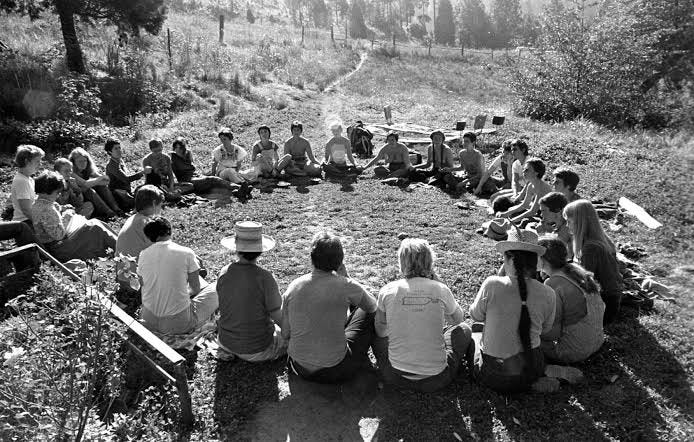
Theory is cheap and land isn't, and attempts to leave the men physically cost money, which selected who got to try. Through the seventies a women's land movement spread across the country, with lesbians pooling their money to buy rural acreage where they could live without men nearby. In southern Oregon a cluster of women's lands took root, WomanShare among them, bought in 1974. A magazine called Country Women taught readers to build and fix the things a husband would otherwise have handled. The land dykes were serious people doing hard physical work, and the lives they built were real. Plenty of them learned to run a farm to get free of men who'd been running them.
But look at the deed. The land had to be bought with money earned in the economy they were trying to leave, or inherited, which means it came down through the same property-and-family system Engels said produced women's subordination in the first place. The purchase was recorded by a county clerk who worked for a state run by men. The mortgage, where there was one, was held by a bank. The property taxes went to a government that could put a lien on the whole dream for nonpayment. You could keep every individual man off the acreage and you couldn't keep out whatever decided whether the acreage was yours, because that was never going to drive up the road and knock. It sat in an office downtown and could enforce claims against the title.
And the money question was a race-and-class question wearing overalls. Pulling together the capital to buy rural land and survive a few lean years learning to farm it took a particular kind of money, and access favored women with some cushion, which in Amerika tends to mean white women, women without children to feed, women whose bodies could do the labor, women who had somewhere to retreat to if the goat died and the well ran dry. The land could be gorgeous while still acting as a filter, and the filter ran on exactly the privileges separatism claimed it was escaping. A poor Black single mother in Detroit who stayed put could be reading the map correctly, since the move required money she didn't have and was built for women who weren't her.
The urban version was the press and the bookstore and the record label, and here the achievements are easier to defend because they didn't require anyone to own forty acres. Daughters Inc. and Diana Press put out lesbian books that no man was going to publish. Feminist bookstores became the physical switchboard of a whole movement, the place you found the pamphlet and the flyer and the other dykes. Olivia Records built women's music into something that filled concert halls and funded a touring circuit. Their work depended on a different form of autonomy: they were women-centered businesses operating inside the market, paying rent and hiring people, with distribution dependent on customers and on printers and pressing plants that didn't care about the politics. They were autonomous women's institutions, and autonomous institutions are the part of this history worth keeping, unlike separatism the doctrine, which ate its own.
A bookstore could stay open longer than a collective house if it could pay the rent, and that meant selling enough books to women who had money to spend. The presses needed printers willing to take their jobs, while Olivia needed places to record and audiences who could buy records. Every one of those women-centered projects still had bills due to somebody outside the movement. But the books traveled, the music traveled, and a dyke in another city could find an argument or a song that somebody had made for her without waiting for a mainstream publisher to decide she was worth the trouble. That mattered more than pretending the cash register had somehow stopped being capitalist because a lesbian was standing behind it.
IS A WOMAN A BODY OR SOMETHING YOU CAN DO TO SOMEONE?
While the land was being bought, the theory split into two things that often got called by the same name, and that split is the most useful part of this history for figuring out what to do now.
On one side was what got called cultural feminism in Amerika, and its monument is Mary Daly's Gyn/Ecology, published by Beacon Press in 1978. Daly's project was a kind of metaphysics of womanhood, femaleness as a well of energy that patriarchy had spent all of history trying to poison and drain, and the political task was recovering that essence. The book is enormous and strange, full of invented words, and underneath the language it claims that woman is a substance, a nature that comes before any social relation. That claim is the taproot of the exclusions, and it's no coincidence that Janice Raymond was Daly's student and that The Transsexual Empire runs on the same premise. If woman is an essence, then a trans woman is a counterfeit by definition, and you don't even have to look at her life to know it, because you've decided the answer lives in the body and the origin before you've considered anything that happens to her.
On the other side, and mostly in France, was a materialism that reached the opposite conclusion from the same anger at the whole system. Monique Wittig, writing in Feminist Issues at the start of the eighties, in "One Is Not Born a Woman" and "The Straight Mind," argued that woman names a position inside a social relation of appropriation, which she called the heterosexual contract, and that nothing about it is natural. Sex, for Wittig, was like class: a product of a system of exploitation, which meant it could in principle be abolished, which was the point. And then she drew the conclusion that still starts fights, in the closing line of "The Straight Mind": lesbians are not women. The line follows from her premise. If woman names a position inside a relation to men, then a person who has genuinely stepped outside that relation no longer occupies the position, whatever her body. For Wittig, woman was a place in a system, and flesh had little to do with it.
Those answers expose a consequential disagreement over what womanhood means. Daly says woman is an essence and the lesbian recovers it. Wittig says woman is a relation and the lesbian escapes it. A lot of the later Amerikan separatist tradition drank from Daly, which is why it ended where it ended, hunting counterfeits. The method I work in descends from Wittig and the French materialists, from the insistence that the relation is what you analyze, whatever body is standing in it. That's what invariance means when I use the word: you find a social relation by watching what keeps operating when you change everything else about it, the particular body, the particular man, the particular era, the particular story a society tells about why. The relation is what remains traceable through those changes. And once you hold the relation as the object, the separatist's whole method of sorting women by their origins stops making sense, because origin alone can't tell you who the relation can appropriate. Racialization and class still shape the terms of that appropriation.
One British tendency took woman-identification somewhere grimmer. The Leeds Revolutionary Feminist Group, founded in 1977, organized the Reclaim the Night marches and then, in 1979, issued a conference paper that became a pamphlet and then a book, "Political Lesbianism: The Case Against Heterosexuality," later collected as Love Your Enemy? Sheila Jeffreys was closely involved. Their argument took woman-identification to its hard edge: a political lesbian was defined as "a woman identified woman who does not fuck men," and the demand was that serious feminists give up heterosexuality as a political act and get men "from your beds and your heads." Asked whether that made heterosexual women the enemy, they answered more cleanly than anything the Amerikans managed: "No, men are the enemy. Heterosexual women are collaborators with the enemy." The honesty is almost admirable, and it shows you the dead end plainly. If men are the enemy as a class of bodies, then women who touch them are collaborators, and you've built a politics that spends most of its energy policing the sex lives of your own side, because the women beside you are the only ones within reach.
BLACK WOMEN WERE FIGHTING A WAR YOU COULDN’T JUST WALK AWAY FROM
One of the clearest refutations of separatism came from the Black lesbian feminists of Combahee, whose materialist analysis arrived at a flat no. In April of 1977, a collective of Black feminists in Boston who'd been meeting since 1974 released the Combahee River Collective Statement, written chiefly by Barbara Smith, Beverly Smith, and Demita Frazier, and named for the river raid Harriet Tubman led in 1863 that freed some seven hundred enslaved people. The statement is a founding document of what later got called intersectional analysis, and it contains, almost in passing, the most devastating sentence ever written about lesbian separatism by people who were themselves feminists and lesbians. They declined the "fractionalization that white women who are separatists demand." Their situation as Black people required solidarity around race, solidarity white women never needed with white men, and a politics that told them to treat all men as the enemy had been written by women who could afford it.
That's the materialist point that breaks separatism in half, and it's the one invariance insists on. Separatism assumes that sex is the one relation that matters and that getting the men out gets the oppression out. For a white woman with some money you can almost believe it, because her other relations, her race and her class, run in her favor and stay quiet, so sex looks like the only thing left to fight. For a Black woman the other relations are screaming. She can't pretend race is subtractable, because the state doesn't let her, and so she can't pretend men are subtractable either, because some of the men standing next to her against the state are the men separatism told her to leave. Hortense Spillers would later give this its sharpest edge, in "Mama's Baby, Papa's Maybe" in 1987, arguing that slavery held Black women outside the category of woman entirely, ungendered them, so that the womanhood white separatism wanted to protect was a category Black women had been violently denied entry to. You can't secede into a category you were never let into.
Angela Davis made the same point at book length in Women, Race & Class in 1981, tracing how the labor and the sexual violence that structured Black women's lives under slavery and after could only be understood through the way sex and race were welded together by a system that wanted free labor and more of it. The lesson these women taught, and that a politics of withdrawal still has to answer, is that there's no single relation you can pull out of a life and fix in isolation. Sex doesn't come apart from race and class cleanly, because the same institutions administer all of them at once. The bank that holds your mortgage also redlines your neighborhood. The court that denies you custody also sends your brother to prison. Separatism's founding bet, that the man is the problem and removing him solves it, only pays off for the women already holding the better cards.
THEY GOT RID OF THE MEN AND STARTED HUNTING EACH OTHER
The sex wars exposed how conflicts over male domination could become disputes over women's conduct within feminist communities. In these conflicts, when exclusionary separatists couldn't reach what they were actually angry at, they found a nearer target among women and went to work on her. The Furies' class conflicts exposed the problem of sharing resources among women with unequal access to them. Political lesbianism directed scrutiny toward which women were still sleeping with men. And at the end of the seventies, when the men were safely outside the walls and the walls turned out not to have changed anything, the movement turned to the one frontier it could still patrol, which was what lesbians did in bed with each other.
By the early eighties, these disagreements had become a sustained conflict over the politics of lesbian desire. In particular, by the early eighties feminism had split over pornography, sadomasochism, butch and femme roles, and the question of whether desire itself could be politically correct. The antipornography feminists, organized into groups like Women Against Pornography, treated certain sexual practices as collaboration with male violence. The women they accused included the lesbian sadomasochists of Samois in San Francisco and the butches and femmes who refused to apologize for wanting what they wanted, and plenty of them thought a feminism that had come all this way to tell dykes how to fuck had lost the plot. It broke open in public at the Barnard conference in April of 1982, where college administrators suppressed the conference's own booklet and antiporn feminists leafleted the attendees, naming speakers.
What matters here is the shape of that fight. The separatist tendency that had defined its enemy as men, and then physically removed the men, was left standing in a women's space with all of that analytic firepower and nothing male to aim it at. So it aimed at women. The femme in the leather, the butch who topped her girlfriend, these became the places where you could still catch the enemy, because the enemy had been defined as a way of relating that could be detected in anyone, which meant it could be detected in your own side, which meant your own side became the hunting ground. That's what separatism does when it runs out of men. It can keep finding enemies by relocating the threat onto the nearest woman who can be made to stand in for him, and the woman it reaches for is, usually, the one with the least protection to begin with.
The conflicts also changed the meaning of feminist authority. An argument about pornography or sexual practice could be conducted through writing and public debate, yet the consequences reached the women whose relationships became evidence in somebody else's political case. When a community decides that certain desires reproduce domination, it still has to distinguish between conduct that harms someone and conduct that violates its preferred account of liberation. Without that distinction, the capacity to accuse becomes a kind of power in its own right. Women who could not control the institutions around them could nonetheless face exclusion from the smaller institutions on which they relied.
THE RAPIST WHO WAS A FOLK SINGER
Beth Elliott is where all of this lands, along with the longer record of what the movement did to trans women, because trans women were the purest case of the reachable stand-in. Exclusionists could reach the woman they'd decided was secretly a man, subject her to the hostility they directed at men, and call it defense.
Go back to the Daughters of Bilitis. Elliott served as vice president of the San Francisco chapter from 1971 to 1972 and edited the newsletter, Sisters, and she was a known and active member until the chapter voted her out, thirty-five to twenty-eight, on the ground that she didn't qualify as a woman. Those numbers are the whole case in miniature. Twenty-eight women in that chapter voted to keep her. At the DOB, a narrow majority expelled her. At the conference, an exclusionary minority made staying intolerable despite a substantial vote in her favor. Those outcomes show different ways of forcing a woman out, and the conference shows that the people threatening her didn't need to persuade everyone.
Then came the West Coast Lesbian Conference in April 1973, where we started. The Gutter Dykes, separatists, leafleted against her. The conference voted better than two to one to keep her. She performed. Robin Morgan rewrote her keynote and, using male pronouns, called Elliott "an opportunist, an infiltrator, and a destroyer" with "the mentality of a rapist," and blamed her for nearly destroying the San Francisco DOB single-handedly. Elliott, who had helped build the conference, had already left before Morgan spoke, and the words circulated through grassroots lesbian networks and bred. That podium helped circulate the transsexual rapist as a stock figure, and she's been with us ever since.
Four years later the movement did it again, to a different woman, with a different weapon. Sandy Stone was a sound engineer who'd worked with rock and roll names, and from 1974 she worked at Olivia Records, the women's music collective, where she joined as a member of the collective. She had disclosed that she was trans before she came in, and it was no secret to the collective. In 1976, a graduate student named Janice Raymond mailed the collective a draft chapter of her dissertation attacking Stone by name, apparently planning to out her and apparently unaware that Stone had told the collective herself. The collective didn't throw her out. They wrote back and defended her, and then in 1977 they defended her in print, in an open letter in Sister magazine, with a sentence I'd put on the wall of every women's space in the country: "Sandy Stone is a person, not an issue."
It didn't hold, because the pressure never came through the front door. In November of 1977, Lesbian Connection ran an open letter attacking Olivia for hiring Stone, the hate mail and the death threats piled up, and eventually Stone left so the collective she loved would stop taking the damage on her account. By every account I've found, nobody voted her out. The pressure came from outside, through a letter campaign and the ambient certainty, voiced at the conference in 1973 and circulating more widely by then, that a trans woman in a women's space was a man invading it. Olivia defended her in public. She left anyway, the way Elliott left anyway, because the thing driving her out was never going to show up at a meeting to be voted down.
Then, in 1979, Beacon Press, the same house that published Mary Daly, put out Janice Raymond's The Transsexual Empire: The Making of the She-Male and gave the whole campaign a book. Raymond named Stone in it. She named another trans woman, Christy Barsky. She used male pronouns throughout. She dismissed trans men as the tokens that let the empire save face, spent her energy on trans women, and wrote the sentence that became the stock line of nearly fifty years of exclusion: "All transsexuals rape women's bodies." Her claim covered every trans woman, with no exception for the ones who behaved well, because the offense she described was the body itself, which she called an appropriation of the real female form. There's the method laid bare. You don't have to examine the woman's life, her labor, her loyalties, what she's survived, because you've decided in advance that the body is the crime and the origin is the verdict. It's Daly's essence with a security detail. An early feminist critique of the book was Carol Riddell's 1980 pamphlet Divided Sisterhood, and Stone eventually answered Raymond herself in "The Empire Strikes Back: A Posttranssexual Manifesto," which many people treat as the founding text of trans studies.
THE TRANSSEXUALS WERE ALREADY IN THE FUCKING ROOM
The absence of early trans lesbian organizing from familiar accounts has helped sustain a misleading chronology of lesbian feminism. That story depends on a timeline: there were women, there was lesbian feminism, it was coherent and whole, and then much later, in our confused present, trans women showed up and started demanding entry into something that had never had anything to do with them. That timeline is a lie, and the evidence that it's a lie was sitting in the archive the entire time.
In 1970, in the San Francisco Bay Area, a trans woman named Sally Anne Douglas began developing a trans lesbian feminism, and in 1971 she organized it into the Salmacis Society. Her people called themselves male lesbians, a phrase that will scramble a modern brain in both directions. They were transfeminine people oriented toward women, femme-for-femme, who understood themselves as lesbians, and they built a feminist social world out of it, tied into the gay and lesbian bars of the city. They published, in Drag and the Berkeley Barb and in directories of their own. Salmacis also helped advance the word transgender. Aino Pihlak and Emily Cousens, reconstructing all of this in an article first published online in Gender & History in 2025, suggest that Douglas and the Salmacis Society may deserve to be counted among the original lesbian separatists, and I think they're right. That puts them at the creation of the movement, building a woman-centered trans lesbian world in the same state, in the same years, that separatists elsewhere in California were deciding trans women were men. Pihlak and Cousens also identify racial and class barriers in Salmacis, including expensive events and membership ideals of sophistication and stature. Inclusion of trans women didn't make those barriers disappear.
They weren't alone and they weren't the last. Trans lesbians moved through second-wave feminism, participating in the bars and collectives as well as women's music, thinly documented and surfacing mainly when someone like Raymond went looking for a target. By the nineties Davina Anne Gabriel was editing TransSisters: The Journal of Transsexual Feminism, an explicitly feminist trans publication, carrying on an argument that had been running since Sally Douglas in 1970. Anyone who tells you trans women are new to lesbian feminism is telling you they never opened the archive.
The relationship becomes clearer across these episodes when the institutional setting changes. Change the body, the city, the decade, and the particular slur, and watch what keeps running across Beth Elliott and Sandy Stone and the people who pushed them out. Both were backed by many of the people who actually knew them. Both were accused of something they hadn't done and couldn't answer, a rapist's mentality in one case and "male energy" in the other, and both left anyway. A system that pins an accusation on a woman because of what she supposedly is underneath, whatever she does, and then makes her place in the institution unlivable, is doing to her what it does to women. That's what Raymond looked at and read as a disguise. The relation that makes someone a woman was running on them in plain view in the record, and her method could only see the body.
There's a limit to this. Being punished as a woman isn't the same as the whole of being a woman, and the position isn't identical in every register. The punishment is evidence about the relation, though, and a lot of it. When a system spends this much force expelling someone from an institution she helped build, the work and belonging being taken from her are part of the evidence, the way the effort a boss spends stopping a worker from quitting tells you the worker was inside the wage relation. Mobility in and out of a position is evidence about the position, and it doesn't refute it. The separatists built an entire apparatus to keep certain women out of womanhood, and the size of the apparatus is the tell. You don't build a wall that big around a place nobody's inside.
Lesbianism forgets it can't escape being in a settler state
Separatism as an organized project mostly came apart through the eighties and into the nineties, and the usual explanation is that it was absorbed, or that feminism moved on. Some of that's true and most of it misses the materialist point, which is that the organizations died and the relation they were responding to didn't, so the energy didn't dissipate, it relocated.
A few of the land projects survive, held for decades by a handful of aging women, while many bookstores closed and the music networks changed, because a women-centered business inside the market lives and dies by the market, and the market changed. Some presses folded or got bought. The Michigan Womyn's Music Festival became a prominent site of conflict over whether trans women could attend, which tells you where this exclusionary tendency's energy had pooled: it went into guarding the border against women it had decided were men, and very little into building the separate world. The last public act of a lot of this tradition was a bouncer's job.
And border-guarding also found a new institutional home. The trans-exclusionary feminism that surfaced at the West Coast Lesbian Conference and got canonized by Raymond didn't stay in the commune. It migrated into courtrooms and legislatures, into a legal and media project that has very little interest in women's land and enormous interest in bathrooms, prisons, sports, and clinic doors. The heir to that border-guarding is an organized campaign to write the essentialist answer into law, and it has little to do with any dyke on a farm in Oregon. I read a continuity between these projects in the way they authorize institutions to police womanhood, although a direct organizational lineage needs further documentation. The answer they enforce is: the body, the origin, whatever you can check at the door.
WHY DO THE DYKES WANT TO SECEDE AGAIN?
A younger trans dyke who's tired and scared, and who's watched the broader world get less safe, might reasonably ask: should we build something separate? Is there a version of lesbian separatism that includes us and protects us, and if there is, do we want it?
Any answer has to take the limits of the historical evidence seriously. In the discussions I encounter, there's more talk than evidence of an organized trans-inclusive separatist movement, which leaves its scale unresolved here. That talk comes in two streams that get confused because they share a vocabulary and want almost opposite things.
The first stream is the gender-critical revival, the people running the old essentialist playbook, and when they say lesbian separatism they mean a women-born-women politics aimed at getting trans women out of lesbian life. That's campaigns to redefine lesbian so it expels every trans woman and a fair number of cis ones too. It's a border guard with a legal department. Its exclusionary demand is an attempt to repossess a word. I'm not going to pretend to be even-handed about whether trans lesbians belong in lesbian life, because the archive already settled that and you just saw the receipts. Sally Douglas was there in 1970. The newcomers are the ones trying to lock the door.
The second stream is the one that deserves a serious answer, because it comes from inside the house, from trans women, and it's less a doctrine than an exhaustion. It's the girl who says she only dates other trans women now and has pulled her life in tight around a few people she trusts because the alternative landed her in a hospital bed, or in a group chat where they'd decided she was the problem. That's real and I'm not going to lecture her. What it is, though, is separation as survival, the same thing the bar was in the fifties, the thing that came before any theory. Her immediate aim is to survive among people she trusts. The mistake would be to hand that scared, sensible girl a fifty-year-old doctrine and tell her the small safe thing she built to survive is actually a nation, because the doctrine won't protect what she built. It risks turning disagreements over the resources they need into tests of who belongs.
For any contemporary project, this uncertainty matters. Online discussions can make a political tendency appear larger and more organized than it is, especially when the same arguments circulate through overlapping audiences. A group of women deciding to share housing or pool emergency money has taken a practical step, but that step alone does not establish a separatist movement. The distinction becomes consequential when participants begin making claims about whom their political project represents. A movement requires some durable capacity to make decisions, sustain resources, and answer to the women whose lives it proposes to organize.
THE MAN IS GONE. THE LANDLORD IS STILL HERE.
Two kinds of safety are at stake here. There's the safety of the immediate scene, the question of who's physically near you, whose hands can reach you, who's at the party and the meeting and in the bed. Separation can reduce immediate exposure, and I won't minimize it. A woman getting beaten by a specific man needs the means to get away from him and protection against further violence. A trans woman who has left a scene full of people who degraded her can gain safety among people she trusts. The land dykes genuinely reduced their exposure to the particular men who'd been hurting them. That protection mattered. For a lot of women across this history it was the difference between a survivable life and an unsurvivable one, and anyone who sneers at it has never needed it.
And there's the other safety, the one separation can't touch, which is safety from the relation that produces your vulnerability in the first place. You can get the specific man off the land. You can't get the bank off the deed, the state off the custody, the boss off the wage, the clinic off your hormones, the insurer off your care, the cop off the road between you and town. None of those arrived as men you could turn away at the gate. They already held the parts of your life you couldn't produce on the acreage, and a man never had to set foot on your property to use the power some man in an office still held over whether you got to keep it. Leaving the man still leaves those dependencies to confront. The lease has a landlord, the landlord has a bank, the bank has the state, and the state will send someone who's usually also a man, and he doesn't need to be in your life to end it. Male domination was never primarily a question of which men are present. It's a fact about who holds the title to the things you need, and withdrawal from men doesn't transfer the title. It just changes which men you can see.
The Furies show how conflict can develop without a man invading the house. They dissolved because the class relation, the thing that actually sorts who eats and who talks and who leads, was already distributed among the twelve of them when they locked the door, and locking the door did nothing to redistribute it, because the door was never what held it in place. Their experience identifies a problem other separatist projects would have to address, on the relation they'd carried in with their own members, because the relation lives in the terms on which everyone, included and excluded alike, gets to survive, even when the people shut out are absent.
Getting away from a man who hurts you is easier to sustain when somebody can help you stay away. A refuge is safer when its residents can obtain medical care, legal assistance, and reliable income without depending on the people they escaped. A community that cannot provide those connections may protect women from one source of danger while leaving them vulnerable to eviction or economic coercion. This is why the terms of access matter as much as the boundary itself. A woman who cannot afford to enter a protected space still needs a politics capable of reaching her where she lives.
SOME WOMEN GOT A COMMUNE. THE REST STILL HAD RENT.
Separation also selects for privileges that can determine who gets to participate. To withdraw you need something to withdraw to, and land takes money. A tight separate circle takes a scene that will have you and people with the time and stability to build alongside. The woman who can't afford to leave, the one with kids and a job she can't lose and a body that can't do farm labor and a bank account that can't absorb a bad year, is no less oppressed and no less a feminist than the women who left. She's more exposed, though, and separatism has nothing for her except the implication that she lacks their courage. Combahee pointed at this in 1977, and it's still true: a politics of withdrawal gets written by and for the women who can afford to withdraw, and the price of pretending otherwise is paid by everyone who can't. Any separatism that doesn't start from this is a lifestyle for the cushioned, dressed as a strategy for the desperate.
And for trans women the selection has a particular cruelty, because for us separation is very often something done to us. A trans woman can be pushed into a small world by exclusion, exiled from the broader scene by the people who decided she was the problem, and a lot of the time the people doing the exiling are other trans women, the roster that got to pick, the group chat where they workshopped why she had to go. When your condition is already exile, a politics organized around withdrawal is your wound handed back to you as an ideology. The girls who need tenderness are standing right here. A trans woman who's been thrown out of everything needs institutions that catch her, and a doctrine that makes a virtue of being thrown out can't do that.
Being thrown out often changes what a choice even looks like. A woman who has repeatedly been pushed out of public life may eventually prefer a smaller circle, and that preference deserves respect. Yet her choice takes shape after other people have narrowed the alternatives available to her. Building institutions for transsexual women therefore requires attention to who controls the resources and who can appeal a decision that threatens their access to them. An emergency fund, a shared home, or a publishing project can protect its members only so long as its procedures do not turn personal conflict into the loss of every form of support at once.
BUILD THE FUCKING INSTITUTIONS ALREADY
We keep calling different things separatism, and then we argue as if everybody is talking about the same damn project. There's separation, the practical act of getting away from specific people who are hurting you, which is survival and needs no theory and deserves no lecture. There's separatism, the doctrine, the claim that withdrawal from men is the strategy, the form of life, maybe the goal, the one the record shows eating itself, selecting for privilege, relocating its unreachable enemy onto the nearest available woman, and mistaking the men in the house for the power over the house. And there's the autonomous women's institution, the shelter, the clinic, the press, the bar, the emergency fund that pays a sick girl's rent, the kind that puts women's needs first and builds the capacity to meet them, and doesn't require anyone to believe that men are a class of poisoned bodies or that a woman who loves one is a traitor.
The autonomous institution is the part of this history that was always doing the real work, and it's the part separatism the doctrine kept poisoning. Olivia was an autonomous institution, and it was at its best when it was least separatist, when it stood by Sandy Stone and said she was a person and not an issue. It lost her anyway when the pressure outside got to be too much. Women should build women-centered things. Build more of them, with deeds and bank accounts as well as lawyers and successors who can keep them going, so no single account getting deleted or single woman getting cancelled can take them down. The moment you organize the whole thing around who to keep out, you've told the relation where to find you, because the relation's favorite trick is to get you to spend your force on the women beside you.
Whether a trans-inclusive separatism is possible is a real question and deserves a real answer. The precedent exists: Sally Douglas built a trans lesbian feminism in 1970 that Pihlak and Cousens suggest may count as separatist, so it was never impossible, and it was there at the start. But watch what inclusion actually requires, because it isn't a tweak. The separatism of Morgan and Raymond ran on the essentialist answer, woman as body and origin, the thing you check at the door. A separatism grounded in Morgan and Raymond's answer would have to abandon it to include trans women. In the materialist terms I'm arguing for, membership would follow the social relation of appropriation. Political membership creates no obligation of sexual or romantic availability. That changes the commitments of Morgan and Raymond's version, while Salmacis shows that trans inclusion already had a place in the wider history. It would abandon the exclusionary politics that made body and origin tests of belonging. So the honest answer depends on which historical commitments a contemporary project chooses to carry forward. What you'd be building is autonomous trans and women's institutions on a relational definition of womanhood, which is what I'm actually for, and calling it separatism mostly invites the ghosts of the people who'd have thrown you out.
Including trans women would hardly make every woman in the room agree with every other woman, and anyone promising that has never met lesbians. Sharing a position within sex-based oppression does not give women identical needs or make their conduct automatically harmless to one another. Political membership could be defined around common interests and commitments, while rules for dealing with abuse would need evidence, fair procedures, and practical support for those at risk. These are questions of institutional design, and they cannot be answered by declaring every member safe on the basis of her sex. The history of separatism gives plenty of reason to distrust that shortcut.
YOU CANNOT EXILE YOUR WAY OUT OF PATRIARCHY
I'm not going to soften the verdict into hope, because hope as a reflex is how this kind of writing usually chickens out. Lesbian separatism built real things and gave women real refuge, and it couldn't reach what made the refuge necessary. It reduced the number of men in the immediate vicinity and it didn't touch the title to anyone's life. It selected for the women who could afford to leave and it left the rest holding the implication that they were cowards. The exclusionary tendency defined its enemy as a way of relating that could be detected in anyone, and so it spent its strength detecting that enemy in its own ranks, in the butch, the femme, the sadomasochist, and above all in the trans woman, who made the perfect target because she could be cast as the man you could finally reach. It mistook the men in the house for the power over the house, and when it locked them out it found the power still inside, because the power had come in with the members, in their class and their race and their certainty about who was real.
As a temporary act of getting away from someone who's hurting you, separation is survival, and I'll defend it to anyone, and it needs no justification beyond a woman's own safety. As the project of building durable institutions that put women's needs first, autonomy is good and we need far more of it than we have. As a comprehensive theory of how women get free, separatism is a dead end, because freedom is a question about who holds the deed and the wage and the clinic and the court, and you can't answer that question by deciding who gets to come to the party. The men were the hands on the lock, and you can get the hands off while the lock stays, because the lock belongs to the bank.
I'll leave the door cracked, because I'm not in the business of telling a frightened girl that the small safe thing she built doesn't count. It counts, so go build it with other people who won't sell you out. Make it big enough to hold more than your own grief, with a bank account and a name that outlives your account getting deleted. It's a place to stop bleeding and gather strength for a while, with work still ahead of it: the thing that's actually coming for you was never going to use the door, and it already knows your address because it holds the lease.
WORKS CITED
Charlotte Bunch, "Lesbians in Revolt," The Furies, January 1972. Bunch supplies the clearest early statement of separatism as a political and material choice. The line about loving oneself, woman, is attributed to Bunch in the DC Historic Preservation Office's staff report and related sources.
Charlotte Bunch, "Perseverance Furthers: Separatism and Our Future," The Furies, Fall 1972, p. 3. Bunch gives her later account of where the collective's problems came from.
Combahee River Collective, "The Combahee River Collective Statement," April 1977. The statement explains the Black feminist refusal of separatism and why sex can't be cleanly subtracted from race and class.
Mary Daly, Gyn/Ecology: The Metaethics of Radical Feminism, Beacon Press, 1978. I read Daly's book as the monument of the essentialist, cultural-feminist answer to what a woman is.
Angela Y. Davis, Women, Race & Class, Random House, 1981. Davis examines how sex and race were welded together under slavery and after, challenging any single-relation analysis.
Christine Delphy, Close to Home: A Materialist Analysis of Women's Oppression, 1984. Delphy analyzes marriage as a mode of production in which a wife's labor is appropriated.
Beth Elliott, "Of Infidels and Inquisitions," The Lesbian Tide, June 1973. Elliott records her response to the conference, as reprinted and described by the Berkeley Revolution archive.
Friedrich Engels, The Origin of the Family, Private Property and the State, 1884. Engels locates women's subordination in property and inheritance.
Davina Anne Gabriel, ed., TransSisters: The Journal of Transsexual Feminism, 1990s. The journal documents the continuity of trans feminist publishing after the second wave.
Colette Guillaumin, "The Practice of Power and Belief in Nature" (sexage), Questions Féministes, 1978. Guillaumin describes the appropriation of the whole woman as a thing owned, beyond labor bought.
Leeds Revolutionary Feminist Group, "Political Lesbianism: The Case Against Heterosexuality," 1979, collected in Love Your Enemy? The Debate Between Heterosexual Feminism and Political Lesbianism, Onlywomen Press, 1981. The group takes woman-identification to its hard edge in the claim that heterosexual women are collaborators with the enemy.
Aino Pihlak and Emily Cousens, "Putting the Femme in Feminist: Trans Feminism and the 'Male Lesbian' in the American Second Wave," Gender & History, first published online 24 March 2025; 38(2), 2026, pp. 680–692. The authors reconstruct the history of Sally Anne Douglas and the Salmacis Society and suggest that they may belong among the original lesbian separatists.
Radicalesbians, "The Woman-Identified Woman," 1970. The paper supplies the founding statement of woman-identification, which I distinguish here from separatism proper.
Janice G. Raymond, The Transsexual Empire: The Making of the She-Male, Beacon Press, 1979. Raymond weaponizes an essentialist account of womanhood against trans women, claiming that all transsexuals rape women's bodies.
Carol Riddell, Divided Sisterhood: A Critical Review of Janice Raymond's The Transsexual Empire, News From Nowhere, 1980. Riddell supplies an early feminist critique of Raymond's book.
Hortense J. Spillers, "Mama's Baby, Papa's Maybe: An American Grammar Book," Diacritics, 1987. Spillers analyzes the ungendering of Black women under slavery, which I connect here to their exclusion from the womanhood white separatism was protecting.
Sandy Stone, "The Empire Strikes Back: A Posttranssexual Manifesto," in Body Guards: The Cultural Politics of Gender Ambiguity, 1991. Stone answers Raymond in a text widely treated as foundational to trans studies.
Monique Wittig, "The Straight Mind" (1980) and "One Is Not Born a Woman" (1981), Feminist Issues, collected in The Straight Mind and Other Essays, 1992. Wittig develops the materialist account of woman as a position in a relation of appropriation, from which the method here descends.
The sources consulted for the historical detail on the West Coast Lesbian Conference, the Daughters of Bilitis vote, Robin Morgan's keynote, Olivia Records and Sandy Stone, the Furies, Combahee, the Leeds group, and the Salmacis Society include the Digital Transgender Archive, the Berkeley Revolution archive of The Lesbian Tide reprints, the DC Historic Preservation Office staff report on 219 11th Street SE, a transcription of Love Your Enemy?, a published reproduction of the Combahee statement, Pihlak and Cousens's article, and contemporary and secondary reporting. Engels, Delphy, Guillaumin, Daly, Davis, Spillers, and Stone's manifesto are cited from prior reading.