Camp Miasma, Castration Movie, and How to Actually Make a Movie
On the limits of queer liberalism, the return of radical feminism, and why everyone suddenly wants to talk about desire again
Support my work on Ko-fi: https://ko-fi.com/bundleofstyyx
Ko-fi and paid subscriptions are what helps me pay rent, buy groceries, and keep Bundle of Styx running. If you value the writing and want me to keep doing it, donations genuinely help.
Follow Bundle of Styx:
Instagram: @bundleof.styx
Tumblr: bundleofstyx
TikTok: @bundleof.styx
Jane Schoenbrun has clearly been reading Tara Knight. There’s no other explanation. I’ve spent the better part of a year writing about desire, about who taught us to want the things we want, about the poverty of consent as an entire sexual ethics, about lesbians being allowed to have boundaries and the men, and increasingly everybody else, who treat those boundaries like a personality defect in need of correction. Sometimes they say it outright, and sometimes they leave it vague enough that you can never really be sure. I published an essay on this in the spring. I’ve got another one sitting in drafts. Then Schoenbrun goes and makes a horny, blood-soaked, extremely good movie about a queer filmmaker who catches feelings for the reclusive scream queen she’s trying to talk into a reboot, and somewhere around the second act my entire argument walks in eating gas-station fried chicken.
Where’s my credit, Jane? My lawyers, who are three group chats and a Notes app, will be in touch. Be ready.
One little thing before we go anywhere. Yes, I’m going to criticize Castration Movie in this. Yes, I remember what the comments did the last time I criticized Castration Movie. I have read the words “she doesn’t even understand what the film is doing” in more variations than most people encounter in a lifetime, all written by dorks with Letterboxd in their Instagram bios who had likely been the smartest people in their freshman English courses.
Consider this my formal notice that I have learned nothing, retained nothing, and will be doing it again at length and with citations.
Anyway, I’m joking about Jane, obviously. Schoenbrun has never read a word I’ve written and has no reason to, and if they had, the movie would be worse and considerably more erotic. What actually happened is stranger than if they had read me, and more interesting. Call me, Jane. Let’s talk. A handful of people who don’t talk to each other, working at wildly different budgets in wildly different corners of the industry, all arrived at roughly the same conclusion in the same year.
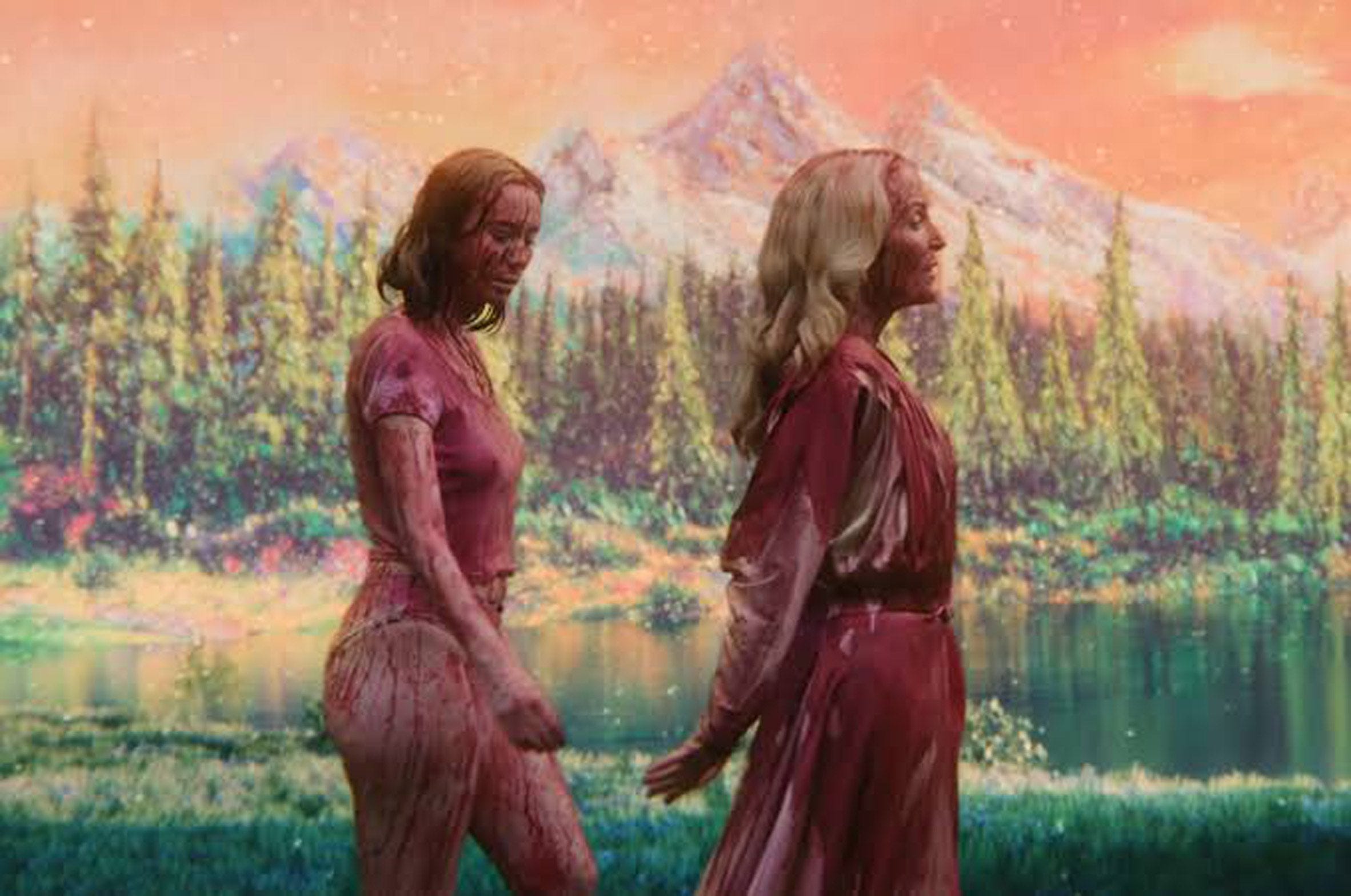
Kris Williams is a Sundance-anointed queer filmmaker handed the assignment every horror kid dreams about and instantly regrets: reboot the dormant Camp Miasma franchise, the sequel-rotted slasher series that scarred and thrilled her as a teenager, for an audience the studio keeps describing as younger and queerer without asking anyone younger or queerer what that’s supposed to mean. Somewhere between research and obsession, Kris goes looking for Billy Presley, the actress who played the original final girl, refused every sequel, and then vanished so completely that she’s apparently been living alone at the actual campground where the first film was shot.
It’s the dead of winter. The lake is frozen solid. Billy answers the door in what I think is a turban, although I genuinely have no idea what it actually was.
What follows is mostly a two-hander, snowed in, with fried chicken, weed, and unbearable proximity carrying the load that teenagers wandering off to have sex normally carry in this genre. Schoenbrun and cinematographer Eric Yue keep cutting back to the original Camp Miasma, the film within the film, with Amanda Fix as young Billy, and the pastiche is genuinely gorgeous: geysers of blood, cartoon gore, and needle drops so unhinged I audibly moaned in the theater as my butch groped me. There’s a sex scene between young Billy and a camp counselor that the killer interrupts at the exact moment it starts working on her, and that scene is the reason Kris does this for a living. She says so out loud. A girl’s arousal and death occupy the same frame, the same second.
That collision isn’t incidental to the movie Kris grew up on. It is the movie Kris grew up on.
She loved that franchise. She loved its monster. She’s remaking the thing that built her, and she has no idea yet what that means.
The killer is called Little Death, which, yes, we all got it, and Jack Haven plays it under a mask for nearly the entire runtime while doing more work than any studio monster has done in years. The backstory begins with a bullied kid drowning in the camp lake, coming back changed and ungendered, and starting to kill teenagers in sequences staged with obvious relish for the gore and this weird, persistent tenderness toward the thing doing the killing.
Haven, who’s trans and nonbinary and worked with Schoenbrun on I Saw the TV Glow, has talked about the slasher as a machine for what they call trans microdosing. The audience bonds with a girl who’s usually got a boyish name and boyish energy, rides along while she becomes fully feminine, and then gets to watch her die for it, or become the monster and die anyway, over and over. It’s an entire genre rehearsing a transition it’s too scared to name out loud.
Little Death descends directly from Norman Bates, Buffalo Bill, and Angela at the end of Sleepaway Camp, all killers horror trained generations to read as monstrous for the specific crime of refusing to stay one gender. The movie is also playing with autogynephilia, which matters enormously to the context here, but I will not be explaining it because the concept has an extraordinary ability to harm trans lesbians and is a disgusting little brainworm. Sorry.
Schoenbrun and Haven aren’t pretending that history is clean. They pick it up anyway, working from the idea that the only way past a disgusting history is to actually hold the thing and reckon with it. The movie is at its best when Little Death is standing at the edge of the frame doing almost nothing, patient and curious and more heartbroken than furious.
Anderson is the reason to see this regardless of how you feel about a single word of my politics. She plays Billy as a Norma Desmond who knows exactly what she’s quoting and commits anyway, mascara applied like she’s going to war with the concept of subtlety, her drawl pitched somewhere between real and a bit she’s run so long that it became real. Both women reject the Sunset Boulevard comparison out loud in the script, which of course confirms it.
I want to be normal about this and I can’t. Gillian Anderson has now spent three decades as a load-bearing wall of lesbian culture, and casting her as a reclusive final girl who lives at the scene of the crime and won’t come out is the kind of move that should require a permit.
Einbinder has the harder and much less flattering job. Kris describes herself at one point as a prude, and she’s anxious, over-intellectual, narrating her own feelings roughly half a second after having them, the sort of person who metabolizes wanting somebody by first turning it into a pitch deck or, in some cases, making a Substack or something. Watching her fail to think fast enough to keep up with what’s happening in the room is one of the most purely enjoyable parts of the film because of how relatable it is. Maybe that’s just me.
There’s a ten-minute scene of the two of them getting high by a fire that serves almost no plot function and earns every second because Schoenbrun understands that two people becoming interested in each other generates its own tension. No jump scare required, although Einbinder does get a great line ribbing the movie for not providing one.
The second half loses some of the grip the first half had. A few critics have pointed out, fairly, that the question of how a one-and-done teen scream queen affords an entire abandoned campground gets waved off in favor of pure vibes, which Schoenbrun is entitled to do and which not every viewer is going to forgive. There were two trans men, shocker, sitting behind me and my fiancée who said, “That movie made no sense. It just went from scene to scene.” Way to pass, boys.
The film is also, at points, so delighted with its own cleverness, so full of a Foucault nod here and a Cronenberg gesture there, that it risks becoming a movie about how smart it is to be making a movie like this.
None of that touches the thing it gets right, which is why I’m still chewing on it and writing this review during an Adderall binge at one in the morning.
Camp Miasma understands that wanting something doesn’t explain why you want it. Like some of us even get “pull here” tramp stamps or something.
Kris loved that franchise. She loved its killer. She specifically loved a scene where a girl’s pleasure and death landed in the same breath, and that love made her an artist. Now it’s helping her fall for a woman twice her age who is functionally still living inside the movie that made them both. The film never treats this as shameful, and it never shrugs it off as no big deal either. It’s also really hot, but that’s not important right now.
Schoenbrun keeps examining that desire from different angles until the film has actually said something about it. That’s harder to pull off than any jump scare, and it’s why I couldn’t stop at simply liking the movie.
There’s a question I keep coming back to like Socrates: Who taught you to want that?
It’s a question our “queer community” hates to ask.
Nobody’s desire fell out of the sky. Desire is shaped by porn, trauma, fantasy, gender, culture, and a world that existed before any of us had language for ourselves. That doesn’t make desire fake. It means desire is produced, the same way everything else about you was formed by a world you didn’t agree to be born into and can’t see the whole of from inside.
Camp Miasma nails this by refusing to turn it into a pathology. Kris’s entire personality was built around a franchise that taught her, before she had language for any of this, that a girl’s arousal and a girl’s death belong in the same shot. That is obviously not a healthy origin story, and the movie never pretends otherwise.
The film also refuses the tidy little equation where the bad childhood explains the grown woman’s taste and the explanation somehow makes the taste evaporate. Desire doesn’t work like that, and the movie knows it without beating you over the head with the message.
Kris’s desire is snarled up with pleasure, identification, and a real, if bent, love for the images that raised her. Schoenbrun lets all of it sit there in a pile. I love complexity in films, but complexity has to mean something. That refusal to simplify is the film’s actual sophistication, much more than any Foucault namecheck. You get to watch somebody want something for reasons that are historical, personal, formally interesting, and hot all at once, without anyone choosing one explanation and calling it the answer.
And now we enter the part of this review where somebody accuses me of wanting a feminist committee to pre-approve everyone’s kinks.
I don’t. I never have. I don’t know a single serious person who does.
Lesbians developed their sexuality inside a culture organized around heterosexuality, and their desire is still theirs. Trans women don’t figure out what gets them off in a sealed laboratory, and our desire is still ours. A feminism that loses the ability to ask how desire got made has quietly resigned from being a feminism because it gave away the question separating political analysis from a shrug and a “you do you, babe.”
Both things fit in one head. A want can be sincerely felt and still have arrived from somewhere.
Camp Miasma holds both ideas for a hundred and twelve minutes without blinking, which is rarer on a screen than it should be.
Consent matters. It isn’t a formality or a box you check on the way to the interesting conversation. It’s the floor. What interests me is what happens after the yes, because a floor isn’t a house, and enormous swaths of sexual culture behave like it is.
Seeing the tears leave the face of the woman I love during a scene in the film involving something nonconsensual made me feel something that had me Googling what the minimum was for a crime that starts with an M.
A woman can consent to something, and that consent settles the ethics of that specific encounter. It does absolutely nothing to settle the political question of why that particular act became something an entire generation of women feels obligated to be into.
A lesbian can say no to a man clearly and repeatedly and watch that no get reinterpreted in real time as evidence of a defect in her rather than evidence that he simply wasn’t who she wanted.
Somebody can sincerely enjoy a fantasy assembled from images the porn industry mass-produced because they were cheap to shoot and reliably profitable. The fantasy still has a manufacturing history, just like mine does.
Consent tells you whether an act was permissible. It can’t tell you why that act, out of everything humans have ever thought to do to each other, is the one the culture keeps handing women a script for.
The habit I’m naming isn’t “consent exists,” which nobody disputes. It’s the reflex that treats any question asked after the yes as an intrusion, as though analysis were simply violation in a better outfit.
Call it queer liberalism, because it needs a name and that one fits.
I mean a political tendency, dominant now across much of institutional queer politics, that handles sexuality almost entirely through individual autonomy: identity recognition, self-description, boundary negotiation, procedural consent. This framework isn’t stupid, and I’m not inventing a strawman. It won real things. It helped get queer people out from under the idea that our desires needed a doctor’s signature or diagnostic code to count, specifically by insisting that what consenting adults get up to is nobody else’s business to litigate.
That was a genuine victory, and I’m not writing this to take it back.
But a framework built to defend the right to want gets structurally itchy the second you ask why so many people, supposedly independently, keep wanting the same narrow gendered thing. Queer liberalism has excellent tools for defending an individual’s yes and almost none for explaining a pattern, because explaining a pattern requires structural analysis. Structural analysis of desire has been treated in plenty of queer spaces as the opening move in confiscating somebody’s yes.
Louise Weard’s Castration Movie isn’t one film, and the scale makes lazy description tempting, so let’s do it properly.
It’s an ongoing anthology, shot mostly on Hi8 camcorder under Weard’s own banner, Hentai Cop Films. i. Traps dropped in 2024 at roughly four and a half hours. ii. The Best of Both Worlds followed in 2025 at a full five. iii. Year of the Hyaena arrived this June at five and a quarter. That’s around fourteen hours of DIY transsexual cinema, self-released on Gumroad before Elizabeth Purchell’s Muscle Distribution picked it up, screened from Glasgow to Austin to rooms Weard has described, without much exaggeration, as unsurprisingly seventy percent trans, because why wouldn’t they be?
Nobody accidentally makes fourteen hours of anything. You do it because there’s something you have to work out and ninety minutes won’t hold it.
Traps opens, of all ways, on a cis guy. Turner is a production assistant whose relationship with his girlfriend Brooklyn is coming apart in real time, and there’s a scene where he reads incel forum posts aloud while she works on a furry porn commission, which is either the bleakest joke in the film or the most accurate portrait of domestic life currently available in North American cinema. I lean toward both.
The real center is the second half, where Weard plays Michaela, known as Traps, a trans sex worker in Vancouver juggling clients, a friend group that loves her and cannot always hold her, and a slow-building decision to get a back-alley orchiectomy because the waitlists have turned her own body into a negotiation she isn’t party to.
The Best of Both Worlds relocates to New York, opens on Trump muttering about gender ideology through nauseating color grain, and spirals out into a trans sex-cult plotline, including a member named Circle whose final choice the film declines to score as triumph or tragedy.
Year of the Hyaena pushes further, with a woman named Izzy doing everything in her power to stop her partner from transitioning while Michaela, per the film’s own synopsis, simply tries her best to be a good person. After fourteen hours, that reads less like a logline and more like a prayer.
The urge to dismiss all this, or to treat the vulgarity as automatically radical or automatically embarrassing, misses what’s happening. Weard has said flat out that she wanted to write a trans woman with really bad politics, which she’s very good at doing. I mean, she is from Boston after all. She wanted somebody she could let say heinous things without the script arranging a redemption arc, and that impulse is worth something.
Trans representation still mostly asks women like Michaela to be dignified on demand. Letting a trans woman be genuinely unpleasant on screen without making her earn her humanity back by the credits is a real achievement, and I’m not going to shrink it for the sake of a cleaner argument.
The problem I have with Castration Movie comes from somewhere else.
Weard has said outright that “the politics should be allowed to be messy and weird and sometimes ambiguous,” and that she deliberately hands interpretation over to the audience’s own media literacy rather than steering it. I take that seriously as a stated position rather than something I invented to knock over.
I still think it’s the project’s central limitation.
After fourteen hours of a trans sex worker’s life, a trans sex cult, a woman sabotaging her partner’s transition, and all the other political conflicts the anthology accumulates, ambiguity starts carrying an extraordinary amount of weight.
Ambiguity itself isn’t a failure. A version of these films that resolved everything into a clean moral would be much worse and much less interesting than what Weard actually made. Art owes nobody a thesis statement, and filmmakers don’t have to lecture.
But refusing easy answers is different from declining to establish any relationship between your own materials. After fourteen hours, “everyone contains their own truth” stops working as humility and starts working as an out.
Explanation has almost completely replaced judgment. A work this long, built so obviously out of real political stakes, keeps walking to the edge of a claim and stepping backward until the stepping back becomes the position.
I think Weard succeeds completely at a specific and limited theory of what a film about marginalized life is for: bearing witness rather than arguing.
Bearing witness is real work.
Representation still cannot stand in for analysis, however much of it you pile up, however explicit or honest or many hours long. Showing a trans woman behaving badly doesn’t automatically make something radical. Showing something taboo doesn’t automatically make it transgressive. Length doesn’t create depth, and explicitness doesn’t produce materialism.
You can put every conceivable perspective on screen, give each of them a monologue, and still leave the organizing question untouched: why does this keep happening, and who benefits from it staying unclear?
The audience walked in with the dominant ideology preinstalled, and nothing in the film’s construction necessarily asks them to leave without it. The filmmaker declines to judge. The audience applauds that refusal because refusing judgment reads as sophistication. Meanwhile the actual social relations underneath all that dangerous material stroll out of the theater completely undisturbed, unbothered, moisturized.
Put that beside what Schoenbrun does at a fraction of the runtime and, on paper, a fraction of the political ambition.
And don’t give me some bullshit about it not being political. The personal is political, nimrods.
Camp Miasma organizes its own material into a claim. The genre trained generations to eroticize and punish gender deviance. That happened to actual people, including people involved in making this film. The way through becomes a complicated and loving reclamation, staged as a love story between two women who are both still living inside the movie that made them.
Desire generates consequences, and the film tracks them.
There’s a real stance in there even where the position stays complicated, even where I have real criticisms of the back half and was feeling very warm looking at the back halves in this movie, let me tell y’all.
That’s why Schoenbrun’s ambiguity feels earned to me. The movie connects its own material. Weard’s project often feels like an extraordinarily sincere, occasionally brilliant act of collection that stops before making those connections.
The problem shows up constantly in queer spaces and almost never gets named: lesbians are allowed to have borders, and the volume of cultural pressure currently aimed at those boundaries is genuinely bizarre.
A woman says she isn’t attracted to men, or isn’t attracted to some particular category of person for reasons she may or may not be able to fully articulate, and that statement increasingly gets processed as a claim requiring public defense.
The pressure isn’t always hostile. Often it arrives wearing the costume of curiosity or concern, as a warm invitation to examine her own exclusionary tendencies, with an unspoken why not him? why not her? humming underneath.
What exactly are you protecting yourself from? Have you considered that the protection might be prejudice in a nicer coat?
Ask a straight man why he only dates women and you’ll get a shrug and a joke about his mother. Ask a lesbian the same question in certain rooms, in a certain tone, and watch how quickly the conversation turns into an audit. That audit often has the worst haircut you’ve ever seen and is going to cope about it on Tumblr.
Every sexual boundary is an exclusion by definition. Desire works that way everywhere, queer spaces included. Wanting some people means not wanting almost everybody else, and no political community, however sincerely committed to inclusion as a value, can abolish that without abolishing sexual autonomy along with it.
Nobody is owed anybody.
And yet lesbian refusal specifically attracts a scrutiny that refusal from other positions doesn’t, because a woman’s no has historically never been permitted to stand as a complete sentence. It has always required a reason, an apology, a softening, some proof that the refusal wasn’t really about the person doing the refusing.
You end up with a grown woman being gently walked through her own sexuality like she’s a failing student and somebody else has the answer key.
None of this requires anyone to be knowingly running interference for male access to women’s bodies. That’s precisely why it works.
The content of heterosexual entitlement, the assumption that a man’s interest generates an obligation somewhere in the woman receiving it, survives beautifully inside vocabulary that has nothing to do with straight culture because the entitlement was never really about men as such. It was about whether a woman’s no ends the conversation or opens one.
Queer language didn’t invent that question. It just gave the old pressure a nicer apartment.
This isn’t a conspiracy, and I’m not interested in narrating every disagreement between queers as a secret operation run by men. Most of the people applying this pressure to lesbians aren’t straight men. They’re often other queers, frequently other women, operating in total good faith and sincerely committed to a version of inclusion they believe has to be demonstrated through erotic availability.
That’s exactly what makes it worth writing about instead of clocking it and scrolling past.
A political culture doesn’t need a mustache-twirling villain to reproduce the oldest trick in the book, which is teaching women that their no has to earn its keep.
A feminism capable of asking hard questions about desire, about where a want came from and what a fantasy owes its own history, has to be equally capable of defending a flat, unadorned, unexplained no.
Those projects belong together.
Curry Barker arrives at all of this entirely by accident, and I mean that as both a compliment to the movie and a factual statement about the man.
He’s twenty-six, built a following making sketch comedy on YouTube with his creative partner Cooper Tomlinson, and broke through with Milk & Serial, an eight-hundred-dollar found-footage feature he put on the internet himself after a year of failing to get distribution.
Obsession premiered at TIFF in 2025, went wide in May of this year on a budget of about seven hundred and fifty thousand dollars, and turned into one of the year’s genuine phenomena, complete with a billboard campaign in LA and New York consisting of increasingly unhinged messages signed only “Nikki.”
Asked directly what he was saying about modern dating, Barker said he wasn’t chasing cultural commentary at all. He wanted to dramatize something private and universal: the low-grade horror of having a crush and not knowing whether it’s returned, the way people quietly construct entire alternate lives with somebody in their heads without that person’s knowledge or consent, and how deeply creepy that ordinary fantasy becomes the second it’s spoken aloud.
That’s the whole stated ambition.
Nothing in his interviews suggests he’s ever read feminist theory on purpose. I looked, and I’m not going to pretend otherwise to make this tidier.
His usefulness here is that he wasn’t trying.
Bear is a shy Atlanta music-store employee in love with his coworker and childhood friend Nikki, and he can’t work up the nerve. She, meanwhile, has just quit her job to write full-time, which the movie establishes early and which matters enormously later.
Rather than risk an actual conversation, Bear buys a cursed antique toy from a crystal shop, the One Wish Willow, and wishes that Nikki would love him more than anyone else in the world.
It works instantly.
She turns up at his car window a different person: obsessive, unhinged, fixated, everything she wanted before scraped out and replaced with a version built to want him and only him, permanently.
What was supposed to be the payoff of a romantic fantasy plays as horror from the first frame after the wish lands because it is horror.
The single most useful line in the film comes from a customer-service voice for the cursed toy: “Just because you chose it for her doesn’t make it any less real.”
Barker has talked about wanting to sit in the discomfort of that rather than resolve it. Bear caused the transformation and therefore, in some warped sense, owes her something, but he has no idea which version of her he owes it to after personally erasing the one who could have told him.
This is entitlement, point blank.
Bear doesn’t want to risk rejection, so he manufactures a Nikki who can’t reject him. The horror isn’t really that she becomes violent, although she does. The horror sits one floor up in the ordinary fantasy underneath it, one plenty of people have had about somebody at some point with no magic object involved: that the person you want could somehow be made to want you correctly, that her interior life is a bug to patch instead of a person you’re supposed to risk yourself in front of.
She had a book she was going to write.
His wish took the book.
The film keeps its sympathy with Nikki even as she becomes dangerous, which is the right call and not an obvious one, because the audience never gets to use her violence as an excuse to stop caring about what was done to her underneath it.
Barker has described selfishness as the connective tissue of the whole wish premise, that every wish serves the person making it rather than anyone else. Bear’s is no exception, dressed as romance right until the costume comes off.
It keeps striking me as funny in the darkest way that a twenty-six-year-old former prankster with no stated interest in gender theory produced a cleaner illustration of male entitlement than most explicitly political films that tried.
Barker gets there because he takes a completely mainstream romantic fantasy, the one where the girl finally sees what’s been in front of her the whole time, and follows its internal logic. He simply declines to look away after the wish gets granted, and what waits there is the same thing hiding inside every fantasy that treats another person’s desire as a problem your desire gets to solve.
So why now?
Why are a queer indie meta-slasher and a mainstream horror debut from a YouTube prankster circling the same wound in the same year, with neither one having read the other and neither one, as far as I can tell, having read a word of what the rest of us have been publishing about desire for the last several years?
I think a culture has simply run out of road on an answer it’s been driving for twenty years and hasn’t noticed the pavement ended.
For a long stretch, the dominant popular story about sexual liberation centered on removing prohibitions, reducing shame, expanding representation, and giving people permission to say what they wanted instead of choking on it in a church parking lot.
That was necessary work for most of that stretch, and I’m not going to pretend otherwise for a punchier essay.
People were dying, closeted, medicated into compliance, arrested, and thrown out of their homes over wanting things that hurt nobody. Expanding the field of permissible desire saved actual lives, and I won’t write one sentence that shrinks that.
Permission was never going to be the whole answer, though, because permission answers questions about the state, the law, and your mother. It answers almost nothing about the culture doing the actual manufacturing of what gets wanted.
Several decades into the sex-positive settlement, people are living inside the results and hitting a different category of problem.
You can be entirely free to want something and still find that the wanting makes you miserable. The market manufactures fantasies faster than anyone can build language to examine them, and porn teaches an entire generation what sex looks like before that generation has any tools to ask who profited from the lesson. Sexual openness, shockingly, doesn’t dissolve gendered power.
The framework of permission has very little to say about any of this because these aren’t questions about permission. They’re questions about production, power, and who benefits when certain desires become culturally mandatory while others stay culturally suspect.
That’s the gap three filmmakers working on unrelated films all backed into this year.
Horror got there first because horror never lied about the stakes. It’s one of the few popular genres comfortable admitting that wanting something can get you killed, turn you into somebody you don’t recognize, or hand your interior life over to somebody else’s idea of who you should be.
Something is happening on the audience side of these movies that’s even more interesting than the movies themselves, and it’s making me hopeful, which is not a sentence I write often and which I’d appreciate you not screenshotting out of context.
Watch what got written about Obsession in the weeks after it went wide.
Emma Cieslik, in Ms. Magazine, read it as a film about “a man deciding he is entitled to a woman’s love” and noticed that most of the discourse had somehow become about Bear anyway. A critic at The Rolling Tape put it among the decade’s most significant feminist horror and read the ending as carrying a clear implication of sexual violence, which is a real reading and not an overreach.
Meanwhile, the highest-upvoted Reddit threads, and I apologize for having to cite Reddit, spent their energy litigating Bear’s psychology: whether he was the real monster, whether it was loneliness or entitlement, scene by scene, as if a man’s interiority were a crime scene and the woman he erased were the weather.
The man becomes the subject of analysis and the woman becomes the setting.
A lot of women watching noticed that split happening in real time and started writing about the split instead of only writing about the film. At that point film criticism starts turning into political consciousness reassembling itself in public, out of a horror movie, in the replies. The movie handed people a scenario clean enough to argue about, and the argument immediately reproduced the exact dynamic the movie was depicting.
You cannot design a better political education than that.
Barker did it by accident with a cursed piece of wood and seven hundred and fifty thousand dollars.
The same thing is happening around Camp Miasma in a different key. It took the Queer Palm at Cannes and turned into a legitimate summer hit, and the conversations coming out of it aren’t really about whether the gore is good. They’re about why the girls in these movies always died the second they got wet, why a generation of lesbians learned arousal and punishment as a single gesture, and what it means that we all still love the movies that taught us.
Those are radical feminist questions.
Nobody’s calling them that, which is fine. They don’t need my label to work.
I’m not saying women are suddenly waking up, as though we’d been asleep and needed a horror movie to shake us. Women have been saying this out loud continuously and getting called prudes for it, sometimes by other women and frequently by queers who should know better.
What’s changed is the permission structure around saying it.
A film gives you cover. You can talk about Nikki’s stolen book and stolen life for two hours in a group chat without ever having to say, “I’ve been treated like that,” out loud. By the end of those two hours, the analysis exists anyway, fully formed and available for use on your own life whenever you’re ready.
Consciousness has always traveled through shared objects people fight over as much as it has through manifestos.
And I think this is going to keep happening.
The conditions producing these films are getting worse, not better. The manosphere didn’t go anywhere, and neither did its recruitment pipeline. Porn is still teaching before anyone gets a chance to ask questions. Women are still being audited over what they don’t want while nobody audits men over what they assume they’re owed.
There will be more of these movies because the material is sitting there, obvious to anyone paying attention, and because Focus Features bought Barker’s next feature before this one even opened. The industry has noticed the appetite even if it hasn’t understood it.
What follows will be uneven. Some of it will be garbage. One of these movies is going to be a genuinely dangerous piece of work made by somebody nobody has heard of yet.
Fine.
The vocabulary gets built out of the arguing, not handed down by the movies.
The analysis I think we’re circling back toward is materialism.
I don’t mean nostalgia for some imaginary purer feminism from before any of us were born. I’ve spent enough of this year fighting that particular nostalgia to avoid turning around and endorsing it here.
I mean something simpler and much harder to practice: sex happens between bodies that are located somewhere, inside relations that have a history, and that fact does not disappear because somebody theorized hard enough.
Sexual subcultures generate their own norms, hierarchies, and quiet policing mechanisms, and none of that dissolves because everyone in the room is queer. Male power does not evaporate on contact with a queer party. Being transsexual doesn’t exempt anybody from operating inside misogyny, including the misogyny transsexual women absorb and then aim at each other, which we all know happens and mostly discuss in DMs.
Lesbianism didn’t become politically weightless because the categories got complicated.
We’re getting back to basics: a feminism that asks what people actually experience, in actual rooms and under actual pressure, and what organizes that experience whether or not the people inside it can see the machinery.
Radical feminism, underneath everything it got wrong and everything it got right, gave us this proposition: “sexuality is a legitimate object of political analysis.”
Sexuality does not have to be treated as a sealed private zone where politics stops at the door and takes its shoes off.
That permission, the willingness to actually look at desire instead of only defending the right to have it, is what’s coming back right now in Cannes premieres, Focus Features horror debuts, and camcorder epics, mostly carried by people who would be startled and possibly horrified to hear it described this way.
The language is different. Plenty of the people rediscovering these questions actively dislike the radical feminist tradition, often for good reasons. Most have never read a page of it.
We inherit the questions whether or not we want the old answers, and we’re allowed to build new ones, including answers the tradition’s architects would have refused to recognize, including ones built to hold trans women.
Weard’s limitation gets far more interesting once you stop reading it as personal and start reading it as historical.
Queer liberalism got extraordinarily good at one specific fight: defending the right of queer people to exist in public without a doctor’s, pastor’s, or legislature’s permission.
That was a real war, and queer liberalism helped win it, with the backs of Black trans women to stand on.
The harder question is how we live together once the central conflict is no longer whether we get to be here. What happens when the conflicts move inside the group, between people wanting incompatible things and wrecking each other in ways the outside world has nothing to do with?
Queer liberalism knows how to protect an identity, and it has much less to say when two people’s individually legitimate choices add up to a collective pattern nobody chose and everybody has to live in.
It speaks autonomy fluently. It goes quiet when autonomous choices, made freely by consenting adults, keep producing the same gendered outcome on repeat because naming the pattern sounds, to ears trained by the last few decades, like an attack on the individuals rather than a question about the conditions they were choosing between.
Coercion in its legible forms can be condemned without hesitation.
Pressure that never announces itself as force, the kind that simply makes one option feel natural while everything else feels like it needs a permission slip, leaves the framework stumped.
And an entire ethics built around the premise that everyone deserves a voice turns out to have very few tools left for the harder job of concluding, occasionally, that somebody is simply wrong.
That doesn’t make Weard a bad filmmaker. She can’t help being born in Boston.
It makes her an unusually honest instrument for measuring exactly where her political generation’s toolkit runs out.
That’s not an insult. It might be the most useful thing the project does.
So, about the title.
Schoenbrun almost certainly doesn’t share my politics point for point, and I’d put money on them bristling at parts of this if they ever read it. Call me.
What matters is that an artist has to arrange contradiction into meaning. They have to decide which images answer which other images even while refusing to hand anybody a thesis in dialogue.
A film can stay ambiguous and still know what question it’s asking. It can refuse easy answers without refusing to take a position. It can shoot desire with real heat and genuine love for the bodies involved without treating desire as automatically liberating because it made it onto a screen.
It can look straight at trauma without reducing the people carrying it to nothing else. It can let pleasure be pleasure, fully and without apology, while staying curious about where that pleasure came from and what it cost to build.
Camp Miasma pulls that off in a hundred and twelve minutes, which is exactly what makes Castration Movie’s much larger ambition and much greater risk more frustrating rather than less.
The size of the swing makes the missing connections more visible.
And Barker isn’t playing this game at all. He wandered into the same territory like any man does: barging in.
Three filmmakers took three unrelated routes to the same place, and the differences are the point.
You have one openly queer artist interrogating desire through queer horror on purpose. You have another building an enormous archive of transsexual life and getting stuck, I think, inside her own refusal to ever close an argument. Then you have an outsider who tripped over the wall by accident and had the nerve, unlike plenty of people who saw it coming, to describe what he found.
So, Jane. I’ll be expecting my royalty check.
Something is moving in the culture that doesn’t run through our essays, our podcasts, or anybody’s think pieces.
If we’re lucky, what develops from this will be a materialist, trans-inclusive, unembarrassed radical feminism that refuses to stop asking where desire came from.
Defending a want and studying its formation were never actually in conflict, whatever twenty years of internet fighting trained people to assume.
Queer sexuality can be celebrated without pretending queers are structurally incapable of reproducing the misogyny that raised us. Lesbian freedom can be defended without quietly redefining freedom as universal erotic availability, since those were never the same thing and only one of them was ever about lesbians.
Mostly, what I want is for somebody to walk into a theater, watch two women fall for each other over fried chicken and gore at a frozen summer camp, and walk back out with more questions about desire than they came in with.
A movie that leaves you with fewer questions was never doing much with desire in the first place. It was describing something until you felt comfortable wanting it.
The good ones make you less comfortable.
They sit you down a little longer than you’d like with the fact that you don’t fully know why you want what you want, and neither does anybody else. That’s not a problem that has to be solved before we’re allowed to have sex.
It’s the actual beginning of thinking about it.
Viewing and sources. Teenage Sex and Death at Camp Miasma, dir. Jane Schoenbrun (MUBI/Plan B, 2026), Queer Palm winner at Cannes, US release August 7, 2026; reporting and interviews drawn from Deadline, IndieWire, CNN, The New Republic, Variety, RogerEbert.com, WBUR, Portland Mercury, Nerdist, iHorror, The Hollywood Reporter, and Out. Castration Movie Anthology i. Traps (2024), ii. The Best of Both Worlds (2025), and iii. Year of the Hyaena (2026), dir. Louise Weard (Hentai Cop Films); Weard quoted from her interview with Filmmaker Magazine, June 2025, and her interview with Truthdig, November 2025; additional reporting from Screen Slate, Phantasmag, Directors Notes, Hyperreal Film Club, and Film Obsessive; the critical reading of the second installment’s central metaphor is from a Letterboxd review by user miseryminister, September 2025. Obsession, dir. Curry Barker (Focus Features), TIFF premiere 2025, wide release May 15, 2026; the One Wish Willow line and Barker’s comments on it are from his interview with Slant Magazine, May 2026; Emma Cieslik’s reading is quoted from Ms. Magazine as excerpted in Trill; the feminist-horror assessment is from The Rolling Tape, May 2026; audience discourse is characterized from reporting in Trill and Salon; additional interviews and reporting from IndieWire, The Wrap, Time, In Review Online, The Playlist, The Cold Magazine, and Deadline.


