
BAD EXAMPLE, ISSUE TWO
Dating After Community, Leaving /tttt/, and What Trans Feminism Is For
Written by Tara Knight
Bundle of Styx
This issue is free to read. Paid subscriptions are genuinely how I cover groceries and keep Bundle of Styx running full time, which is the only reason I get to do this instead of finding a writing essays for pennies on the street. If the work means something to you, subscribe or drop something in the Ko-fi
Bundle of Styx was always more than essays floating in cyber space for some dork. It came out of a life where theory had to explain why we try to kill each other more than anyone, why the people who called themselves community could reproduce exile so easily, why trans women get fluent in the language of care while still abandoning each other with almost professional efficiency, why a woman can be told she is a man by the same structure that punishes her as a woman, and why "safety" so often means "whoever has the most social power gets to call herself afraid first."
So Bad Example can’t really be only advice. it would be a betrayal of myself and would be slop manufacturing of the highest caliber
Most good trans writing (of which there’s very little) splits itself in half. (Sorta like what my fiancée did to me the other UP TOP) On one side you get the theory, the careful sentences, the citations, the part that wants to be taken seriously by people who have never had to sleep in their car. On the other side you get the survival content, the practical posts, the where-to-get-hormones, the how-to-talk-to-your-landlord, the part that helps but never gets to think out loud about why any of it is happening. Both halves are starving. Theory without survival becomes a hobby for people who are already safe. Survival without theory becomes a list of tasks you perform forever without ever being allowed to ask who arranged the tasks. I want the column that refuses the split. The one where the question about your bad girlfriend and the question about the state arrive in the same breath, because in an actual life they always do.
Alongside the advice column, there is now a feminist movie review and a section on the news you actually need to track. This used to be normal. In the 80s feminist publications assumed their readers wanted advice, criticism, political education, art, gossip, and practical information in one place, because women have whole lives. Women have crushes and bills and bodies and enemies and favorite movies and bad friends and state governments trying to ruin their week. Then the internet chopped all of that into separate feeds, walled them off from each other, and somehow made every one of them more annoying. You now need four apps and a content calendar to feel one coherent feeling.
First we have Five questions sent in from all of you:
Dating after community, What made me eventually stop using /tttt/, what trans feminism is for, how to make friends again after exile, and how to tell criticism of an article from punishment.
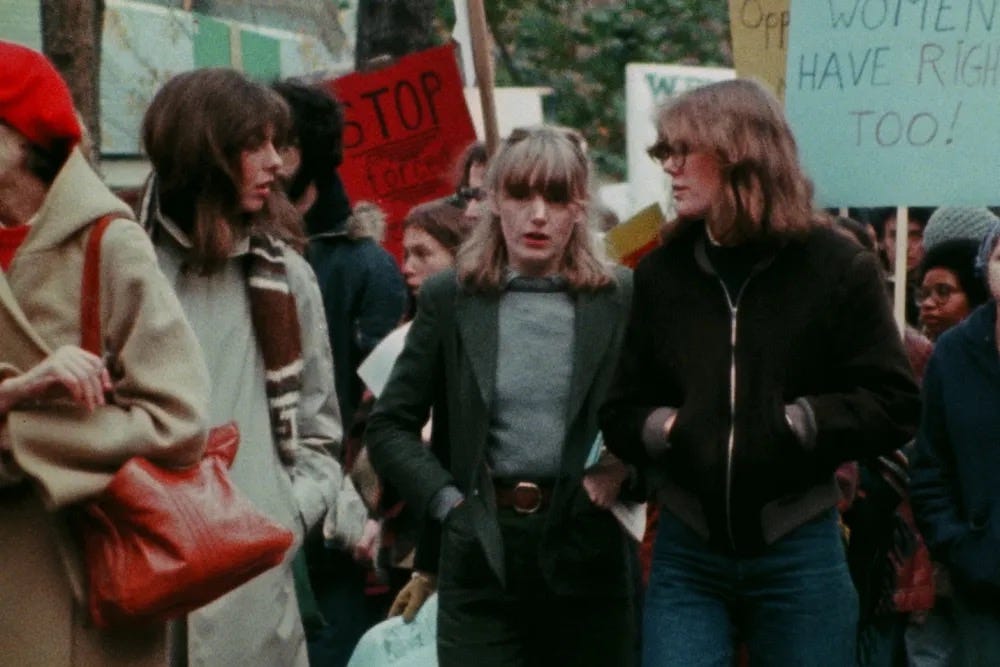
Then a review of Born in Flames this is an old feminist movie about revolution something clearly some of you need to remember how to do.
Then four things that happened to all of us recently that you should understand before somebody turns them into an infographic with a teal background and tells you that the world ends tomorrow.
This issue is about what remains after community stops being a promise and becomes a place you survived. It is about what you build after leaving. It is about how to keep wanting people without handing them a knife and a map of where to put it. It is about how to keep a feminism anchored in ordinary life something a lot of you seem to lack, because theory that cannot explain the pharmacy, the shelter intake form, the bad date, the rent payment, the rumor, the clinic, and the woman crying in the bathroom has confused itself for citation stuffing.
I have made most of these mistakes personally, so you can collect the educational value without paying the full tuition. (Despite the fact I should be charging and survive off donations and paid subs so please please please)
⸻
QUESTION ONE: WHAT DOES DATING LOOK LIKE OUTSIDE COMMUNITY?
The Submission
What does dating look like outside community?
Tara's Answer
It gets quiet at first. Less exciting. Half of us read that quiet as boredom and the other half read it as danger (personally I was more the later), and both of us are wrong. When you have dated inside community long enough you realize every 5 seconds you have to stop an emergency.
Then you date outside that and you start to see fewer people know when she slept over. Fewer people know which of you went quiet first. Fewer people are reading your posts like weather reports from a hostile country. Nobody is piecing together your emotional life from playlist changes, Instagram stories, and who liked whose selfie at 1:00 in the morning. You do not have twelve women developing a theory before breakfast. You do not have three of them picking a side in a breakup that has not happened yet. (This isn’t a joke I swear on my whole life I saw some other trans girls placing bets in a gc and saying who they would side with in a hypothetical breakup.) The relationship belongs, at least a little more, to the people actually trying to have it.
Community dating gives you a lot. I get the exes, the situationships, the 3am calls about dysphoria with someone who actually understands what that means, and the subsequent six months of avoiding her at every event in a forty-mile radius to prove it. (I’ve talked to enough nuclear bomb level cules to understand this) I still think about some of those women with a fondness that is frankly inconvenient. A shared political vocabulary makes the beginning easier. Another trans woman might already understand dysphoria, medical dependence, family estrangement, the terror of being wanted by someone who could later become ashamed of having wanted you, and the specific kind of poverty that develops when your body becomes a project you have to fund yourself. She might know exactly why you froze at the doctor's office, why a joke hit wrong, why being called pretty by the wrong person made your skin crawl. She might understand without you having to build the entire museum exhibit of your life from scratch. She might also have slept with your last girlfriend. In the trans lesbian scene this is so normal it barely qualifies as information.
But recognition is not character. Shared damage is not compatibility. A person understanding your wound does not mean she knows how to stop touching it. Community can make intimacy happen fast because both of you arrive with the same shorthand, the same references, the same enemies, the same inherited grief, the same little jokes that only make sense if your life has already been deranged in the proper direction. Falling for her can feel like walking into a place that already had your name on the door.
The place may also have six hidden microphones. Also your ex is in the server. Her ex moderates it. The woman you kissed at the Halloween party is dating the girl you had a thing with last spring, who is best friends with your current girlfriend's most recent ex. The trans lesbian dating pool in any given city contains maybe fourteen women and they have all, in some configuration, seen each other cry. There is no dating outside this scene. There is only dating different corners of it.
When two people skip the slow part because they already share a language, the relationship arrives pre-aged, like it has history it never earned. Three weeks in, you feel like you have known her for years, and you confuse that feeling for evidence. You have not known her for years. You have known a vocabulary for years, and she happens to speak it. Like someone who immigrates to a new country and for years never hears her native tongue and finally meets someone who does. Dating outside community makes you learn the actual person. Reputation becomes less useful. So does mythology. So does whatever file the scene has already made on her. You have to learn whether she can apologize without turning the apology into a performance review of your reaction. You have to see whether her politics survive contact with inconvenience. You have to find out whether she can be kind when nobody is applauding her for being kind, which turns out to be the only kind of kindness that pays rent in a relationship.
It is safer in the long run, which is an irritating thing to discover if you are addicted to intensity, and many of us are. It feels like the universe stamping the paperwork. It says, this is real, this is huge, this is different, this one understands. Then six weeks later you are sobbing in a kitchen at 3:00 in the morning because the woman who understood your abandonment wound has become an expert in operating it. The human heart remains a badly designed machine.
The ordinary part matters more than we want it to. Shared marginalization can create enormous intimacy, but it cannot run a whole relationship forever. At some point the dishes are still in the sink. Somebody forgot the pharmacy closes early on Sunday. One of you is tired. One of you is broke. One of you wants to talk and the other one wants to stare at the wall like a cursed Victorian child. Somebody has to sit through the long boring story about the coworker and keep her phone in her pocket. Somebody has to say "I was wrong" without adding a footnote about the trauma that made her wrong in an interesting way. The relationship lives or dies in those minutes, and there is no political vocabulary advanced enough to skip them.
Most trans women date through community because that is where the people most likely to understand you are. It is also where the people most likely to hurt you in ways nobody else can quite understand are. A beautiful arrangement. Humanity really outdid itself there.
The same small network becomes your dating pool, support system, political home, rumor mill, crisis line, archive, mutual aid structure, and, when everything collapses, courtroom. Stack that many functions onto one structure and of course every breakup feels like an eviction. You are losing more than a girlfriend. You might lose the group chat, the event, the friend who "doesn't want to get involved" but somehow only stops speaking to you, the parties, the casual invitations, the sense that you can walk into a place without watching everyone's eyes move at once. A breakup in a fused community is a custody battle over an entire social world, and the children are your friends.
That is why dating inside community can become so terrifying. Every relationship sits under the threat of exile. Even when nobody says it, you feel it. Behave correctly or lose access to the place where your life happens. Be easy to narrate or somebody else will narrate you. Stay beloved or become a cautionary tale. They will call this romance. It is romance conducted inside a small claims court run by people with untreated attachment issues and Canva accounts.
And the threat changes how you behave inside the relationship itself. That is where you pay for it. When leaving is this expensive, you stop saying the true thing. You swallow the small complaint because raising it might escalate, and escalation might reach the group chat, and the group chat might decide. You learn to manage her instead of knowing her, because management feels safer than honesty when honesty could end your housing situation, your friendships, and your standing in the only place that ever felt like home. A relationship you cannot safely leave is a relationship you cannot safely be honest inside. Take away the ability to walk out clean and you take away the ability to tell the truth while you stay.
Dating outside community does not magically solve this. People outside our scenes can still be cruel, selfish, cowardly, fetishistic, racist, transmisogynistic, boring, emotionally useless, or fond of podcasts. There is no pure dating market hiding beyond the transsexual gates. Sorry. The world remains the world, with worse lighting.
But it does change the shape of the risk. It gives you a chance to keep your relationship from being fused to every other part of your life. It lets you build privacy before the public gets hungry. It lets a breakup be painful without becoming a referendum on whether you still get to belong anywhere.
So spread your weight across more than one structure. Keep friends who have nothing to do with any of this. Have interests that cannot be turned into discourse. Know people who have never heard the worst thing anyone has ever said about you. Let your relationship keep some rooms the community never gets the keys to. The goal is to stop letting one network hold every single thing you need to live, so that losing one part of your life does not automatically cost you all the others.
Privacy is healthy. Secrecy protects abuse. Adults keep mixing them up because telling them apart requires judgment, and judgment seems to have died in committee. Privacy is keeping your own ordinary life to yourself because it belongs to you. Secrecy is hiding harm from the people who could stop it.
A woman who wants her relationship out of the group chat is asking for privacy. A woman who needs you isolated from everyone who might notice what she is doing to you is building secrecy. They look similar from across the room. They are opposite things, and the difference is whether the silence protects the relationship or protects the harm.
The Bad Example's Verdict
Date the woman whose behavior you understand better than her reputation.
Watch how she treats waitresses, ex-girlfriends, strangers, animals, and anyone who has no power to help her. Watch what she does in the hour after she hurts somebody. Watch whether her apology arrives with changed behavior or just a better vocabulary. A woman can memorize every correct political phrase and still take your life apart with tremendous ideological precision.
The Lesson From the Wreckage
A shared identity can start intimacy. Character decides whether it survives.
⸻
QUESTION TWO:
YOU USED TO BROWSE /tttt/. WHAT MADE YOU STOP?
The Submission
You mentioned in the last issue that you used to browse /tttt/. What made you stop?
Tara's Short Answer:
Tara’s long Answer:
I left when I realized I had stopped learning anything and started absorbing. My friends would repeatedly get angry with me and I got backhanded by a cute girl for saying that stuff in public.
At first, the board felt like the only honest room on the internet. People who have never been there cannot believe that. They hear the reputation, the cruelty, the brain worms, the racism, the slurs, the strange little rituals of despair, and they assume nobody could ever have gone there for relief. But some of us did. Some of us found it after realizing that respectable community spaces were very good at saying "you are valid" and very bad at saying anything useful about why you wanted to peel your face off in a bathroom mirror.
People talked openly about passing, dysphoria, desire, resentment, humiliation, surgery, race, sex, loneliness, envy, and the weird grief of transition. They talked about the things polite spaces handled by laying a slogan over them and backing away quickly. There was relief in that. Somebody would finally say the thing everyone else pretended did not matter, and your shoulders would drop an inch, because for once you were not the only person in the building who had noticed reality. Someone would describe the pharmacy and you would know exactly which pharmacy, exactly which moment, without her saying another word. That kind of recognition is worth something. I am not going to pretend it was nothing.
Because passing does matter. Beauty does matter. Money does matter. Surgery does matter. Being wanted matters. Being able to move through public space without getting studied matters. The world punishes bodies differently, and a politics that cannot admit that leaves trans women alone with the truth at the exact moment they need company. The official line tells you these things should not matter, which is a sentence written by people they have never been allowed to hurt. The board, at least, did not lie about whether they hurt. That was its real draw. It told the truth about the wound when everyone respectable was busy insisting the wound was a thought crime.
Then the honesty turned into a ritual. It stopped opening anything and started closing everything. The same arguments came back on a loop. The same hierarchies got measured down to the millimeter. The same photographs were passed around and studied for evidence of permanent doom. Every insecurity became a theory of human nature. Every bad night became proof that happiness had been handed out at birth to somebody prettier, younger, richer, whiter, straighter, smaller, softer, luckier. Nothing could just hurt for an afternoon. It had to reveal the total structure of reality, and the structure was always rigged, and you were always standing on the losing side of it.
The board was teaching despair. There is a difference between describing a thing and teaching it, and that difference is the reason I left. Describing despair would have meant naming a real thing and then leaving you free to do something about it. Teaching despair means building you a worldview where doing something about it is evidence that you have not understood your own situation. It gave you a vocabulary for fear, then examples, then habits, then a finished philosophy with your defeat already written into the foundation. It taught you how to catch your own humiliation in every reflective surface. It taught you how to scan other women for proof of where you stood. It taught you how to turn every difference between you and another trans woman into a verdict. It taught you how to confuse noticing hierarchy with understanding life. By the end you were not sad about your face. You had a theory about your face, and the theory was airtight, and an airtight theory of your own doom is the most comfortable prison ever built, because it lets you stop trying and call the stopping intelligence.
That is the trap. A place can be right about the existence of the wound and wrong about what the wound means. It can identify a real structure and still train you to kneel in front of it. It can tell you the truth about beauty and then lie by omission about love. It can tell you the truth about passing and then lie about womanhood. It can tell you the truth about cruelty and then lie about the future. Every individual sentence checks out. The world it adds up to is a fabrication, because it has quietly removed every fact that would let you keep going, and a worldview built only from the facts that hurt only looks like realism. It is curation with a body count.
I already had enough institutions in my life dedicated to teaching me to hate myself. The church got there first. The school took a turn. The medical system had notes. The street offered ongoing seminars. I did not need an extra one staffed entirely by unpaid volunteers working nights, especially one I was choosing to attend, refreshing on my own time, paying in the only currency I had left, which was the part of me that still thought things might get better.
What is this Really About
Anonymous spaces can say what respectable spaces suppress. That is their real value, so I am not going to pretend the answer is just to go back to the slogans. The same anonymity that lets one girl finally confess the thing she could not say anywhere else also lets another one turn somebody's pain into entertainment without ever paying for it. Nobody has to answer for what she talks another person into believing about herself. Nobody has to sit across from the woman whose face she just casually condemned. Nobody has to watch what happens after the thread closes and the girl goes back to the mirror with a new sentence in her head that she did not have an hour ago and will not be able to get rid of for years.
Cruelty starts performing as intelligence, and it shows up far beyond imageboards. The harshest answer wins because it sounds brave to people who have mistaken despair for courage. Moderation looks naive next to a woman calmly informing you that your face has already decided your life. The person who says "this matters, but it is not everything" gets treated like she is handing out state propaganda from the Ministry of Cope. So the conversation drifts, every single time, toward whoever is willing to say the most hopeless thing with the straightest face, because hopelessness reads as honesty and honesty reads as authority, and nobody notices that the most hopeless person in the thread has just given up the most completely, and she is recruiting.
People call that realism. Realism would have to account for the trans women who are loved, wanted, housed, employed, funny, difficult, ordinary, brilliant, annoying, and alive. A worldview that cannot fit a single one of those women inside it does not have a hard truth. It has a data problem. It has decided in advance which evidence is allowed to count, thrown out everything that contradicts the conclusion, and then presented the rigged sample as the cold honest face of the world. Calling that honesty is generous. It is building a haunted house and then being frightened by it on purpose because the fear feels like proof you are awake.
This is also why I write the way I write now. I do not want a trans feminism that lies to trans women because the truth might hurt. I also do not want a trans feminism that hands us the truth with no door attached. Telling a woman that hierarchy exists is not enough. She knows. Her body knows. Her bank account knows. Her dating history knows. Her pharmacy knows. The question is never whether the hierarchy is real. The question is what she can still build while standing inside it, and any analysis that cannot answer that second question has not finished its job. It has just described the weather and called itself a coat.
A theory that only teaches doom with no method to at least plan to fight back is just another cop in your head
The Bad Example's Verdict
Leave any room that makes you more observant and less able to move.
That is the test. Not whether it tells the truth. Plenty of true things are being said in the worst places on earth. The test is what the truth does to you once you have it. Good analysis is a tool you pick up and use. Bad analysis is a weight you carry that slowly convinces you that picking anything up is pointless. If you walk away from a place sharper, angrier in a way you can aim, more able to name what is happening and do something about it, stay. If you walk away from a place more accurate and more paralyzed, knowing more and hoping less, fluent in your own defeat, that place is grooming you for surrender, and it does not matter how correct its individual observations are.
You can talk about passing without shrinking womanhood down to facial measurements. You can take dysphoria seriously without treating your misery as a credential. You can admit beauty has power without worshiping it. You can understand that the world ranks bodies without volunteering to become one of its clerks.
The world is already full of men with calipers and a theory about your skull. Trans women do not need to sign on as their apprentices.
The Lesson From the Wreckage
A place can understand your pain completely and still spend all its time teaching you how to keep it.
⸻
QUESTION THREE: WHAT IS TRANS FEMINISM TO YOU?
The Submission
What is trans feminism to you?
Tara's Answer
Trans feminism starts with what actually happens to trans women.
That should be too obvious to print. Somehow it has become controversial enough to require several thousand essays, a bookshelf, a crisis, three fights, and at least one woman pacing her apartment at midnight talking to nobody. Reader, I have met that woman. Unfortunately, I keep being that woman. (This woman keeps my wife up sometimes sorry honey)
For me, trans feminism is a feminism built from the real conditions of transsexual women's lives. Medical dependence. Job discrimination you could never prove in court. Sexual violence. Racial hierarchy. Beauty. Passing. Housing. Family. Desire. Arrest. Exile. Rumor. Clinic waiting rooms. The way womanhood gets recognized, withdrawn, mocked, desired, punished, and managed all at once, often by the same person, sometimes in the same hour.
It begins where the body meets power.
Patriarchy argues with our womanhood in language and then punishes us through every structure it built to punish women. A trans woman can be told she is a man and beaten for being a woman in the same evening. She can be locked out of womanhood at the door and worked through her femininity the moment she is inside. She can be treated as sexually available, deceptive, disposable, dangerous, ridiculous, and somehow impossible to actually injure. That contradiction is the system working exactly as designed. It is patriarchy telling the truth about itself. The system was never organized around a sincere belief about who is and is not a woman. It was organized around control, and it will say whatever it needs to say about your gender to keep its hands where it wants them. Call you a man to deny you protection. Treat you as a woman to justify the violence. The category is a lever, and they pull whichever direction gets them the outcome.
That is what I keep coming back to in my own work. The denial of our womanhood does not spare us from misogyny. It often makes the misogyny easier to carry out. If they can say you are not a woman, they can deny the injury even as they perform it. They can punish the femininity while refusing the name. They can use your womanhood when it makes you vulnerable and deny it when you ask to be protected. This is the engine I have spent years trying to describe, the part where the same gesture that strips you of the category also uses the category against you, where you are too much of a woman to be safe and not enough of one to be defended, and where both of those judgments are made by people who would swear, sincerely, that they are simply telling the truth about your body.
Recognition still matters. I want trans women called women. I want the language. I want the category. I want the obvious sentence said plainly. I have not evolved beyond wanting to be named correctly, and anyone who implies otherwise should be forced to read comment sections for sport.
But recognition has never been enough, and this is where a lot of trans politics quietly gives up while believing it has arrived. A theory that stops at "trans women are women" cannot explain why the same people denying our womanhood stay so invested in controlling our bodies, sex lives, labor, faces, movement, and public existence. It cannot explain why the shelter intake form, the workplace, the clinic, the prison, the street, the family, the partner, the community, and the state all seem to know exactly where to put their hands on us. If the whole problem were that they refuse to call us women, then getting called women would fix it. It does not fix it. You can win the word and still lose the apartment, the job, the custody, the safety, the life. So the word was never the whole fight. Trans feminism has to explain the punishment, because the punishment is what continues after the language has been won.
So it has to ask ugly questions. Who gets protected. Whose pain becomes political. Which women get to be complicated. Which women become warnings. Why femininity is an order handed to some women and evidence used against others. Why trans women are desired as a secret, mocked as a public object, and abandoned as a liability. Why communities can learn every correct phrase and still reproduce the same hierarchy with better lighting. These questions only sound cynical. They are the only ones that lead anywhere, because they go looking for power where it actually sits instead of where it has agreed to be discussed.
Race sits inside all of this from the first sentence. Black trans women cannot be added at the end like a seasoning somebody forgot on the first pass. Racialization decides who gets read as feminine, who gets read as threatening, who gets believed, who gets called deceptive, who gets imagined as sexually available, who gets treated as disposable, and who is ever considered worth rescuing. The same femininity that gets a white trans woman read as fragile gets a Black trans woman read as a performance, an aggression, a provocation. The protection that flows toward one body curves away from another. Any trans feminism that treats race as a later chapter has already mislaid half of who it claims to be for, because the punishment it wants to explain does not arrive evenly, and the unevenness is the design, written in on purpose.
Class is there too, because transition runs on money. Safety runs on housing. Passing runs partly on access to care you have to pay for. Survival runs on paperwork, transportation, food, rest, a phone that works, a door that locks, and people who will answer when you call. Political recognition gets thin very quickly for a woman who cannot make rent, cannot eat reliably, cannot get across town, or has nowhere to sleep tonight. You can affirm her gender in flawless language while she loses everything that would let her live inside it. A theory that only hands her correct words has confused vocabulary with liberation, and the woman it failed will not be comforted by how respectful the failure was.
And I do mean liberation. Not branding. Not identity maintenance. Not community theater where everyone recites the right lines and then goes home to treat each other exactly the same. I mean the material work of making trans women harder to kill, harder to evict, harder to isolate, harder to exploit, harder to disappear, and harder to turn into a lesson for everyone else. The ordinary, humiliating work. The work that does not photograph well. The work that no logo improves.
That is why my feminism keeps turning back toward community, even after everything I have written about what community does. I do not write about community because I believe in it easily. I write about it because I stopped believing in it easily and still had to figure out how to keep living near other people. I write about it because exile is real. I write about it because a woman can be harmed by a community and still need food, medicine, friends, shelter, theory, jokes, and somewhere to put the part of herself that wanted to belong. I write about it because abandoning the word to the people who use it badly feels like letting the arsonists keep the house. The people who reproduce exile under the banner of care would love for everyone who notices to leave quietly and stop using the word. I decline. The word is worth fighting over precisely because it is being used as cover, and you do not win that fight by conceding the territory.
Trans feminism, to me, is the work of telling the truth about that house. Who built it. Who gets a room. Who gets the couch. Who gets locked outside. Who gets called dangerous for pointing at the fire. Who keeps calling the smoke a communication issue.
What This Is Really About
A lot of trans politics right now is organized around recognition: the correct name, the right pronouns, the proper category, a seat at the public table. Those fights matter. Language helps decide which injuries an institution is willing to record as real, and an injury an institution refuses to record is an injury you have to prove twice, once to the person who caused it and once to the system that pretends it did not happen.
But recognition has a ceiling, and we keep walking face first into it. A shelter can agree you are a woman and still leave you on the sidewalk. A workplace can put pronouns in every email signature and still fire you by spring. A clinic can affirm you in language and make access impossible in practice. A community can speak fluent transmisogyny theory and still close ranks around the popular woman who hurt you. Material life stays stubbornly material. Rent has never accepted discourse as payment, though several activists appear to be preparing a pilot program.
The point is to keep going after recognition arrives and the building still has the same locks. Recognition is the start of the fight dressed up as the end of it. The institution says the right words, everyone relaxes, the cameras leave, and then the actual distribution of housing and medicine and safety and money continues exactly as before, because the words cost the institution nothing and the redistribution would cost it everything, and it correctly guessed that most people would accept the words and go home.
That is also why trans feminism has to be feminist in the old sense, the useful sense, the sense that understood women's lives as lives. More than identity. More than representation. Lives. Work, sex, violence, medicine, beauty, children, aging, dependency, housing, food, art, friendship, marriage, loneliness, state power, prisons, gossip, fear, pleasure, all of it. Feminism mattered because it refused to treat women's oppression as a single issue that could be solved in a single place. It understood that the harm comes through the whole day, through the job and the doctor and the husband and the law and the mirror, all at once, in a weave you cannot pull one thread out of. Trans feminism inherits that or it inherits nothing.
It should be able to explain the whole day.
It should be able to explain why a trans woman needs hormones and also why she is scared to date. Why she wants to pass and also why passing cannot be the measure of her life. Why she hates the community and still needs other trans women. Why she distrusts recognition and still needs to be called by her name. Why she can see straight through the scene and still want someone to text her back. None of those tensions are contradictions to be resolved. They are just what it is to be a whole person under these conditions, and a feminism that cannot hold all of them at once is not too sophisticated for ordinary life. It is not sophisticated enough.
The Bad Example's Verdict
Trans feminism should go looking for power at the exact point where it enters the body and the ordinary day.
Who can actually get hormones. Who gets believed after she is hurt. Who gets hired. Who gets touched. Who gets public sympathy. Who gets a sigh. Who is allowed to be angry. Who is expected to disappear so everyone else can keep up the appearance of safety. Who gets called complex. Who gets called drama. Who gets archived as a problem and removed from the room. Follow those questions and you will always end up somewhere real, somewhere with a cost attached, somewhere the slogans were specifically designed to keep you from looking.
Start there, on the ground, where the answers cost something.
The Lesson From the Wreckage
Womanhood shows itself most clearly in the systems that govern women's lives, including the lives of the women those systems refuse to name.
⸻
QUESTION FOUR: HOW DO I MAKE FRIENDS AFTER COMMUNITY HURT ME?
The Submission
I left a trans community that treated me badly, and now I do not trust anyone. How am I supposed to make friends again?
Tara's Answer
You start one person at a time.
That is the whole method. I know how thin it sounds. I know it can feel insulting when you are standing in the wreckage of a whole life and someone offers you a coffee as though the answer to exile is a pastry and forty-five minutes with a girl who might forget to text back. But that is where it starts. A whole new community cannot fail safely. One coffee can. When you have already been destroyed by something big, the only thing you can afford to risk is something small. The smallness is the mechanism of repair.
The word community trains us to picture friendship as a structure you find the entrance to. The right server, the right group, the right scene, the right city, the right politics, and then belonging is supposed to arrive fully assembled, like furniture you ordered. It never does. Community is an accumulation of actual relationships, built one at a time, that eventually got dense enough to deserve a name. When people skip the relationships and chase the name, they end up with the banner and nothing underneath it, and a banner with nothing underneath it is exactly the kind of place that hurt you, because it had all the language of belonging and none of the load-bearing structure, so the first time weight was applied it collapsed and took you with it.
After you have been hurt, big groups feel dangerous because big groups can coordinate. A private disagreement becomes shared knowledge by Tuesday. One person's version of you picks up witnesses who were never in the room. You start scanning every face for signs that the process is about to begin again. The laugh across the room becomes evidence. The late reply becomes evidence. The slight shift in tone becomes evidence. Your nervous system becomes a little prosecutor in a cheap suit, building a case out of everything, working overtime, certain that if it just stays vigilant enough it can see the betrayal coming this time.
That fear is not stupid. It learned from experience. I will never tell a woman who got burned that the fire was imaginary. Some communities do punish through social disappearance. Some people do use safety language as a weapon. Some groups do turn one woman's pain into a public identity and then act shocked when she stops trusting them. You are not paranoid for knowing what people can do once they decide the story is already written. The fear is good information about what happened.
But fear left to run the whole house becomes another jailer. The trap is one the fear will present as wisdom. It will keep you safe from betrayal by making sure no one can ever get close enough to betray you. It will protect you from abandonment by arranging your life so that everyone is already gone, on your terms, in advance. It will call this discernment. It will sound convincing, because fear always has receipts, it can always point to the last time and say remember, and it is not wrong about the last time. It is only wrong about the cost of its solution, which is a life with no one in it, defended perfectly, against nothing.
So start smaller than your fear wants. One person. One coffee. One walk. One shared task. One book passed back and forth. One ordinary favor. Help someone carry a table. Make soup. Work on a project together. Watch a movie. Sit next to someone without turning the conversation into a complete audit of your respective wounds. The size is the feature. Small, repeated, low-stakes contact is the only place you can gather real evidence about a person, and evidence is the thing you are missing, the thing the last place taught you to skip.
Because trust is supposed to come from behavior you have watched, over time, with your own eyes. A fast feeling is not that. So watch. Does she keep a secret. Does she show up when she said she would. Does she stay roughly the same person when other people enter the room, or does she rearrange herself for whoever has the most status present. Can she disagree without becoming cruel. Can she hear no. Does she gossip as a form of intimacy, pulling you close by handing you someone else's private life. Does she treat absent people like future material. Does she make every minor inconvenience into a referendum on loyalty. Does she apologize in a way that lowers the temperature, or does she apologize like she is trying to win a debate nobody else knew was happening. None of these are answered by how she makes you feel in week one. They are answered by what she does in month four, when nothing is at stake and she does not know you are still looking.
You do not owe a stranger your whole interior because the two of you share a category. You are allowed to be careful. You are allowed to have layers. You are allowed to enjoy someone without giving her a guided tour through every wound, every dead name, every hormone log, every screenshot, every betrayal, every humiliating photo from before, every humiliating thing you still remember at 2am. There is no prize for becoming legible to someone before she has shown she can read gently. The fast intimacy that political spaces run on only feels like closeness. It is exposure, and exposure to a person whose character you have not tested is just risk wearing the costume of connection.
Political spaces fast-forward intimacy through disclosure. Everybody meets, everybody trauma-dumps, everybody says "I love you" too early, everybody becomes emotionally dependent on people whose character has never been tested by a single inconvenience. It feels like the realest connection of your life. It is just velocity. In trans women's spaces it moves even faster because the shorthand is already installed. You mention your mom's face when you told her and twenty women in the room make the exact same expression. By the second hangout someone is crying on someone else's shoulder. By week three half the room is each other's emergency contact and someone has proposed a found family arrangement with a Discord server and a shared grocery budget. None of it is fake. All of it is too soon. Then the first real conflict arrives, and everyone discovers they built a house out of wet cardboard and shared terminology, and it comes apart in a weekend, and everyone is shocked, and no one should be, because nothing was ever load-bearing. They mistook the speed of the bonding for the strength of it, and those are not the same measurement. Some of the deepest bonds form slowest. Most of the fastest ones form because something is wrong.
Build slower. Build around doing. Build around ordinary time. Character shows up when nothing dramatic is happening. It shows up in boredom, mild disagreement, errands, a missed bus, a bad mood, someone being tired, someone needing help and it being inconvenient to give it, someone being corrected without an audience and choosing whether to be decent about it. The boring hours tell you more than the confessional ones, because anyone can be moving at 2:00 in the morning during a crisis. The question is who she is at 4:00 on a Tuesday afternoon when helping you would cost her something small and no one is watching to applaud.
And be patient with the part of you that keeps flinching. It is trying to save your life with outdated equipment. It learned its rules in a genuine emergency and it has not been told the emergency is over, so it keeps treating ordinary friction as the opening move of an attack. Sometimes a woman answered badly because she is awkward, not because she is cold. Sometimes she forgot to text back because she is tired, not because she is pulling away. Sometimes she is not secretly organizing your social death. Sometimes she is simply a little annoying, which remains legal in most jurisdictions despite my objections. Part of healing is learning to tell the difference again between a real warning and an old echo, and you only get that skill back by staying in the room long enough to be occasionally, safely wrong.
What This Is Really About
You are trying to solve loneliness and fear at the same time, and they pull in opposite directions, which is why the obvious moves both fail. Run straight into another intense group and you might fix the loneliness for a month while making the fear permanently worse, because you walked into the exact structure that hurt you and asked it to heal you. Withdraw from everyone and you are safe from betrayal and guaranteed to be alone, which is just a slower way of letting the last people who hurt you win. Small, repeated, low-stakes contact is the narrow road between those two failures. It is slower than either one. That is precisely why it works. It is the only approach that treats the loneliness and the fear as both real, instead of sacrificing one to the other.
This is also why I keep arguing for infrastructure instead of vibes. Vibes cannot hold you when things go wrong. A room full of people saying "community care" cannot substitute for actual relationships with actual obligations to you. If there is no process, no boundaries, no privacy, no agreed way to repair harm, no way to leave without being destroyed, then the community is just a social weather system with a logo, warm when the weather is warm, gone the second it turns. Infrastructure is the unglamorous version of love: the standing agreement that you get fed even when you are difficult, that there is a way back after a fight, that someone's standing in the group does not depend on her staying convenient. None of that is produced by feeling. All of it has to be built, on purpose, by people willing to do boring work, which is why it is so rare and why the places that skip it always end up reproducing the harm they swore they were against.
Friendship after community harm means refusing two lies at once, and they are both seductive, and they will both ruin you in different ways. The first lie says you should trust everyone because you are all oppressed together. Absolutely not. Oppression does not make people safe. Sometimes it makes them more creative about how they harm each other, because they know exactly where the soft tissue is. The second lie says you should trust no one because you were hurt before. That one feels smarter, more adult, more protected. It will still empty out your entire life. Both lies let you skip the work, which is the slow, unglamorous business of watching individual people behave over individual time and deciding, one at a time, who has earned what.
You need evidence. Not promises. Not intensity. Evidence. The friend who quietly texts to check whether you got home is worth more than the woman who swears eternal loyalty four days in. Eternal loyalty, as a product, has suffered serious inflation lately. It tends to default the moment it is asked to cost her anything, and the women handing it out fastest are very often the ones with the least intention of paying when the bill arrives. Watch what people do when being your friend is inconvenient. That hour tells you everything the vows were trying to distract you from.
The Bad Example's Verdict
Look for consistency before you trust intensity.
Do not search for a new "community" as though it will arrive in one piece and save you. Build relationships that can survive being real, one at a time, slowly, with your eyes open. Then, if enough of those relationships happen to gather in one place over enough years, maybe you get something that actually deserves the word, something with structure under it, something that will still be standing the next time the weather turns. That is the only version of community I trust now. The kind you grow from the bottom, out of tested individual relationships, instead of the kind you join from the top and pray about.
The Lesson From the Wreckage
Trust is evidence, gathered slowly, in person.
⸻
QUESTION FIVE: WHEN IS CRITICISM CARE, AND WHEN IS IT PUNISHMENT?
The Submission
How do I know when someone is criticizing me because she cares and when she just wants power over me?
Tara's Answer
Look for the exit.
Real criticism leaves you one. Punishment quietly removes it. That is the cleanest test I have, and almost everything else is detail hanging off it. Criticism that cares is trying to get somewhere specific and then stop. It names the thing you did, explains the harm it caused, asks you to change it, and leaves enough room for the change to actually count once you make it. Punishment keeps the original accusation alive long after the behavior has stopped, because by then the accusation has stopped being about the behavior at all. It has become useful, and useful things do not get put down voluntarily.
Care tends to stay specific. It can tell you what happened, with a date and a sentence, in words you could actually act on. Punishment expands on its own, and the expansion is the tell. A slow reply becomes proof of deep narcissism. One rude comment becomes a danger to the entire community. A private fight becomes an ideological problem the public urgently needs to know about. Give it a week and your whole personality has been reverse-engineered out of the worst fifteen minutes you had all month, and every neutral thing you have ever done is being reread through the new frame as further evidence. Care narrows toward the fixable thing. Punishment widens toward the unforgivable person. Watch which direction it travels, because the direction is the diagnosis.
Care keeps proportion. Punishment treats maximum escalation as proof that it is serious, as though volume were a substitute for accuracy. Care can handle privacy when privacy would solve the problem, because care wants the problem solved. Punishment goes looking for an audience, every time, because the audience is where the power comes from, and a punishment conducted in private gives up the only thing it actually wanted. Care can tolerate hearing your side. Punishment needs a confession, and it will keep adjusting the charge until it gets one, because the goal was never to find out what happened. The goal was to win, and you do not let the other party speak when speaking might cost you the verdict. Care wants the harmful thing to stop. Punishment wants you filed permanently under a category you are not allowed to leave, because the category is the prize. She will call the category accountability. She means: I get to be right about you forever.
This does not mean every criticism that hurts you is punishment. I would love it if pain reliably meant we were correct, that the sting was proof of innocence, but unfortunately the universe has denied us this particular convenience. Sometimes you are defensive because somebody is being unfair to you. Sometimes you are defensive because somebody is right and your ego has decided to respond by setting off fireworks indoors. Both experiences feel almost identical in the body. Same heat, same racing chest, same urge to explain. That is yet another design flaw in the equipment, and it means you cannot use your own discomfort as a readout. The fact that it hurts tells you nothing about whether it is true. You have to look at the criticism itself, not at how loudly your nervous system is objecting to it.
So listen even when it feels unfair. Ask what part of it is true, even if it is only a small part wrapped in a lot that is wrong. Ask what repair is actually available. Ask what you would want to change regardless of the other person's motives, because sometimes a person can come at you in bad faith and still accidentally name something real, and you are allowed to take the real thing and leave the bad faith. There is a hard kind of maturity in extracting the useful piece without letting someone own your entire self through it. You can be wrong about a specific thing without becoming the monster in somebody else's theater. You can repair a real harm without consenting to permanent degradation as the price. Those are different transactions, and people who are punishing you will work very hard to make them feel like the same one, because if repair and degradation are bundled together then your accountability becomes their leverage.
Then watch what happens after you respond. Almost nobody does, because by the time they get here they are too busy panicking, confessing, defending, apologizing, screenshotting, subtweeting, or consulting the group chat Supreme Court for an emergency ruling. But the aftermath is where the truth lives. Does she notice the repair, or talk straight past it as though it never happened. Does the standard stay the same from one week to the next, or does it move every time you get close to meeting it. Does she apply it to her own friends, or only to you. Does she want the behavior changed, which is something you can do, or does she want the accusation preserved, which is something you can never undo. Can this end. Under any possible version of events, under any apology, any change, any amount of time, can this ever be over. Sit with that last one, because the answer is usually already known to everyone involved, including the person who keeps insisting it could be resolved if you would just do more.
The way it ends, or refuses to, tells you almost everything you came here to learn.
What This Is Really About
Most communities have no real process for conflict. So they improvise one out of whatever is lying around: group chats, callouts, whisper networks, blocks, bans, vague warnings, social pressure, public statements, and the ancient human appetite to be on the winning side before all the facts are in. The improvised process feels like justice because it has the shape of justice, the accusation and the consensus and the consequence, but it skipped the parts that make justice anything other than a popularity contest with stakes, which are the parts where the accused gets to respond, where the standard is fixed in advance, where the punishment has a limit, and where someone neutral has to be convinced.
Sometimes those tools surface real harm. Sometimes there truly was nowhere else for the information to go, because the formal channels were captured or useless or actively protecting the person doing the harm. Sometimes privacy has already failed the person who was hurt, and going public is the only protection left. I am not interested in a politics that treats every public accusation as hysteria, that hears a woman name what happened to her and reaches immediately for reasons to doubt her. That reflex is just misogyny wearing reading glasses, and it has buried an enormous amount of real harm under the word drama.
But I am also not interested in pretending that every conflict becomes more righteous the moment you add an audience. Publicity is power. People know this, even when they are pretending they do not, even when they are insisting they went public reluctantly and only for safety. They know the first coherent story usually becomes the official one, regardless of whether it is the true one. They know a moral frame can convert ordinary interpersonal mess into a political emergency that no one is allowed to examine too closely. They know safety language can sanctify a punishment that would look ugly if it were named plainly. They know vagueness protects whoever already has the most social force behind her, because in the absence of specifics the crowd fills in the blanks in favor of the person it already likes.
This is why precision matters, and why mistaking it for coldness gets everything backwards. Precision is how you tell the difference between harm and discomfort, between abuse and incompatibility, between danger and dislike, between a pattern and a single bad night, between a person who needs to repair something specific and a person the community has simply decided it would be convenient to exile. Every one of those distinctions matters, and every one of them gets deliberately blurred when somebody is using harm language to win a fight she could not win on the facts. The blur is the strategy, because the moment you are forced to be specific, the disproportion shows.
And the cost of losing those distinctions falls exactly where you would least want it to. When every bad date becomes a public emergency, genuinely dangerous people thrive, because real danger is now indistinguishable from ordinary disappointment and the warnings have lost all their meaning. When every rude message becomes abuse, actual abuse becomes harder to name, because the word has been spent on things that did not deserve it and no longer carries the weight the real thing needs. When every conflict gets framed as safety, safety becomes a costume that ordinary power puts on to do what it wanted to do anyway. And once that happens, the most vulnerable people in the room do not get safer. They get more narratable, more available to be cast as the threat, because they are the ones with the least social power to contest the story being told about them.
I have written far too much about community to believe in punishment just because it arrives with a gentle name. Accountability is real and I want it. But accountability needs shape. It needs proportion, so the response matches the harm. It needs memory, so a resolved thing can actually be treated as resolved. It needs privacy when privacy protects the person who was hurt, and public action when public action is genuinely necessary, and the judgment to tell those situations apart instead of defaulting to whichever one feels more satisfying. And it needs enough honesty to admit, out loud, when someone is using the language of harm to run a campaign she could not run on the merits. A community that cannot tell the difference between accountability and exile will eventually do both under the same word and feel righteous the entire time.
The Bad Example's Verdict
Five questions.
What exactly happened, in specific words, with a time and a place. What specific repair is being asked for, and is it something a person could actually do. Is the reaction in proportion to the thing itself, or has the volume detached from the offense. Can this accusation ever be resolved, or was it built from the start to be permanent. Would the same standard survive being applied to a popular person, or does it only function against someone the room had already decided to be done with.
That last question is a small blade, so use it carefully and use it honestly, including on your own side. If the answer is no, if the standard would never survive contact with someone well-liked, then you are not watching accountability. You are watching punishment shop for a public outfit, and the outfit is the language of care.
The Lesson From the Wreckage
Accountability needs a future to point at. Permanent condemnation is exile with an administrative badge.
⸻
THE FEMINIST MOVIE REVIEW
BORN IN FLAMES
The Revolution Happened. Women Are Still Doing the Dishes.
Lizzie Borden made Born in Flames in 1983 and set it ten years after a peaceful socialist revolution wins power in the United States.
The revolution has already happened. The government speaks fluent equality. The old order is officially defeated. Everyone in charge will tell you, at impressive length, that liberation is now policy, that the work is done, that what remains is a matter of patience and process and trusting the institutions that the revolution so generously left in place.
Women are still poor. Black women are still watched. Men still run the institutions, only now with better language and a sincere belief that they are the good ones. The harassment continues. Women's labor is still treated as worth less than it is. The left throws itself a standing ovation while the women living underneath its great victory quietly begin organizing the next revolt, because they have noticed that the victory rearranged the slogans without rearranging the work.
I will admit this is a wildly unrealistic premise, since left-wing men would obviously never declare the revolution finished while women were standing directly in front of them describing problems that had not been solved. That has never happened in the entire history of the left. I cannot think of a single instance. Moving on.
The film moves through several groups of women in New York: the Women's Army, two underground radio stations that cannot stand each other, newspaper workers, organizers, lesbians, Black radicals, white feminists, and women whose political disagreements keep crashing into the one fact they all share, which is that men still hold the power and the new dispensation has no plan to change it.
It is built like a political collage, and the form is part of the argument. It does not slow down to hold your hand. News reports cut into surveillance footage, radio broadcasts, meetings, protests, music, street arguments, and the film simply expects you to keep up without a gentle explainer voice tucking you into bed. That refusal is part of its force. Most political films sand the conflict down until the audience knows exactly who has the correct opinion and can go home morally comfortable. Born in Flames does the opposite. It gives its women competing strategies, real racial tension, genuine class difference, personal loyalty, resentment, suspicion, and solid reasons to distrust one another. Coalition is hard in this film because the women have been handed actual politics instead of slogans, and actual politics is where people who agree on the enemy still disagree, painfully, on everything else.
The socialist government keeps offering reforms, and the reforms are the most familiar thing in the movie. There is talk of wages for housework. There are committees, explanations, programs, promises, all the soft machinery of a state that has learned how to absorb dissent by sounding sympathetic until everyone gets tired and goes home. The institutions insist that progress is ongoing and patience is owed. The women stay suspicious, because recognition keeps arriving while power does not, because every reform is structured to look like motion while changing nothing about who decides, and because they have learned to read the gap between what the state says and what the state does.
This is where it bites.
The film understands something feminist movements rediscover every single generation and then forget again. Women get invited into a political project after its real priorities have already been set, after the important questions have already been answered by other people, and they are told that their particular injuries are scheduled for a later that somehow never arrives. Their anger gets accused of threatening unity, as if unity were a fragile thing the women were endangering, when it was a silence the men were enforcing. Their demands get called divisive, when the only thing being divided is a false peace that was built on their compliance in the first place. Born in Flames asks the question every woman in every movement eventually has to ask, which is what you are supposed to do when patience has quietly become another word for staying in your place.
Its answer gets more militant as it goes, and it earns the escalation. The Women's Army organizes protection against street harassment and sexual violence, the bicycles arriving in a swarm, because the state that calls itself revolutionary will not protect them and they have stopped waiting for it to. Pirate radio gives women a way to interpret what is happening to them before the official version hardens into accepted fact. When the Black organizer Adelaide Norris dies in police custody, the state produces its tidy explanation and expects everyone to file back to normal, to accept the official account and let the matter close. The women decline to file back to normal. That refusal is the hinge the whole film turns on.
The politics feel alive because the film treats media as part of the fight rather than a neutral window onto it. Whoever narrates an event controls what that event is permitted to mean. The official broadcast calls it order. The underground stations call it power. The surveillance footage turns women into threats before they have done anything at all, the camera itself doing the work of conviction. The state assembles, in real time, the story it needs to justify whatever it had already decided to do next, and the film makes you watch the assembly happen, which is the most useful thing it does.
We run that same process through our phones now, constantly, which has of course made everyone calmer and far better informed. A genuine miracle age. No notes.
The film also knows that sharing an oppression does not hand you solidarity for free, and it refuses the easy version where the women discover they were on the same side all along. They get divided by race, by class, by sexuality, by strategy, by proximity to the institutions, and by how much faith each of them has left in the possibility of reform. Some still believe the system can be forced to keep its promises if they push hard enough through the proper channels. Others have already watched the system swallow reform whole and hand survival back to them wrapped as a victory, and they are done asking. Both positions are held by serious people for serious reasons, and the film does not tell you which one is correct. It makes you sit inside the disagreement.
Born in Flames does not resolve any of this with a tearful speech about unity, and thank God, because I have personally absorbed enough speeches about unity to last several lifetimes and at least one medium-sized dictatorship. The alliance, when it finally comes, comes through action, through accumulated pressure, through shared grief, and through the slow grinding recognition that every faction, however much they distrust each other, is operating inside the same structure and getting crushed by the same hand.
That is the most useful thing the movie has to teach, and it is the thing I keep coming back to in my own work. Coalition needs difference that can survive contact with itself. Unity built out of silence falls apart the second somebody finally says something true, because it was never unity. It was just everyone agreeing not to mention the thing, and the moment the thing gets mentioned the whole arrangement reveals how little was actually holding it together. Real solidarity is messier and more durable, because it was built by people who disagreed out loud and stayed anyway.
The film is rough, impatient, and sometimes more convincing as political imagination than as a tidy story, and that roughness belongs to it completely. It feels like it was made by people who had something urgent to say and made it before anybody handed them permission or funding, which is exactly what happened. Its imagined future looks almost precisely like 1983, because the future, in practice, almost always shows up wearing the furniture of the present, and the film is honest enough to admit that the world after the revolution will mostly resemble the world before it unless someone does the specific work of changing the relations underneath.
That is the central question, and it is still entirely ours. What happens when a movement takes control of the institutions and leaves the relations underneath them perfectly intact. The slogans change. The hierarchy studies the new slogans and learns them by heart. Women get told to be grateful for the progress and patient about the rest. Their anger gets treated as a threat to the project they were promised was theirs. Their labor keeps the whole world running while the men hold the press conference about how far everyone has come.
Then, somewhere across town, somebody turns on the pirate radio.
The Bad Example's Rating
Four and a half bicycle gangs out of five.
Watch it with the woman in your life most likely to pause the movie every seven minutes to explain how this exact scene proves the argument she was making at dinner. She will be insufferable about it. She will also, irritatingly, be mostly correct, and you will think about the film for a week.
⸻
THINGS YOU SHOULD KNOW THIS WEEK
THE FTC AND FOUR STATES SUED WPATH
The Federal Trade Commission, joined by Texas, Alaska, Iowa, and Nebraska, sued the World Professional Association for Transgender Health on June 17. The complaint accuses WPATH of making deceptive claims about gender-affirming care for minors, alleges its members profited from those claims, and asks the court for an injunction against the organization's care recommendations. WPATH denies all of it and calls the suit what it plainly is, retaliation, noting that the FTC has no jurisdiction over a medical organization's noncommercial speech.
Pay attention to where it was filed. The case went into federal court in the Northern District of Texas, a court with a reliably conservative reputation where this administration has been quietly centralizing its legal campaign against trans care. That is the same district that produced the criminal subpoena against NYU Langone, which is the next item on this list. When the same office in the same friendly venue keeps generating the legal instruments aimed at trans medicine, you are looking at a strategy with a return address.
The FTC is a consumer-protection agency. It is not a medical board. It is not a pediatric endocrinologist. It is not the parent sitting in a clinic with a frightened kid trying to make an impossible decision well. Pointing a consumer-protection agency at medical standards of care opens a new road, and the road is the point. Restricting care no longer requires one clean national ban that a court can strike down in an afternoon and that makes for an ugly headline. Instead you make providing the care legally dangerous and financially ruinous enough that hospitals quietly stop on their own, decide it is not worth the exposure, and close the program before anyone forces them to. Even a public-health expert quoted on the suit called it a significant expansion of how the agency has historically operated, which is the polite institutional way of saying they have found a new weapon.
That is the move, and the method repeats. It is not always prohibition in the dramatic sense, the cop at the clinic door. Sometimes it is paperwork. Subpoenas. Penalties. Investigations. Compliance risk. Insurance fear. Grant pressure. The slow steady conversion of ordinary medicine into a standing legal hazard, until the people who provide it decide the risk is no longer survivable. They have discovered administrative warfare, which remains one of this country's favorite ways of doing real and lasting violence while keeping a respectable indoor voice the entire time.
Winning the lawsuit is not even the main goal. The point is to make every institution downstream of it afraid. The clinic gets afraid. The hospital's legal department gets afraid. The insurer gets afraid. The individual doctor gets afraid. The family gets afraid. Then everyone calls the resulting disappearance of care a pause, a review, a policy update, a temporary suspension pending guidance, or whatever other phrase the cowardice department settles on before lunch.
Trans people have lived through the shape of this before, and the shape rarely involves a door slamming all at once. First it gets complicated. Then it gets expensive. Then it gets risky. Then it gets delayed. Then one ordinary afternoon you realize the right technically still exists, somewhere, on paper, in a place you can no longer reach. Watch this case for exactly what it is. An attempt to make the entire infrastructure of trans medical care flinch.
⸻
A JUDGE PARTIALLY BLOCKED IDAHO'S CRIMINAL BATHROOM LAW
On June 16, a federal judge granted a preliminary injunction partially blocking Idaho's House Bill 752, a law that would have put criminal penalties on transgender people for using public bathrooms that match their gender. The law was set to take effect July 1. A first offense was written as a misdemeanor carrying up to a year in prison, a second as a felony carrying up to five. The judge also provisionally certified a statewide class, so the injunction reaches beyond the six named plaintiffs and temporarily covers transgender people across Idaho while the case proceeds.
Read the scope carefully, because the relief is narrower than the early headlines suggested. The injunction bars enforcement when the bathroom in question is a single-user facility, and when no single-user facility is available because none exists on that floor or all of them are occupied or out of service. It does not touch changing rooms or locker rooms, which were not part of the request. And a trans person who uses a multi-stall bathroom while a single-user option sits available nearby can, as written, still be charged. So this is a real and meaningful limit on the law, and it is also a maze, and trans Idahoans now have to solve the maze every single time they need to do the most ordinary thing a body does in public.
This law sits far outside any mainstream, and that tells you what it was for. Idaho's is the only criminal bathroom ban that extends to private businesses open to the public, and it carries the steepest penalties of the handful of states that have criminalized bathroom use at all. Even the state's own Fraternal Order of Police and its association of police chiefs opposed it, on the straightforward ground that there is no reasonable way to determine a stranger's birth sex during a field encounter without invasive and inappropriate questioning or searches. When the cops themselves tell you a law is unworkable, the law was written to send a message, and the message was leave.
Because bathroom laws were never about bathrooms. They are about making public life conditional. They are about training a trans person to run a calculation before entering any building at all. Where is the bathroom. Who is watching. What does the sign say. Is there a single-user option. Is it on this floor. Is it occupied. What happens if someone notices me. How much danger attaches to my body performing one unremarkable biological function. That calculation is the actual punishment, and it lands long before anyone is ever arrested.
The law does its damage even when the courts intervene. It does not need to jail a single person to get what it wants. It only has to make you hesitate. It turns movement into arithmetic. It makes public space feel borrowed, revocable at any moment by anyone who decides to look too closely. It teaches trans people to withdraw from ordinary life on their own, preemptively, to avoid the risk, and then it points at the resulting absence as evidence that the policy was reasonable all along, that trans people simply do not belong in those spaces, look, they are not even there. A partial injunction beats full enforcement and I will take it gratefully. It does not undo the arithmetic the law already installed in people's heads.
⸻
FAMILIES ARE FIGHTING A FEDERAL DEMAND FOR TRANS YOUTHS' MEDICAL RECORDS
This is the NYU Langone subpoena, and it is the one I would not let anyone wave off as procedure. On May 7, NYU Langone received a criminal grand jury subpoena from the U.S. Attorney's Office in the Northern District of Texas, demanding seventeen broad categories of records, including patient-identifying information and the sensitive medical histories of people who received gender-affirming care as minors, going back to 2020. It also demanded information about the staff who provided that care, at a program the hospital has since shut down. Other New York City institutions, including Mount Sinai, appear to have received similar subpoenas. Because of a New York shield law, NYU was required to post a public notice telling affected patients their records had been demanded, which is how many of them found out.
In June, three transgender minors and two adults who received that care as minors, represented by the ACLU, the New York Civil Liberties Union, and Lambda Legal, filed a class action and asked for emergency relief to block the subpoena. For now, the hospital and the Justice Department have agreed that nothing covered by the suit will be handed over before June 24, while the court weighs the motion. That date is days away as I write this. Watch it.
For roughly a year before the grand jury subpoena, the Justice Department tried to obtain private medical records like these through administrative subpoenas, and federal courts kept quashing them, again and again, at least eight different district judges refusing to enforce them as blatant intrusions into patient privacy. One court dismissed the government's stated reasoning as a smokescreen. Another concluded the department had issued the subpoena first and gone looking for a justification afterward. Having lost that fight repeatedly in the open, the administration switched instruments, reaching for a criminal grand jury in a friendlier district to demand substantially the same information the civil process had already been told it could not have. Not paperwork. Not procedure.
Medical privacy here is not an abstract liberal nicety, and I want to be exact about the danger, because softness about it is how people let it pass. The state is trying to learn who received care, who provided it, when it happened, where it happened, and how the entire network of care around these patients actually functioned. That information can be used to intimidate the doctors into stopping, to frighten the families into silence, to map the connections between providers, and to make every person attached to that care feel that they are already, personally, under investigation. The chilling effect is the point. It is the product the demand was designed to deliver.
This is precisely what I mean when I say trans politics cannot stop at recognition and then sit down. A child can be recognized perfectly correctly by her doctor, called by the right name in the right language with the right care, and still be turned into a target through the file that same doctor was legally required to keep. A family can do every single thing right and still wake up inside a federal dragnet because of records they had no choice about generating. A hospital can issue warm public statements about dignity while its legal department privately calculates how much of a patient's life it is willing to surrender to avoid the fight. In the wrong hands, with the wrong intentions behind it, a medical record stops being a record and becomes a map. And the people who want the map have been extremely clear about what they intend to do with the territory.
⸻
PENNSYLVANIA'S CONSTITUTION NOW PROTECTS ABORTION RIGHTS, AT LEAST FOR NOW
One older item that still belongs on your radar, because the fight over it is live even though the ruling is not fresh. This spring, on April 20, Pennsylvania's Commonwealth Court ruled four to three that the state constitution protects abortion rights, and struck down the provision of the 1982 Abortion Control Act that had kept state Medicaid funds from covering abortion care. The majority went further than the funding question. It recognized a fundamental right to reproductive autonomy under the state constitution, holding that the Medicaid exclusion amounted to sex-based discrimination under Pennsylvania's Equal Rights Amendment. The governor's administration had already declined to defend the ban. The attorney general's office defended it, lost, and has signaled it is weighing an appeal, which means this very likely lands eventually in front of the Pennsylvania Supreme Court, where a majority has already hinted in an earlier round that it sees abortion access as a protected right. So treat this as a real win that is not yet finished, rather than a closed case.
A restriction on public funding is how you take a right that is technically legal and quietly convert it into a right that only women with money can actually use. The procedure stays legal. The coverage disappears. And a right you cannot afford to exercise is a museum piece, something you are permitted to stand in front of and admire in principle while your actual life keeps happening somewhere much colder and much more expensive. The case may still go up on appeal. For right now it is a genuine state-level win, and specifically a win for low-income women, which means it will receive roughly one polite round of applause before everyone moves on to the next disaster, because wins for poor women rarely hold anyone's attention the way they should.
Funding is where rights either become real or reveal themselves as decorative, and this ruling went straight at the decorative version. It did more than declare abortion protected in the elevated language of the state constitution. It went after the economic trap built quietly underneath legal access, the trap where the law says yes and the budget says only if you can pay. Poor women have always been expected to experience choice as a locked door with a very nice sign on it, and Medicaid funding restrictions are one of the main ways the state launders coercion into the neutral language of budget policy, so that refusing to pay for a right looks like fiscal prudence rather than what it is.
And yes, this belongs in a trans feminist publication, and I am not going to pretend the connection needs an apology. Reproductive autonomy, state control of bodies, medical access, poverty, sex discrimination, and the enormous distance between a right printed on paper and a right a person can actually reach are all the same political terrain, the same machinery aimed at different bodies. The state demanding trans kids' medical records and the state refusing to fund a poor woman's abortion are the same hand deciding which bodies it gets to govern, and which medical decisions it will permit to belong to the person making them. Anyone who cannot see the connection has mistaken feminism for a seating chart.
⸻
FROM THE STYX PARLOR
The trans feminist library is built, live, and free to use, and more goes into it all the time.
The plan is simple and stubborn. It collects trans feminist writing, theory, history, and practical resources, the work that otherwise sits scattered across dead Tumblrs, abandoned personal sites, broken links, expired domains, old PDFs nobody reseeded, half-remembered arguments, screenshots of screenshots, and the increasingly unreliable memory of the internet itself. Our history has a way of evaporating, partly because the platforms it lived on do not care whether it survives and partly because we have been kept too busy surviving to archive ourselves. So somebody has to keep it somewhere that does not vanish the next time a platform decides we are bad for engagement and quietly deletes a decade.
This is part of the same project as Bad Example, one project, not a scattered set of hobbies. The essays, the readers, the archive, the server, the advice column, the movie reviews, the little news desk I apparently own now because I have been cursed with pattern recognition and cannot stop noticing things. It is all a single attempt to build something durable after the fantasy of automatic belonging collapses, something that does not depend on everyone liking you, something that keeps feeding people even after the group chat has decided they are no longer worth feeding.
I do not believe in community as a magic word. I have written far too much about what people actually do under that word to believe in it cheaply or to hand it out as reassurance. What I believe in is infrastructure. Memory that does not get deleted. Boundaries that hold when tested. Repair that has an actual procedure instead of a vibe. Rooms that do not require women to be easy or popular or convenient before they are allowed inside. Resources that stay available to a woman precisely on the day the scene has decided she is a problem, because that is the day she needs them most and the day she is least likely to be given them. Infrastructure is just love with the boring parts left in, and the boring parts are the parts that hold weight.
The Styx Parlor is still here, as a discussion space and a home for exiled transsexual women, and recent controversy has not changed one thing about what it is for and is not going to. Women who got pushed out of every other room still deserve information, conversation, tools, history, jokes, theory, and each other. That was never up for negotiation, and it is not becoming negotiable now because some people are uncomfortable.
We are also building a bot that pings the server whenever I post on Bundle of Styx or anywhere else, because following one woman now apparently requires her to stand up an entire automated communications department just to make sure the work reaches the people who asked for it across nine platforms that each want to be the only one. Every day I understand a little better why the medieval mystics simply fled to the desert.
More readers, zines, archives, and library additions are on the way. And if Bundle of Styx hits 1.9K subscribers, I will finally open Photoshop and give this publication a real logo. I have delayed it for so long that the delay now legally qualifies as a labor dispute, with myself, which I am losing.
⸻
SEND YOUR QUESTIONS
Bad Example takes questions about relationships, transition, sex, friendship, community, politics, writing, work, and the terrible decisions you went ahead and made even though you could see the ending coming from the very start.
Change identifying details before you send anything. Do not send screenshots unless they are truly necessary. Do not submit somebody else's private life as public entertainment, because that is the exact thing half of this issue is about, and I refuse to build an entire column only to watch everyone reenact the problem in my inbox like unpaid theater students.
I cannot diagnose strangers, decide guilt from six cropped messages, or explain why your girlfriend follows her ex from three separate accounts. That last one is between her, God, and Instagram's product team, and none of the three is currently taking my calls.
Send your questions for Issue Three. I will answer them out of the accumulated wisdom of lived experience, feminist theory, and having personally field-tested a number of options that really should have stayed hypothetical.
We will also begin accepting submissions for a comic strip.
We also now have a discord server for readers and enjoyers of Tara Knight and her writings.
Join below:
Bundle of Styx
Theory, criticism, survival, and the chaos between essays.


